Pakistan's urban air pollution is among the most severe in the world and it engenders significant damages to human health and the economy. Air pollution, inadequate water supply, sanitation, and hygiene are the top environmental priority problems in Pakistan. Industrialization and urbanization, in conjunction with motorization, can result in further deterioration of urban air quality. This book examines policy options to strengthen the Pakistan clean air program (PCAP) to better address the cost imposed by outdoor air pollution upon Pakistan's economy and populace. The approach provided in this book recommends that the federal and provincial environmental protection agencies (EPAs) take on a limited number of high return, essential, and feasible interventions drawn largely from the PCAP. The objective of this book is to examine policy options to control outdoor air pollution in Pakistan. The findings of the analysis aim at assisting the Government of Pakistan (GoP) in the design and implementation of reforms to improve the effectiveness and efficiency of Pakistan's ambient air quality institutions. The overarching theme of this book is that prioritizing interventions is essential to address the cost of outdoor air pollution, given current resource limitations. The book also includes a review of secondary sources, focusing on recent analysis of the effects of different air pollutants on human health, as well as lessons learned from ongoing regional and international efforts to improve ambient air quality. This book has seven chapters. Chapter one gives overview. Chapter two identifies major trends in ambient air pollution, including concentration levels of main pollutants and the identification of principal sources. Chapter three examines the evolution of Pakistan's air quality management (AQM) framework over the period 1993 to 2013. Chapter four examines options to control air pollution from mobile sources, the main contributors of several air pollutants, including noxious fine particulate matter (PM) and its precursors. Chapter five addresses measures to tackle pollution from industrial sources. Chapter six identifies synergies of interventions for air pollution control and climate change mitigation. Chapter seven summarizes the main conclusions of the book.
eBook - PDF
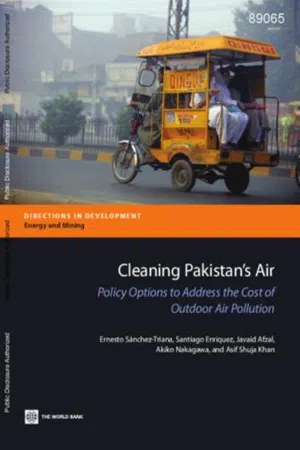
Cleaning Pakistan's Air
Policy Options to Address the Cost of Outdoor Air Pollution
- 207 pages
- English
- PDF
- Available on iOS & Android
eBook - PDF
Cleaning Pakistan's Air
Policy Options to Address the Cost of Outdoor Air Pollution
About this book
Information
Table of contents
- Front Cover
- Contents
- Foreword
- Acknowledgments
- About the Authors
- Abbreviations
- Executive Summary
- Chapter 1 Overview
- Chapter 2 Air Pollution in Pakistan
- Chapter 3 Air Quality Management Institutions
- Chapter 4 Mobile Sources
- Chapter 5 Industrial and Other Stationary Sources
- Chapter 6 Potential Co-Benefits of Air Quality Management for Climate Change
- Chapter 7 Conclusions and Recommendations
- Figures
- Map
- Tables
Trusted by 375,005 students
Access to over 1.5 million titles for a fair monthly price.
Study more efficiently using our study tools.
Frequently asked questions
Yes, you can cancel anytime from the Subscription tab in your account settings on the Perlego website. Your subscription will stay active until the end of your current billing period. Learn how to cancel your subscription
No, books cannot be downloaded as external files, such as PDFs, for use outside of Perlego. However, you can download books within the Perlego app for offline reading on mobile or tablet. Learn how to download books offline
Perlego offers two plans: Essential and Complete
- Essential is ideal for learners and professionals who enjoy exploring a wide range of subjects. Access the Essential Library with 800,000+ trusted titles and best-sellers across business, personal growth, and the humanities. Includes unlimited reading time and Standard Read Aloud voice.
- Complete: Perfect for advanced learners and researchers needing full, unrestricted access. Unlock 1.5M+ books across hundreds of subjects, including academic and specialized titles. The Complete Plan also includes advanced features like Premium Read Aloud and Research Assistant.
We are an online textbook subscription service, where you can get access to an entire online library for less than the price of a single book per month. With over 1.5 million books across 990+ topics, we’ve got you covered! Learn about our mission
Look out for the read-aloud symbol on your next book to see if you can listen to it. The read-aloud tool reads text aloud for you, highlighting the text as it is being read. You can pause it, speed it up and slow it down. Learn more about Read Aloud
Yes! You can use the Perlego app on both iOS and Android devices to read anytime, anywhere — even offline. Perfect for commutes or when you’re on the go.
Please note we cannot support devices running on iOS 13 and Android 7 or earlier. Learn more about using the app
Please note we cannot support devices running on iOS 13 and Android 7 or earlier. Learn more about using the app
Yes, you can access Cleaning Pakistan's Air by Ernesto Sanchez-Triana, Santiago Enriquez, Javaid Afzal, Akiko Nakagawa, Asif Shuja Khan in PDF and/or ePUB format, as well as other popular books in Politics & International Relations & Environment & Energy Policy. We have over 1.5 million books available in our catalogue for you to explore.