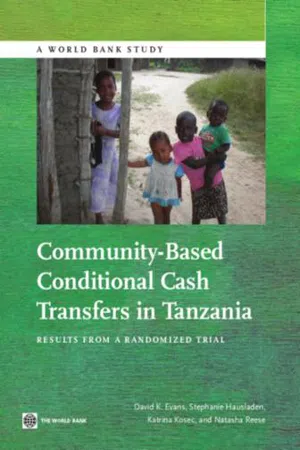
Given the success of conditional cash transfer (CCT) programs elsewhere, in 2010 the Government of Tanzania rolled out a pilot CCT program in three districts. Its aim was to see if, using a model relying on communities to target beneficiaries and deliver payments, the program could improve outcomes for the poor the way centrally-run CCT programs have in other contexts. The program provided cash payments to poor households, but conditioned payments on complying with certain health and education requirements. Given scarce resources, the Government randomly selected 40 out of 80 eligible villages to receive the pilot program. Households in participating and comparison villages were broadly comparable at baseline. This report describes the program and the results of a rigorous, mixed methods impact evaluation. Two and a half years into the program, participating households were healthier and more educated. Health improvements due to the CCT program were greatest for the poorest half of households—the poorest of the poor. They experienced a half a day per month reduction in sick days on average, and poor children age 0-4 in particular had a full day per month reduction in sick days. In education, the program showed clear positive impacts on whether children had ever attended school and on whether they completed Standard 7. Households were also more likely to buy shoes for children, which can promote both health and school attendance. In response to the program, households also made investments to reduce risk: Participating households were much more likely to finance medical care with insurance and much more likely to purchase health insurance than were their comparison counterparts. The program did not significantly affect savings on aeverage, although it did increase non-bank savings amongst the poorest half of households. Participating households also invested in more livestock assets, which they used to create small enterprises. The program did not, however, have significant impacts on food consumption. On the whole, the results suggest that households focused on reducing risk and on improving their livelihoods rather than principally on increasing consumption. There is also evidence that the project had positive effects on community cohesion.
eBook - PDF
Community-Based Conditional Cash Transfers in Tanzania
Results from a Randomized Trial
- 191 pages
- English
- PDF
- Available on iOS & Android
eBook - PDF
Community-Based Conditional Cash Transfers in Tanzania
Results from a Randomized Trial
About this book
Information
Subtopic
Development EconomicsIndex
EconomicsTable of contents
- Front Cover
- Contents
- Acknowledgments
- Abbreviations
- Executive Summary
- Chapter 1 Background
- Chapter 2 Results of the Baseline Survey
- Chapter 3 Evaluation Strategy
- Chapter 4 Impact Evaluation Results at the Midline
- Chapter 5 Results of the Community Score Card Exercise
- Chapter 6 Results of the Midline Focus Group Exercise
- Chapter 7 Impact Evaluation Results at Endline
- Chapter 8 Conclusions
- Appendix A Attrition
- References
- Map
- Figures
- Tables
- Back Cover
Trusted by 375,005 students
Access to over 1.5 million titles for a fair monthly price.
Study more efficiently using our study tools.
Frequently asked questions
Yes, you can cancel anytime from the Subscription tab in your account settings on the Perlego website. Your subscription will stay active until the end of your current billing period. Learn how to cancel your subscription
No, books cannot be downloaded as external files, such as PDFs, for use outside of Perlego. However, you can download books within the Perlego app for offline reading on mobile or tablet. Learn how to download books offline
Perlego offers two plans: Essential and Complete
- Essential is ideal for learners and professionals who enjoy exploring a wide range of subjects. Access the Essential Library with 800,000+ trusted titles and best-sellers across business, personal growth, and the humanities. Includes unlimited reading time and Standard Read Aloud voice.
- Complete: Perfect for advanced learners and researchers needing full, unrestricted access. Unlock 1.5M+ books across hundreds of subjects, including academic and specialized titles. The Complete Plan also includes advanced features like Premium Read Aloud and Research Assistant.
We are an online textbook subscription service, where you can get access to an entire online library for less than the price of a single book per month. With over 1.5 million books across 990+ topics, we’ve got you covered! Learn about our mission
Look out for the read-aloud symbol on your next book to see if you can listen to it. The read-aloud tool reads text aloud for you, highlighting the text as it is being read. You can pause it, speed it up and slow it down. Learn more about Read Aloud
Yes! You can use the Perlego app on both iOS and Android devices to read anytime, anywhere — even offline. Perfect for commutes or when you’re on the go.
Please note we cannot support devices running on iOS 13 and Android 7 or earlier. Learn more about using the app
Please note we cannot support devices running on iOS 13 and Android 7 or earlier. Learn more about using the app
Yes, you can access Community-Based Conditional Cash Transfers in Tanzania by David K. Evans, Stephanie Hausladen, Katrina Kosec, Natasha Reese in PDF and/or ePUB format, as well as other popular books in Economics & Development Economics. We have over 1.5 million books available in our catalogue for you to explore.