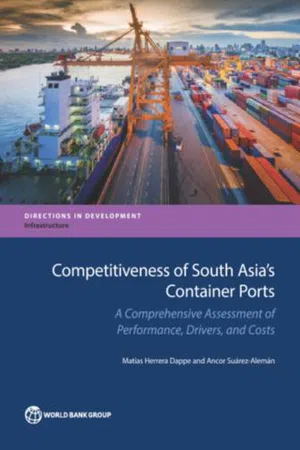
South Asia's trade almost doubled in the past decade, but the share of trade in GDP is still smaller (47 percent) than in East Asia (55 percent), and South Asia's economic competitiveness continues to lag that of other regions. Part of the problem is the region's container ports. As a result of inefficiencies, the average cost of exporting or importing a container in the region is more than twice what it is in East Asia. Better port logistics could help increase trade, diversify exports, attract more foreign direct investment, and spur economic growth. As container traffic continues to grow and physical expansion is constrained by the limited supply of available land at most ports, the best way to improve port performance is by increasing productivity. To identify strategies for doing so, this report examines the performance of the 14 largest container ports in the region based on two sets of criteria: operational performance and economic performance. To measure operational performance, the report benchmarks total time at port, waiting time at port, and idle time as a share of total time at berth. To measure economic performance, it benchmarks productivity and efficiency using two useful techniques: Malmquist total factor productivity decomposition and data envelopment analysis. The report identifies key drivers of port performance and examines how differences in performance across ports are related to those drivers. This analysis is based on an original dataset on private sector participation, governance, and competition in South Asia's container port sector. To highlight the potential gains from improving performance of container ports, the report uses econometric techniques to isolate the impact of efficiency improvements on maritime transport costs and trade. The results suggest that the best strategy for improving port performance in the region is a three-pronged approach that (a) encourages private sector participation through a well-developed enabling environment, including further adoption of the "landlord" port model; (b) strengthens the governance of port authorities' boards; and (c) promotes competition between and within ports, in part through transparent and competitive concession bidding.
eBook - PDF
Competitiveness of South Asia's Container Ports
A Comprehensive Assessment of Performance, Drivers, and Costs
- 121 pages
- English
- PDF
- Available on iOS & Android
eBook - PDF
Competitiveness of South Asia's Container Ports
A Comprehensive Assessment of Performance, Drivers, and Costs
About this book
Information
Subtopic
InfrastructureIndex
BusinessTable of contents
- Front Cover
- Contents
- Foreword
- Acknowledgments
- About the Authors
- Executive Summary
- Abbreviations
- Introduction
- Chapter 1 South Asia’s Container Port Sector
- Chapter 2 Performance of South Asian Container Ports
- Chapter 3 Drivers of Container Port Performance in South Asia
- Chapter 4 Gains to Improved Port Performance in South Asia
- Appendix A Studies of Port Efficiency and Productivity
- Appendix B Competition Index
- Appendix C Data Sources
- Boxes
- Figures
- Map
- Tables
Trusted by 375,005 students
Access to over 1.5 million titles for a fair monthly price.
Study more efficiently using our study tools.
Frequently asked questions
Yes, you can cancel anytime from the Subscription tab in your account settings on the Perlego website. Your subscription will stay active until the end of your current billing period. Learn how to cancel your subscription
No, books cannot be downloaded as external files, such as PDFs, for use outside of Perlego. However, you can download books within the Perlego app for offline reading on mobile or tablet. Learn how to download books offline
Perlego offers two plans: Essential and Complete
- Essential is ideal for learners and professionals who enjoy exploring a wide range of subjects. Access the Essential Library with 800,000+ trusted titles and best-sellers across business, personal growth, and the humanities. Includes unlimited reading time and Standard Read Aloud voice.
- Complete: Perfect for advanced learners and researchers needing full, unrestricted access. Unlock 1.5M+ books across hundreds of subjects, including academic and specialized titles. The Complete Plan also includes advanced features like Premium Read Aloud and Research Assistant.
We are an online textbook subscription service, where you can get access to an entire online library for less than the price of a single book per month. With over 1.5 million books across 990+ topics, we’ve got you covered! Learn about our mission
Look out for the read-aloud symbol on your next book to see if you can listen to it. The read-aloud tool reads text aloud for you, highlighting the text as it is being read. You can pause it, speed it up and slow it down. Learn more about Read Aloud
Yes! You can use the Perlego app on both iOS and Android devices to read anytime, anywhere — even offline. Perfect for commutes or when you’re on the go.
Please note we cannot support devices running on iOS 13 and Android 7 or earlier. Learn more about using the app
Please note we cannot support devices running on iOS 13 and Android 7 or earlier. Learn more about using the app
Yes, you can access Competitiveness of South Asia's Container Ports by Matías Herrera Dappe, Ancor Suárez-Alemán in PDF and/or ePUB format, as well as other popular books in Business & Infrastructure. We have over 1.5 million books available in our catalogue for you to explore.