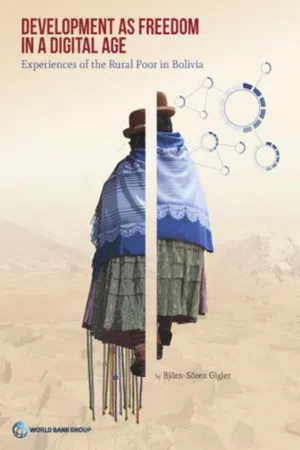
Under what conditions can new technologies enhance the well-being of poor communities? The study designs an alternative evaluation framework (AEF) that applies Amartya Sen's capability approach to the study of information and communications technologies (ICTs) in order to place people's well-being, rather than technology, at the center of the study. The AEF develops an impact chain that examines the mechanisms by which access to, and meaningful use of, ICTs can enhance people's "informational capabilities" and improve people's human and social capabilities. This approach thus uses people's individual and collective capabilities, rather than measures of access or use, as its principal evaluative space. Based on empirical evidence from indigenous communities' use of new technologies in rural Bolivia, the study concludes that enhancing poor people's informational capabilities is the most critical factor determining the impact of ICTs on their well-being. Improved informational capabilities, like literacy, do enhance the human capabilities of poor and marginalized peoples to make strategic life choices and achieve the lifestyle they value. Evaluating the impact of ICTs in terms of capabilities thus reveals no direct relationship between improved access to, and use of, ICTs and enhanced well-being; ICTs lead to improvements in people's lives only when informational capabilities are transformed into expanded human and social capabilities in the economic, political, social, organizational, and cultural dimensions of their lives. The study concludes that intermediaries are bound to play a central, even fundamental, role in this process. They help poor communities to enact and appropriate ICTs to their local socio-cultural context so that their use becomes meaningful for people's daily lives, enhances their informational capabilities, and ultimately improves their human and social capabilities.
eBook - PDF
Development as Freedom in a Digital Age
Experiences from the Rural Poor in Bolivia
- 519 pages
- English
- PDF
- Available on iOS & Android
eBook - PDF
Development as Freedom in a Digital Age
Experiences from the Rural Poor in Bolivia
About this book
Information
Subtopic
Popular CultureIndex
Social SciencesTable of contents
- Cover
- Contents
- Foreword
- Foreword
- Preface
- Acknowledgments
- About the Author
- Abbreviations and Acronyms
- PART I: ICTs and the Well-Being of Poor Communities
- PART II: The Empirical Evidence
- PART III: The Case Studies
- PART IV: Conclusions
- Appendix A: Map of Indigenous Peoples in Bolivia
- Appendix B: Indigenous Peoples’ Development Plan
- Appendix C: Instrumental and Substantive Social Capabilities
- Appendix D: The Ethnicity Index by Xavier Albó
- Appendix E: Statistical Data
- Appendix F: Definition of ICT Capability Variable
- Appendix G: Definition of Informational Capability Variable
- Appendix H: Definition of Sector and Thematic Indexes
- Appendix I: Interview List
- Appendix J: List of Focus Groups
- Appendix K: Survey Forms
- Index
- Box
- Figures
- Maps
- Tables
Trusted by 375,005 students
Access to over 1.5 million titles for a fair monthly price.
Study more efficiently using our study tools.
Frequently asked questions
Yes, you can cancel anytime from the Subscription tab in your account settings on the Perlego website. Your subscription will stay active until the end of your current billing period. Learn how to cancel your subscription
No, books cannot be downloaded as external files, such as PDFs, for use outside of Perlego. However, you can download books within the Perlego app for offline reading on mobile or tablet. Learn how to download books offline
Perlego offers two plans: Essential and Complete
- Essential is ideal for learners and professionals who enjoy exploring a wide range of subjects. Access the Essential Library with 800,000+ trusted titles and best-sellers across business, personal growth, and the humanities. Includes unlimited reading time and Standard Read Aloud voice.
- Complete: Perfect for advanced learners and researchers needing full, unrestricted access. Unlock 1.5M+ books across hundreds of subjects, including academic and specialized titles. The Complete Plan also includes advanced features like Premium Read Aloud and Research Assistant.
We are an online textbook subscription service, where you can get access to an entire online library for less than the price of a single book per month. With over 1.5 million books across 990+ topics, we’ve got you covered! Learn about our mission
Look out for the read-aloud symbol on your next book to see if you can listen to it. The read-aloud tool reads text aloud for you, highlighting the text as it is being read. You can pause it, speed it up and slow it down. Learn more about Read Aloud
Yes! You can use the Perlego app on both iOS and Android devices to read anytime, anywhere — even offline. Perfect for commutes or when you’re on the go.
Please note we cannot support devices running on iOS 13 and Android 7 or earlier. Learn more about using the app
Please note we cannot support devices running on iOS 13 and Android 7 or earlier. Learn more about using the app
Yes, you can access Development as Freedom in a Digital Age by Björn Sören Gigler in PDF and/or ePUB format, as well as other popular books in Social Sciences & Popular Culture. We have over 1.5 million books available in our catalogue for you to explore.