The chapters presented in this volume adopt a variety of these methodological tools in order to explore the extent to which discrimination against women and demographic minorities is pervasive in Latin America. In chapter two, Castillo, Petrie, and Torero present a series of experiments to understand the nature of discrimination in urban Lima, Peru. They design and apply experiments that exploit degrees of information on performance as a way to assess how personal characteristics affect how people sort into groups. Along similar lines, in chapter three, Cardenas and his research team use an experimental field approach in Colombia to better understand pro-social preferences and behavior of both individuals involved in the provision of social services (public servants) and potential beneficiaries of those services (the poor). In chapter four, Elias, Elias, and Ronconi try to understand social status and race during adolescence in Argentina. They asked high school students to select and rank ten classmates with whom they would like to form a team and use this information to construct a measure of popularity. In chapters five and six, Bravo, Sanhueza, and Urzua present two studies covering different aspects of the labor market using different methodological tools. Based on an audit study by mail, their first study attempts to detect gender, social class, and neighborhood of residence discrimination in hiring practices by Chilean fir. In a second study, they use a structural model to analyze gender differences in the Chilean labor market. In chapter seven, Soruco, Piani, and Rossi measure and analyze possible discriminatory behaviors against international emigrants and their families remaining in southern Ecuador (the city of Cuenca and the rural canton of San Fernando). Finally, in chapter eight, Gandelman, Gandelman, and Rothschild use micro data on judicial proceedings in Uruguay and present evidence that female defendants receive a more favorable treatment in courts than male defendants.
eBook - PDF
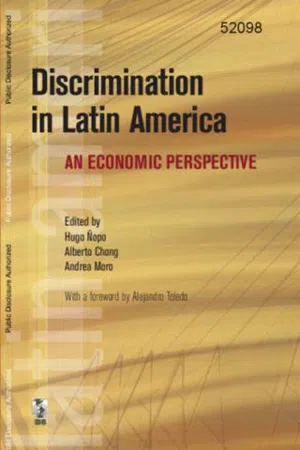
Discrimination in Latin America
An Economic Perspective
- 340 pages
- English
- PDF
- Available on iOS & Android
eBook - PDF
About this book
Information
Subtopic
Discrimination & Race RelationsIndex
Social SciencesTable of contents
- Contents
- Foreword
- Acknowledgments
- Abbreviations
- 1 What Do We Know about Discrimination in Latin America? Very Little!
- 2 Ethnic and Social Barriers to Cooperation: Experiments Studying the Extent and Nature of Discrimination in Urban Peru
- 3 Discrimination in the Provision of Social Services to the Poor: A Field Experimental Study
- 4 Discrimination and Social Networks: Popularity among High School Students in Argentina
- 5 An Experimental Study of Labor Market Discrimination: Gender, Social Class, and Neighborhood in Chile
- 6 Ability, Schooling Choices, and Gender Labor Market Discrimination: Evidence for Chile
- 7 What Emigration Leaves Behind: The Situation of Emigrants and Their Families in Ecuador
- 8 Gender Differentials in Judicial Proceedings: Evidence from Housing-Related Cases in Uruguay
- Index
- Figures
- Tables
Trusted by 375,005 students
Access to over 1.5 million titles for a fair monthly price.
Study more efficiently using our study tools.
Frequently asked questions
Yes, you can cancel anytime from the Subscription tab in your account settings on the Perlego website. Your subscription will stay active until the end of your current billing period. Learn how to cancel your subscription
No, books cannot be downloaded as external files, such as PDFs, for use outside of Perlego. However, you can download books within the Perlego app for offline reading on mobile or tablet. Learn how to download books offline
Perlego offers two plans: Essential and Complete
- Essential is ideal for learners and professionals who enjoy exploring a wide range of subjects. Access the Essential Library with 800,000+ trusted titles and best-sellers across business, personal growth, and the humanities. Includes unlimited reading time and Standard Read Aloud voice.
- Complete: Perfect for advanced learners and researchers needing full, unrestricted access. Unlock 1.5M+ books across hundreds of subjects, including academic and specialized titles. The Complete Plan also includes advanced features like Premium Read Aloud and Research Assistant.
We are an online textbook subscription service, where you can get access to an entire online library for less than the price of a single book per month. With over 1.5 million books across 990+ topics, we’ve got you covered! Learn about our mission
Look out for the read-aloud symbol on your next book to see if you can listen to it. The read-aloud tool reads text aloud for you, highlighting the text as it is being read. You can pause it, speed it up and slow it down. Learn more about Read Aloud
Yes! You can use the Perlego app on both iOS and Android devices to read anytime, anywhere — even offline. Perfect for commutes or when you’re on the go.
Please note we cannot support devices running on iOS 13 and Android 7 or earlier. Learn more about using the app
Please note we cannot support devices running on iOS 13 and Android 7 or earlier. Learn more about using the app
Yes, you can access Discrimination in Latin America by Hugo Nopo, Alberto Chong, Andrea Moro in PDF and/or ePUB format, as well as other popular books in Social Sciences & Discrimination & Race Relations. We have over 1.5 million books available in our catalogue for you to explore.