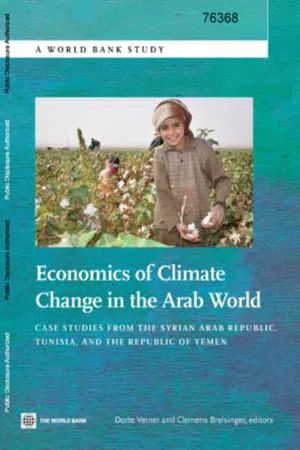
This Economics of Climate Change in the Arab World is presents detailed case studies on the impacts of climate change in the Syrian Arab Republic, Tunisia, and the Republic of Yemen that were summarized. The Arab region is already being impacted by climate change through more frequent cyclones, floods, and prolonged droughts. Thousands of rural producers have seen their crops and herds devastated by extreme conditions, and have been forced to abandon their traditional way of life and migrate to crowded urban areas. Those who stay behind in rural areas struggle to cope with shortages of food and water. Climate change affects countries' economies and households through a variety of channels. Rising temperatures and changes in rainfall patterns affect agricultural yields of both rainfed and irrigated crops, and thus global and local food markets. Adaptation is a process that will take place over decades as new information makes policy makers reevaluate their climate vulnerabilities. Still, by seizing the opportunity to act now and act together, the Arab region can not only meet the immense challenges of climate change but advance the development of its entire people.
eBook - PDF
Economics of Climate Change in the Arab World
Case Studies from the Syrian Arab Republic, Tunisia, and the Republic of Yemen
- 155 pages
- English
- PDF
- Available on iOS & Android
eBook - PDF
Economics of Climate Change in the Arab World
Case Studies from the Syrian Arab Republic, Tunisia, and the Republic of Yemen
About this book
Information
Topic
EconomiaSubtopic
Economia ambientaleTable of contents
- Cover
- Contents
- Acknowledgments
- About the Authors
- Abbreviations and Acronyms
- Chapter 1 Introduction
- Chapter 2 Modeling Suite
- Chapter 3 Economic Impacts of Climate Change
- Chapter 4 Economic Impacts of Droughts in the Syrian Arab Republic and Floods in the Republic of Yemen
- Chapter 5 Conclusions and Proposed Actions for Adaptation
- Appendix A Inputs Used for DSSAT Model
- Appendix B Methodology of Aggregation from Pixel Data to Agroecological Zones (the Syrian Arab Republic)
- Appendix C Mapping Decision Support System for Agrotechnology Transfer (DSSAT) and International Model for Policy Analysis of Agricultural Commodities and Trade (IMPACT) Crops to the Social Accounting Matrix (SAM) Sectors
- Appendix D Supplementary Model Tables
- Appendix E The Republic of Yemen Nutrition Model Tables
- Appendix F Precipitation and Temperature by AEZ (the Republic of Yemen)
- Figures
- Tables
Trusted by 375,005 students
Access to over 1.5 million titles for a fair monthly price.
Study more efficiently using our study tools.
Frequently asked questions
Yes, you can cancel anytime from the Subscription tab in your account settings on the Perlego website. Your subscription will stay active until the end of your current billing period. Learn how to cancel your subscription
No, books cannot be downloaded as external files, such as PDFs, for use outside of Perlego. However, you can download books within the Perlego app for offline reading on mobile or tablet. Learn how to download books offline
Perlego offers two plans: Essential and Complete
- Essential is ideal for learners and professionals who enjoy exploring a wide range of subjects. Access the Essential Library with 800,000+ trusted titles and best-sellers across business, personal growth, and the humanities. Includes unlimited reading time and Standard Read Aloud voice.
- Complete: Perfect for advanced learners and researchers needing full, unrestricted access. Unlock 1.5M+ books across hundreds of subjects, including academic and specialized titles. The Complete Plan also includes advanced features like Premium Read Aloud and Research Assistant.
We are an online textbook subscription service, where you can get access to an entire online library for less than the price of a single book per month. With over 1.5 million books across 990+ topics, we’ve got you covered! Learn about our mission
Look out for the read-aloud symbol on your next book to see if you can listen to it. The read-aloud tool reads text aloud for you, highlighting the text as it is being read. You can pause it, speed it up and slow it down. Learn more about Read Aloud
Yes! You can use the Perlego app on both iOS and Android devices to read anytime, anywhere — even offline. Perfect for commutes or when you’re on the go.
Please note we cannot support devices running on iOS 13 and Android 7 or earlier. Learn more about using the app
Please note we cannot support devices running on iOS 13 and Android 7 or earlier. Learn more about using the app
Yes, you can access Economics of Climate Change in the Arab World by Dorte Verner, Clemens Breisinger in PDF and/or ePUB format, as well as other popular books in Economia & Economia ambientale. We have over 1.5 million books available in our catalogue for you to explore.