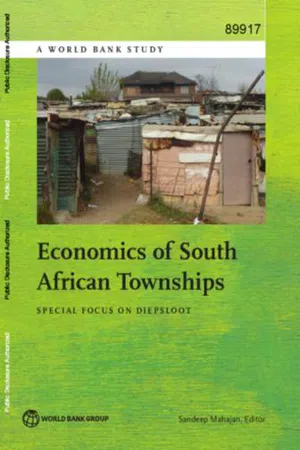
Countries everywhere are divided into two distinct spatial realms: one urban, one rural. Classic models of development predict faster growth in the urban sector, causing rapid migration from rural areas to cities, lifting average incomes in both places. The process continues until the marginal productivity of labor is equalized across the two realms. The pattern of rising urbanization accompanying economic growth has become one of the most visible and self-evident empirical facts of development across the world, with almost 200,000 people making the rural-to-urban trek every day, according to the United Nations. Cities across the world are powering growth, development, and modernization. The study then takes a close look at Diepsloot, a large township in the Johannesburg Metropolitan Area, to bring out more vividly the economic realities and choices of township residents. Although atypical in many ways, by the virtue of being newer, poorer, and more informal, with a bigger concentration of migrants (many of them foreign nationals), than the historically established townships, Diepsloot also retains many of the economic characteristics of South African townships: Issues of joblessness, uneven access to basic public services, and overwhelming levels of crime and violence are almost as pervasive in Diepsloot as they are in other T&IS. At the same time, an emergent informal sector more visibly pervades the township than seen in the average township, which makes it a particularly useful place to study in order to develop an understanding of the kinds of economic activities that are feasible in townships. It focuses particularly on the nature of business activity in the township, the key investment-climate constraints faced by its firms, income and expenditure patterns across households, and some aggregative social and human indicators. In a first attempt of its kind for a township, the report also develops a Social Accounting Matrix (SAM) of Diepsloot for a comprehensive and consistent picture of the place, including the circular flow of income within the township, the nature of its interaction with the rest of the South African economy, and a simple multiplier analysis of its economy.
- 297 pages
- English
- PDF
- Available on iOS & Android
eBook - PDF
About this book
Information
Subtopic
Urban SociologyIndex
Social SciencesTable of contents
- Front Cover
- Contents
- Acknowledgments
- About the Authors
- Abbreviations
- Overview
- Chapter 1 A History of Townships in South Africa
- Chapter 2 A Conceptual Framework for the Township Economy
- Chapter 3 Economic and Social Trends in Townships and Informal Settlements
- Chapter 4 Access to Finance in Townships and Informal Settlements
- Chapter 5 Qualitative Assessment of the Diepsloot Economy
- Chapter 6 Diepsloot’s Investment Climate
- Chapter 7 Income and Expenditure Patterns in Diepsloot
- Chapter 8 A Social Accounting Matrix for the Economy of Diepsloot
- Boxes
- Figures
- Map
- Photos
- Tables
Trusted by 375,005 students
Access to over 1.5 million titles for a fair monthly price.
Study more efficiently using our study tools.
Frequently asked questions
Yes, you can cancel anytime from the Subscription tab in your account settings on the Perlego website. Your subscription will stay active until the end of your current billing period. Learn how to cancel your subscription
No, books cannot be downloaded as external files, such as PDFs, for use outside of Perlego. However, you can download books within the Perlego app for offline reading on mobile or tablet. Learn how to download books offline
Perlego offers two plans: Essential and Complete
- Essential is ideal for learners and professionals who enjoy exploring a wide range of subjects. Access the Essential Library with 800,000+ trusted titles and best-sellers across business, personal growth, and the humanities. Includes unlimited reading time and Standard Read Aloud voice.
- Complete: Perfect for advanced learners and researchers needing full, unrestricted access. Unlock 1.5M+ books across hundreds of subjects, including academic and specialized titles. The Complete Plan also includes advanced features like Premium Read Aloud and Research Assistant.
We are an online textbook subscription service, where you can get access to an entire online library for less than the price of a single book per month. With over 1.5 million books across 990+ topics, we’ve got you covered! Learn about our mission
Look out for the read-aloud symbol on your next book to see if you can listen to it. The read-aloud tool reads text aloud for you, highlighting the text as it is being read. You can pause it, speed it up and slow it down. Learn more about Read Aloud
Yes! You can use the Perlego app on both iOS and Android devices to read anytime, anywhere — even offline. Perfect for commutes or when you’re on the go.
Please note we cannot support devices running on iOS 13 and Android 7 or earlier. Learn more about using the app
Please note we cannot support devices running on iOS 13 and Android 7 or earlier. Learn more about using the app
Yes, you can access Economics of South African Townships by Sandeep Mahajan in PDF and/or ePUB format, as well as other popular books in Social Sciences & Urban Sociology. We have over 1.5 million books available in our catalogue for you to explore.