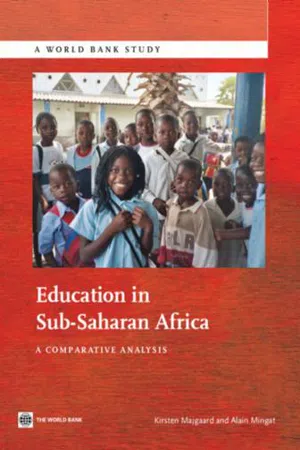
As in most countries worldwide, Sub-Saharan African countries are striving to build their human capital so they can compete for jobs and investments in an increasingly globalized world. In this region, which includes the largest number of countries that have not yet attained universal primary schooling, the ambitions and aspirations of Sub-Saharan African countries and their youth far exceed this basic goal. Over the past 20 years, educational levels have risen sharply across Sub-Saharan Africa. Already hard at work to provide places in primary schools for all children, most countries of the region are also rapidly expanding access to secondary and tertiary levels of education. Alongside this quantitative push is a growing awareness of the need to make sure that students are learning and acquiring the skills needed for life and work. Achieving education of acceptable quality is perhaps an even greater challenge than providing enough school places for all. Thus, Sub-Saharan African countries are simultaneously confronting many difficult challenges in the education sector, and much is at stake. This book gives those concerned with education in Sub-Saharan Africa an analysis of the sector from a cross-country perspective, aimed at drawing lessons that individual country studies alone cannot provide. A comparative perspective is useful not only to show the range of possibilities in key education policy variables but also to learn from the best performers in the region. (Although the report covers 47 Sub- Saharan African countries whenever possible, some parts of the analysis center on the region's low-income countries, in particular, a sample of 33 low-income countries). Although countries ultimately must make their own policy choices and decide what works best in their particular circumstances, Sub-Saharan African countries can benefit from learning about the experiences of other countries that are faced with, or have gone through, similar development paths. Given the large number of countries included in the analysis, the book finds that Sub-Saharan African countries have more choices and more room for maneuver than will appear if attention were focused on only one or a few country experiences. Countries can make better choices when understanding the breadth of policy choices available to them. They are well advised, however, to evaluate the applicability of policy options to their contexts and to pilot and evaluate the results for performance and subsequent improvement.
- 266 pages
- English
- PDF
- Available on iOS & Android
eBook - PDF
About this book
Information
Topic
EducationSubtopic
Educational PolicyTable of contents
- Contents
- Acknowledgments
- Acronyms and Abbreviations
- Overview
- Chapter 1 Coverage of Education and Prospects for Expansion
- Chapter 2 Socioeconomic Disparities in Education
- Chapter 3 Out-of-School Children
- Chapter 4 Patterns of Spending on Education
- Chapter 5 Learning Outcomes
- Chapter 6 Social Outcomes
- Chapter 7 Education and Employment
- Appendix A Definitions and Background Information
- Appendix B Enrollment Data
- Appendix C Social Disparities
- Appendix D Out-of-School Children
- Appendix E Education Expenditure
- Appendix F Gross Enrollment Rate (GER) and Its Underlying Components
- Appendix G Student Learning
- Appendix H Social Outcomes
- Appendix I Education and Employment
- Appendix J Lists of Surveys
- Appendix K The Millennium Development Goals
- Boxes
- Tables
- Figures
- Maps
Trusted by 375,005 students
Access to over 1.5 million titles for a fair monthly price.
Study more efficiently using our study tools.
Frequently asked questions
Yes, you can cancel anytime from the Subscription tab in your account settings on the Perlego website. Your subscription will stay active until the end of your current billing period. Learn how to cancel your subscription
No, books cannot be downloaded as external files, such as PDFs, for use outside of Perlego. However, you can download books within the Perlego app for offline reading on mobile or tablet. Learn how to download books offline
Perlego offers two plans: Essential and Complete
- Essential is ideal for learners and professionals who enjoy exploring a wide range of subjects. Access the Essential Library with 800,000+ trusted titles and best-sellers across business, personal growth, and the humanities. Includes unlimited reading time and Standard Read Aloud voice.
- Complete: Perfect for advanced learners and researchers needing full, unrestricted access. Unlock 1.5M+ books across hundreds of subjects, including academic and specialized titles. The Complete Plan also includes advanced features like Premium Read Aloud and Research Assistant.
We are an online textbook subscription service, where you can get access to an entire online library for less than the price of a single book per month. With over 1.5 million books across 990+ topics, we’ve got you covered! Learn about our mission
Look out for the read-aloud symbol on your next book to see if you can listen to it. The read-aloud tool reads text aloud for you, highlighting the text as it is being read. You can pause it, speed it up and slow it down. Learn more about Read Aloud
Yes! You can use the Perlego app on both iOS and Android devices to read anytime, anywhere — even offline. Perfect for commutes or when you’re on the go.
Please note we cannot support devices running on iOS 13 and Android 7 or earlier. Learn more about using the app
Please note we cannot support devices running on iOS 13 and Android 7 or earlier. Learn more about using the app
Yes, you can access Education in Sub-Saharan Africa by Kirsten Majgaard, Alain Mingat in PDF and/or ePUB format, as well as other popular books in Education & Educational Policy. We have over 1.5 million books available in our catalogue for you to explore.