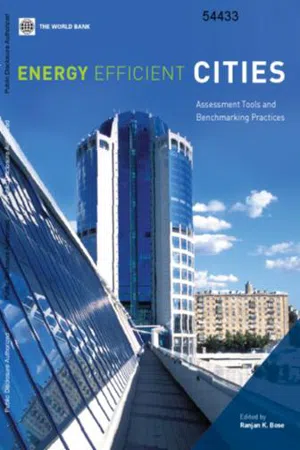
With cities accounting for half the world's population today, and two-thirds of global energy demand, urbanization is exacting a serious toll on the environment. As rapid urban growth continues, energy use in cities and associated levels of greenhouse gas (GHG) emissions are projected to continue unabated; current projections indicate that approximately 70 percent of the world's population will live in cities by 2050, producing some 80 percent of the world's GHG emissions. Unfortunately, most of this urban growth will take place in developing countries, where the vast majority of people remain underserved by basic infrastructure service and where city authorities are under-resourced to shift current trajectories. Further, the developing regions of Africa and Asia are where the most rapid urbanization is taking place, and they are least able to cope with the uncertainties and extremities of climate impacts. The development and mainstreaming of energy-efficient and low-carbon urban pathways that curtail climate impacts without hampering the urban development agenda thus are essential to meeting such challenges. Reducing long-term energy use through efficiency also enhances energy security by decreasing dependence on imported and fossil fuel. In addition, lower energy costs free up a city's resources to improve or expand services while providing important local co-benefits, creating new jobs, enhancing competitiveness, improving air quality and health, and providing a better quality of life. The scope of the papers encapsulates all three urban contexts: new cities, expanding cities, and retrofitting existing cities. The range of policy-relevant conceptual tools and practices discussed during the sessions, and subsequently built upon in this volume, helps achieve a better understanding of leverage points for energy-efficiency interventions and helps catalyze solutions that will delink high levels of carbon-intensive energy use from urban growth without compromising local development priorities.
- 250 pages
- English
- PDF
- Available on iOS & Android
eBook - PDF
About this book
Information
Table of contents
- Contents
- Foreword
- Acknowledgments
- Abbreviations
- 1 The Imperative of Efficient Energy Use in Cities: Analytical Approaches and Good Practices
- 2 SynCity: An Integrated Tool Kit for Urban Energy Systems Modeling
- 3 City-Scale Integrated Assessment of Climate Impacts, Adaptation, and Mitigation
- 4 Using an Integrated Assessment Model for Urban Development to Respond to Climate Change in Cities
- 5 Green Star and NABERS: Learning from the Australian Experience with Green Building Rating Tools
- 6 Efficient Lighting Market Transformation in the Making— The Philippine Experience
- 7 The Role of Information and Communication Technologies for Demand Responsive Transport
- 8 Getting to Carbon Neutral: A Review of Best Practices in Infrastructure Strategy
- 9 Supporting Energy Efficient Solutions in Developing Countries: The Way Ahead
- Index
- Appendix
- Boxes
- Figures
- Tables
Trusted by 375,005 students
Access to over 1.5 million titles for a fair monthly price.
Study more efficiently using our study tools.
Frequently asked questions
Yes, you can cancel anytime from the Subscription tab in your account settings on the Perlego website. Your subscription will stay active until the end of your current billing period. Learn how to cancel your subscription
No, books cannot be downloaded as external files, such as PDFs, for use outside of Perlego. However, you can download books within the Perlego app for offline reading on mobile or tablet. Learn how to download books offline
Perlego offers two plans: Essential and Complete
- Essential is ideal for learners and professionals who enjoy exploring a wide range of subjects. Access the Essential Library with 800,000+ trusted titles and best-sellers across business, personal growth, and the humanities. Includes unlimited reading time and Standard Read Aloud voice.
- Complete: Perfect for advanced learners and researchers needing full, unrestricted access. Unlock 1.5M+ books across hundreds of subjects, including academic and specialized titles. The Complete Plan also includes advanced features like Premium Read Aloud and Research Assistant.
We are an online textbook subscription service, where you can get access to an entire online library for less than the price of a single book per month. With over 1.5 million books across 990+ topics, we’ve got you covered! Learn about our mission
Look out for the read-aloud symbol on your next book to see if you can listen to it. The read-aloud tool reads text aloud for you, highlighting the text as it is being read. You can pause it, speed it up and slow it down. Learn more about Read Aloud
Yes! You can use the Perlego app on both iOS and Android devices to read anytime, anywhere — even offline. Perfect for commutes or when you’re on the go.
Please note we cannot support devices running on iOS 13 and Android 7 or earlier. Learn more about using the app
Please note we cannot support devices running on iOS 13 and Android 7 or earlier. Learn more about using the app
Yes, you can access Energy Efficient Cities by Ranjan K. Bose in PDF and/or ePUB format, as well as other popular books in Politics & International Relations & City Planning & Urban Development. We have over 1.5 million books available in our catalogue for you to explore.