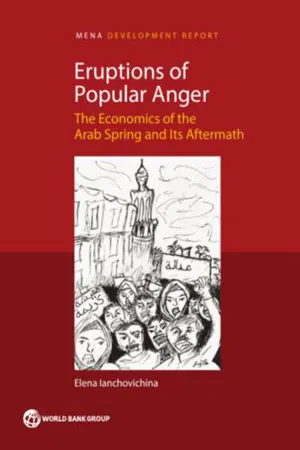
Eruptions of Popular Anger: The Economics of the Arab Spring and Its Aftermath sets out to answer three puzzles—the "Arab inequality" puzzle of civil uprisings in countries with low-to-moderate and stagnant economic inequality, the "unhappy development" paradox of increasing dissatisfaction at a time of moderate-to-rapid development, and the paradox of political violence in middle-income countries. The book's empirical investigation rules out high and rising inequality as a reason for the Arab Spring uprisings. It shows that the real problem was the erosion in middle-class incomes and the growing dissatisfaction with the quality of life, the shortage of formal sector jobs, and corruption. Frustration was particularly high among the young, educated, middle-class residents in urban areas. The old social contract, which had delivered development results in the past and under which Arab governments provided public-sector jobs and subsidized services in return for subdued voice, was unsustainable and malfunctioning. The public sector could no longer be the employer of choice, but the private sector did not generate enough formal sector jobs, because of distortions that constrained its growth and policies that offered advantages to a few firms with political connections, limiting competition and private investment. The breakdown in the social contract increased the premium on freedom and created impetus for political change. This report shows that the Arab Spring revolutions and the subsequent spread of violence and civil wars in the post–Arab Spring Middle East and North Africa region can be traced to the broken social contract, institutional weaknesses, and regional divisions in societies polarized along ethnic and sectarian lines. The Arab Spring and its aftermath indicate the need for a new social contract under which governments promote private-sector job creation, design public services in a way that holds providers accountable to beneficiaries, and promote inclusion and good governance.
eBook - PDF
Eruptions of Popular Anger
The Economics of the Arab Spring and Its Aftermath
- 177 pages
- English
- PDF
- Available on iOS & Android
eBook - PDF
About this book
Information
Subtopic
Economic PolicyIndex
EconomicsTable of contents
- Cover
- Half Title
- Title
- Copyright
- Contents
- Acknowledgments
- About the Author and Contributors
- Abbreviations
- Overview
- PART 1 The “Arab Inequality” Puzzle
- PART 2 The “Unhappy Development” Syndrome
- PART 3 The Paradox of “Political Violence in Middle-Income Countries”
- Box
- Figures
- Maps
- Tables
Trusted by 375,005 students
Access to over 1.5 million titles for a fair monthly price.
Study more efficiently using our study tools.
Frequently asked questions
Yes, you can cancel anytime from the Subscription tab in your account settings on the Perlego website. Your subscription will stay active until the end of your current billing period. Learn how to cancel your subscription
No, books cannot be downloaded as external files, such as PDFs, for use outside of Perlego. However, you can download books within the Perlego app for offline reading on mobile or tablet. Learn how to download books offline
Perlego offers two plans: Essential and Complete
- Essential is ideal for learners and professionals who enjoy exploring a wide range of subjects. Access the Essential Library with 800,000+ trusted titles and best-sellers across business, personal growth, and the humanities. Includes unlimited reading time and Standard Read Aloud voice.
- Complete: Perfect for advanced learners and researchers needing full, unrestricted access. Unlock 1.5M+ books across hundreds of subjects, including academic and specialized titles. The Complete Plan also includes advanced features like Premium Read Aloud and Research Assistant.
We are an online textbook subscription service, where you can get access to an entire online library for less than the price of a single book per month. With over 1.5 million books across 990+ topics, we’ve got you covered! Learn about our mission
Look out for the read-aloud symbol on your next book to see if you can listen to it. The read-aloud tool reads text aloud for you, highlighting the text as it is being read. You can pause it, speed it up and slow it down. Learn more about Read Aloud
Yes! You can use the Perlego app on both iOS and Android devices to read anytime, anywhere — even offline. Perfect for commutes or when you’re on the go.
Please note we cannot support devices running on iOS 13 and Android 7 or earlier. Learn more about using the app
Please note we cannot support devices running on iOS 13 and Android 7 or earlier. Learn more about using the app
Yes, you can access Eruptions of Popular Anger by Elena Ianchovichina in PDF and/or ePUB format, as well as other popular books in Economics & Economic Policy. We have over 1.5 million books available in our catalogue for you to explore.