What is the human cost of the global economic crisis? How many people will the crisis prevent from escaping poverty, and how many will remain hungry? How many more infants will die? Are children being pulled out of schools, not getting the education they need to become more productive adults and making it virtually impossible to reach 100 percent completion in primary education by 2015? What are the gender dimensions of the impacts? These are some of the questions as the global economy comes out of the worst recession since the great depression. The questions do not have immediate answers, partly because the data to assess development outcomes are incomplete and collected infrequently but also because impacts can take several years to emerge. For example, deteriorating health and nutrition today could lead to higher mortality rates in subsequent years. Lower investments will hamper future progress in sanitation and water supply. Fewer children in school will lower completion rates in later years. And household incomes that fall far below the poverty line will delay escapes from poverty. This report uses indirect evidence to assess the impact of the crisis on several indicators, including the number of people who will not escape poverty, the increase in infant mortality, the number of children who will be denied education, and the increase in discrimination against women. Based on that assessment, the report identifies key policies necessary for the developing countries, donors, and the international financial institutions (IFIs) to reestablish progress toward the Millennium Development Goals (MDGs).
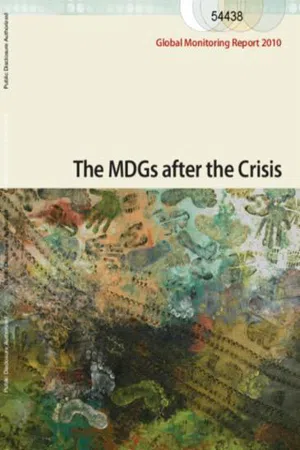
eBook - PDF
Global Monitoring Report 2010
The MDGs after the Crisis
- 172 pages
- English
- PDF
- Available on iOS & Android
eBook - PDF
About this book
Information
Subtopic
Economic PolicyIndex
EconomicsTable of contents
- Contents
- Foreword
- Acknowledgments
- Abbreviations and Acronyms
- Goals and Targets from the Millennium Declaration
- Overview: MDGs after the Crisis
- 1 Millennium Development Goals: Significant Gains before the Crisis
- 2 Lessons from Past Crises—and How the Current Crisis Differs
- 3 Growth Outlook and Macroeconomic Challenges in Emerging and Developing Countries
- 4 Outlook for the Millennium Development Goals
- 5 The International Community and Development—Trade, Aid, and the International Financial Institutions
- Appendix: Classification of Economies by Region and Income, Fiscal 2010
- Boxes
- Figures
- Maps
- Tables
Trusted by 375,005 students
Access to over 1.5 million titles for a fair monthly price.
Study more efficiently using our study tools.
Frequently asked questions
Yes, you can cancel anytime from the Subscription tab in your account settings on the Perlego website. Your subscription will stay active until the end of your current billing period. Learn how to cancel your subscription
No, books cannot be downloaded as external files, such as PDFs, for use outside of Perlego. However, you can download books within the Perlego app for offline reading on mobile or tablet. Learn how to download books offline
Perlego offers two plans: Essential and Complete
- Essential is ideal for learners and professionals who enjoy exploring a wide range of subjects. Access the Essential Library with 800,000+ trusted titles and best-sellers across business, personal growth, and the humanities. Includes unlimited reading time and Standard Read Aloud voice.
- Complete: Perfect for advanced learners and researchers needing full, unrestricted access. Unlock 1.5M+ books across hundreds of subjects, including academic and specialized titles. The Complete Plan also includes advanced features like Premium Read Aloud and Research Assistant.
We are an online textbook subscription service, where you can get access to an entire online library for less than the price of a single book per month. With over 1.5 million books across 990+ topics, we’ve got you covered! Learn about our mission
Look out for the read-aloud symbol on your next book to see if you can listen to it. The read-aloud tool reads text aloud for you, highlighting the text as it is being read. You can pause it, speed it up and slow it down. Learn more about Read Aloud
Yes! You can use the Perlego app on both iOS and Android devices to read anytime, anywhere — even offline. Perfect for commutes or when you’re on the go.
Please note we cannot support devices running on iOS 13 and Android 7 or earlier. Learn more about using the app
Please note we cannot support devices running on iOS 13 and Android 7 or earlier. Learn more about using the app
Yes, you can access Global Monitoring Report 2010 by World Bank, International Monetary Fund in PDF and/or ePUB format, as well as other popular books in Economics & Economic Policy. We have over 1.5 million books available in our catalogue for you to explore.