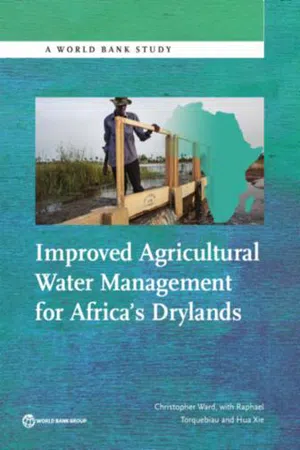
Dryland regions in Sub-Saharan Africa are home to one-half of the region's population and three-quarters of its poor. Poor both in natural resources and in assets and income, the inhabitants of drylands are highly vulnerable to droughts and other shocks. Despite a long history of interventions by governments, development agencies, and civil society organizations, there have been no sustained large-scale successes toward improving the resilience of drylands dwellers. Improved Agricultural Water Management for Africa's Drylands describes the extent to which agricultural water management interventions in dryland regions of Sub-Saharan Africa can enhance the resilience and improve the well-being of the people living in those regions, proposes what can realistically be done to promote improved agricultural water management, and sets out how stakeholders can make those improvements. After reviewing the current status of irrigation and agricultural water management in the drylands, the authors discuss technical, economic, and institutional challenges to expanding irrigation. A model developed at the International Food Policy Research Institute is used to project the potential for irrigation development in the Sahel Region and the Horn of Africa. The modeling results show that irrigation development in the drylands can reduce vulnerability and improve the resilience of hundreds of thousands of farming households, but rainfed agriculture will continue to dominate for the foreseeable future. Fortunately, many soil and water conservation practices that can improve the productivity and ensure the sustainability of rainfed cropping systems are available. The purpose of this book is to demonstrate the potentially highly benefi cial role of water and water management in drylands agriculture in association with agronomic improvements, market growth, and infrastructure development, and to assess the technological and socioeconomic conditions and institutional policy frameworks that can remove barriers to adoption and allow wide-scale take-up of improved agricultural water management in the dryland regions of Sub-Saharan Africa.
eBook - PDF
Improved Agricultural Water Management for Africa's Drylands
- 157 pages
- English
- PDF
- Available on iOS & Android
eBook - PDF
Improved Agricultural Water Management for Africa's Drylands
About this book
Information
Subtopic
AgricultureTable of contents
- Front Cover
- Contents
- Foreword
- Acknowledgments
- About the Authors
- Executive Summary
- Abbreviations
- Chapter 1 Introduction
- Chapter 2 Agricultural Water Management, Vulnerability, and Resilience
- Chapter 3 Current State of Irrigation and Agricultural Water Management
- Chapter 4 Technical and Economic Scope for Expanding Irrigation in Sub-Saharan African Drylands
- Chapter 5 Key Challenges: Exploiting Irrigation Development Potential and Strengthening Resilience
- Chapter 6 Priorities and Actions to Develop the Potential of Agricultural Water Management to Increase Resilience
- Chapter 7 Conclusions
- Appendix A Public and Private Roles and Investments by Farmer Type and Farming Livelihood Systems
- Bibliography
- Boxes
- Figures
- Maps
- Tables
- Back Cover
Trusted by 375,005 students
Access to over 1.5 million titles for a fair monthly price.
Study more efficiently using our study tools.
Frequently asked questions
Yes, you can cancel anytime from the Subscription tab in your account settings on the Perlego website. Your subscription will stay active until the end of your current billing period. Learn how to cancel your subscription
No, books cannot be downloaded as external files, such as PDFs, for use outside of Perlego. However, you can download books within the Perlego app for offline reading on mobile or tablet. Learn how to download books offline
Perlego offers two plans: Essential and Complete
- Essential is ideal for learners and professionals who enjoy exploring a wide range of subjects. Access the Essential Library with 800,000+ trusted titles and best-sellers across business, personal growth, and the humanities. Includes unlimited reading time and Standard Read Aloud voice.
- Complete: Perfect for advanced learners and researchers needing full, unrestricted access. Unlock 1.5M+ books across hundreds of subjects, including academic and specialized titles. The Complete Plan also includes advanced features like Premium Read Aloud and Research Assistant.
We are an online textbook subscription service, where you can get access to an entire online library for less than the price of a single book per month. With over 1.5 million books across 990+ topics, we’ve got you covered! Learn about our mission
Look out for the read-aloud symbol on your next book to see if you can listen to it. The read-aloud tool reads text aloud for you, highlighting the text as it is being read. You can pause it, speed it up and slow it down. Learn more about Read Aloud
Yes! You can use the Perlego app on both iOS and Android devices to read anytime, anywhere — even offline. Perfect for commutes or when you’re on the go.
Please note we cannot support devices running on iOS 13 and Android 7 or earlier. Learn more about using the app
Please note we cannot support devices running on iOS 13 and Android 7 or earlier. Learn more about using the app
Yes, you can access Improved Agricultural Water Management for Africa's Drylands by Christopher Ward, Raphael Torquebiau, Hua Xie in PDF and/or ePUB format, as well as other popular books in Technology & Engineering & Agriculture. We have over 1.5 million books available in our catalogue for you to explore.