Ethiopia, like most developing countries, has opted to deliver services such as basic education, primary health care, agricultural extension advice, water, and rural roads through a highly decentralized system (Manor 1999; Treisman 2007). That choice is based on several decades of theoretical analysis examining how a decentralized government might respond better to diverse local needs and provide public goods more efficiently than a highly centralized government. Ethiopia primarily manages the delivery of basic services at the woreda (district) level. Those services are financed predominantly through intergovernmental fiscal transfers (IGFTs) from the federal to the regional and then the woreda administrations, although some woredas raise a small amount of revenue to support local services. Since 2006, development partners and the government have cofinanced block grants for decentralized services through the Promoting Basic Services (PBS) Program. Aside from funding the delivery of services, the program supports measures to improve the quality of services and local governments capacity to deliver them by strengthening accountability and citizen voice.
eBook - PDF
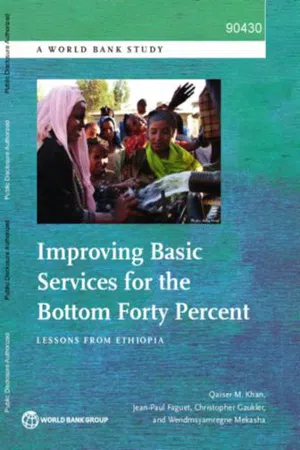
Improving Basic Services for the Bottom Forty Percent
Lessons from Ethiopia
- 139 pages
- English
- PDF
- Available on iOS & Android
eBook - PDF
Improving Basic Services for the Bottom Forty Percent
Lessons from Ethiopia
About this book
Information
Subtopic
Public PolicyTable of contents
- Front Cover
- Contents
- Foreword
- Acknowledgments
- About the Authors
- Executive Summary
- Abbreviations
- Introduction and Background
- Chapter 1 Conceptual Framework and Methodology
- Chapter 2 Citizen Direct Voice and Accountability
- Chapter 3 Effectiveness of Woreda Block Grant Spending on Education, Health, and Agriculture
- Chapter 4 How Equitable Is Decentralized Spending at the Woreda Level?
- Chapter 5 The Federal System’s Role in Helping Lagging Areas and Groups
- Conclusions and Recommendations
- Appendix A Detailed Methodology and Data Sources
- Appendix B Financial Transparency and Social Accountability under the PBS Program
- Appendix C The Center and the Periphery in Ethiopia: The Evolution of Today’s Federal State
- Appendix D Detailed Regression Results
- Bibliography
- Boxes
- Figures
- Tables
- Back Cover
Trusted by 375,005 students
Access to over 1.5 million titles for a fair monthly price.
Study more efficiently using our study tools.
Frequently asked questions
Yes, you can cancel anytime from the Subscription tab in your account settings on the Perlego website. Your subscription will stay active until the end of your current billing period. Learn how to cancel your subscription
No, books cannot be downloaded as external files, such as PDFs, for use outside of Perlego. However, you can download books within the Perlego app for offline reading on mobile or tablet. Learn how to download books offline
Perlego offers two plans: Essential and Complete
- Essential is ideal for learners and professionals who enjoy exploring a wide range of subjects. Access the Essential Library with 800,000+ trusted titles and best-sellers across business, personal growth, and the humanities. Includes unlimited reading time and Standard Read Aloud voice.
- Complete: Perfect for advanced learners and researchers needing full, unrestricted access. Unlock 1.5M+ books across hundreds of subjects, including academic and specialized titles. The Complete Plan also includes advanced features like Premium Read Aloud and Research Assistant.
We are an online textbook subscription service, where you can get access to an entire online library for less than the price of a single book per month. With over 1.5 million books across 990+ topics, we’ve got you covered! Learn about our mission
Look out for the read-aloud symbol on your next book to see if you can listen to it. The read-aloud tool reads text aloud for you, highlighting the text as it is being read. You can pause it, speed it up and slow it down. Learn more about Read Aloud
Yes! You can use the Perlego app on both iOS and Android devices to read anytime, anywhere — even offline. Perfect for commutes or when you’re on the go.
Please note we cannot support devices running on iOS 13 and Android 7 or earlier. Learn more about using the app
Please note we cannot support devices running on iOS 13 and Android 7 or earlier. Learn more about using the app
Yes, you can access Improving Basic Services for the Bottom Forty Percent by Qaiser M. Khan, Jean-Paul Faguet, Christopher Gaukler, Wendmsyamregne Mekasha in PDF and/or ePUB format, as well as other popular books in Politics & International Relations & Public Policy. We have over 1.5 million books available in our catalogue for you to explore.