Uganda is one of the few African countries with a functional national assessment system. Established in 2003, the National Assessment of Progress in Education (NAPE) Program is executed by the Uganda National Examination Board (UNEB). The program uses a learning outcomes measurement framework to annually measure achievement in literacy and numeracy proficiency on the basis of a cross-sectional, nationally representative sample of learners from the primary three (P3) and primary six (P6) grades. In 2008, the framework was extended to the senior two (S2) grade of lower secondary education for English, math, and biology. However, use of national assessment results to inform improvements in student learning remains weak. These data can nevertheless be used to search for solutions to the challenge of low-quality education in Uganda. The objective of this study is to generate a comprehensive, consolidated evidence base about student learning outcomes and teacher effectiveness in primary and secondary schools Uganda, grounded in existing, nationally owned NAPE assessment data. In specific terms, this analytical work attempts to establish the following: (a) the performance levels and patterns of students in P3, P6, and S2; (b) problematic curriculum areas in the respective grades; (c) teacher competency; and (d) predictors of student and teacher performance levels. The goal is not to reanalyze existing data, but rather, provide additional analysis that can help complement the very useful summary reports provided by NAPE for individual years. This analysis is also supported by findings from the qualitative end-of-cycle (EOC) curriculum examination reports generated by UNEB chief examiners.
eBook - PDF
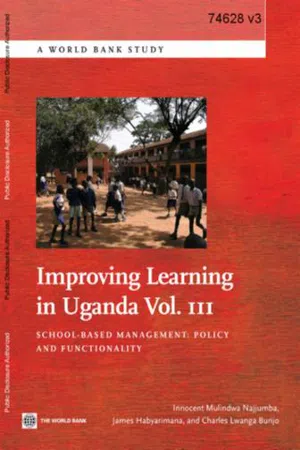
Improving Learning in Uganda, Volume III
School-based Management, Policy and Functionality
- 133 pages
- English
- PDF
- Available on iOS & Android
eBook - PDF
Improving Learning in Uganda, Volume III
School-based Management, Policy and Functionality
About this book
Information
Topic
EducationSubtopic
Education AdministrationTable of contents
- Cover
- Contents
- Acknowledgments
- About the Authors
- Abbreviations and Acronyms
- Executive Summary
- Chapter 1 Introduction
- Chapter 2 Policy and Regulatory Framework of School-Based Management in Uganda
- Chapter 3 Capacity of School Management Committees
- Chapter 4 Functionality of School-Based Management Structures
- Chapter 5 School Management and School-Level Results
- Chapter 6 Performance Monitoring and Evaluation of School-Based Management
- Chapter 7 Strategic Options for the Government Going Forward
- Appendix A: Data Sources
- Appendix B: Estimation of the Likelihood of SMC Members Participating in Key School-Based Management Activities
- Appendix C: Some of the Documented Capacity Development Programs for SMCs in Uganda
- Appendix D: Description of the Sensitivity Tests Model for the Multivariate Analysis
- References
- Boxes
- Figures
- Tables
Trusted by 375,005 students
Access to over 1.5 million titles for a fair monthly price.
Study more efficiently using our study tools.
Frequently asked questions
Yes, you can cancel anytime from the Subscription tab in your account settings on the Perlego website. Your subscription will stay active until the end of your current billing period. Learn how to cancel your subscription
No, books cannot be downloaded as external files, such as PDFs, for use outside of Perlego. However, you can download books within the Perlego app for offline reading on mobile or tablet. Learn how to download books offline
Perlego offers two plans: Essential and Complete
- Essential is ideal for learners and professionals who enjoy exploring a wide range of subjects. Access the Essential Library with 800,000+ trusted titles and best-sellers across business, personal growth, and the humanities. Includes unlimited reading time and Standard Read Aloud voice.
- Complete: Perfect for advanced learners and researchers needing full, unrestricted access. Unlock 1.5M+ books across hundreds of subjects, including academic and specialized titles. The Complete Plan also includes advanced features like Premium Read Aloud and Research Assistant.
We are an online textbook subscription service, where you can get access to an entire online library for less than the price of a single book per month. With over 1.5 million books across 990+ topics, we’ve got you covered! Learn about our mission
Look out for the read-aloud symbol on your next book to see if you can listen to it. The read-aloud tool reads text aloud for you, highlighting the text as it is being read. You can pause it, speed it up and slow it down. Learn more about Read Aloud
Yes! You can use the Perlego app on both iOS and Android devices to read anytime, anywhere — even offline. Perfect for commutes or when you’re on the go.
Please note we cannot support devices running on iOS 13 and Android 7 or earlier. Learn more about using the app
Please note we cannot support devices running on iOS 13 and Android 7 or earlier. Learn more about using the app
Yes, you can access Improving Learning in Uganda, Volume III by Innocent Mulindwa Najjumba, James Habyarimana, Charles Lwanga Bunjo in PDF and/or ePUB format, as well as other popular books in Education & Education Administration. We have over 1.5 million books available in our catalogue for you to explore.