The new 2030 Agenda for Sustainable Development includes water, sanitation, and hygiene (WASH) at its core. A dedicated Sustainable Development Goal (SDG 6) declares a commitment to "ensure availability and sustainable management of water and sanitation for all." Monitoring progress toward this goal will be challenging: direct measures of water and sanitation service quality and use are either expensive or elusive. However, reliance on household surveys poses limitations and likely overstated progress during the Millennium Development Goal period. In Innovations in WASH Impact Measures: Water and Sanitation Measurement Technologies and Practices to Inform the Sustainable Development Goals, we review the landscape of proven and emerging technologies, methods, and approaches that can support and improve on the WASH indicators proposed for SDG target 6.1, "by 2030, achieve universal and equitable access to safe and affordable drinking water for all," and target 6.2, "by 2030, achieve access to adequate and equitable sanitation and hygiene for all and end open defecation, paying special attention to the needs of women and girls and those in vulnerable situations." Although some of these technologies and methods are readily available, other promising approaches require further field evaluation and cost reductions. Emergent technologies, methods, and data-sharing platforms are increasingly aligned with program impact monitoring. Improved monitoring of water and sanitation interventions may allow more cost-effective and measurable results. In many cases, technologies and methods allow more complete and impartial data in time to allow program improvements. Of the myriad monitoring and evaluation methods, each has its own advantages and limitations. Surveys, ethnographies, and direct observation give context to more continuous and objective electronic sensor data. Overall, combined methodologies can provide a more comprehensive and instructive depiction of WASH usage and help the international development community measure our progress toward reaching the SDG WASH goals.
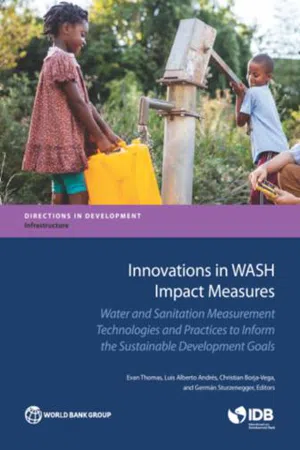
eBook - PDF
Innovations in WASH Impact Measures
Water and Sanitation Measurement Technologies and Practices to Inform the Sustainable Development Goals
- 123 pages
- English
- PDF
- Available on iOS & Android
eBook - PDF
Innovations in WASH Impact Measures
Water and Sanitation Measurement Technologies and Practices to Inform the Sustainable Development Goals
About this book
Information
Subtopic
Gestione ambientaleTable of contents
- Front Cover
- Contents
- Foreword
- Acknowledgments
- About the Editors and Contributors
- Abbreviations
- Executive Summary
- Chapter 1 A Review of WASH Monitoring Indicators
- Chapter 2 Water Quality Monitoring
- Chapter 3 Sanitation and Hygiene Monitoring
- Chapter 4 Behavioral Monitoring
- Chapter 5 Sensing WASH—In Situ and Remote Sensing Technologies
- Chapter 6 Mobile, Cloud, and Big Data for Measuring Progress in WASH
- Appendix A Household Surveys within WASH Monitoring Indicators
- Appendix B Technologies and Data-Sharing Platforms for WASH Data
- Box
- Figures
- Photos
- Tables
Trusted by 375,005 students
Access to over 1.5 million titles for a fair monthly price.
Study more efficiently using our study tools.
Frequently asked questions
Yes, you can cancel anytime from the Subscription tab in your account settings on the Perlego website. Your subscription will stay active until the end of your current billing period. Learn how to cancel your subscription
No, books cannot be downloaded as external files, such as PDFs, for use outside of Perlego. However, you can download books within the Perlego app for offline reading on mobile or tablet. Learn how to download books offline
Perlego offers two plans: Essential and Complete
- Essential is ideal for learners and professionals who enjoy exploring a wide range of subjects. Access the Essential Library with 800,000+ trusted titles and best-sellers across business, personal growth, and the humanities. Includes unlimited reading time and Standard Read Aloud voice.
- Complete: Perfect for advanced learners and researchers needing full, unrestricted access. Unlock 1.5M+ books across hundreds of subjects, including academic and specialized titles. The Complete Plan also includes advanced features like Premium Read Aloud and Research Assistant.
We are an online textbook subscription service, where you can get access to an entire online library for less than the price of a single book per month. With over 1.5 million books across 990+ topics, we’ve got you covered! Learn about our mission
Look out for the read-aloud symbol on your next book to see if you can listen to it. The read-aloud tool reads text aloud for you, highlighting the text as it is being read. You can pause it, speed it up and slow it down. Learn more about Read Aloud
Yes! You can use the Perlego app on both iOS and Android devices to read anytime, anywhere — even offline. Perfect for commutes or when you’re on the go.
Please note we cannot support devices running on iOS 13 and Android 7 or earlier. Learn more about using the app
Please note we cannot support devices running on iOS 13 and Android 7 or earlier. Learn more about using the app
Yes, you can access Innovations in WASH Impact Measures by Evan Thomas, Luis Alberto Andrés, Christian Borja-Vega, Germán Sturzenegger in PDF and/or ePUB format, as well as other popular books in Tecnologia e ingegneria & Gestione ambientale. We have over 1.5 million books available in our catalogue for you to explore.