Light Manufacturing in Vietnam makes the case that, if the country is to continue along a rapid economic growth path and create jobs, it must undertake a structural transformation that can lift workers from low-productivity agriculture and the mere assembly of imported inputs to higher-productivity activities. Vietnam needs to address fundamental issues in the manufacturing sector that, until now, have been masked by economic growth. The book shows that there is a dichotomy between domestic enterprises and enterprises supported by foreign direct investment. The dominant state-owned enterprises and foreign-invested firms are often not integrated with smaller, domestic firms through backward or forward links in the use of domestically produced inputs or intermediate products. Growth in the domestic light manufacturing sector has arisen from the sheer number of micro and small enterprises rather than from expansion in the number of medium and large firms. As a consequence, final products have little value added; technology and expertise are not shared; and the economy has failed to move up the structural transformation ladder. This structure of production is one of the reasons Vietnam's rapid process of industrialization over the last three decades has not been accompanied by a favorable trade balance. Policy measures to address problems in competitiveness in Vietnam must confront the dual structure of the light manufacturing sector, while raising the value added in the industry. To that end, measures must be taken to nurture the expansion of small domestic firms, while helping these firms to achieve greater productivity through trade integration. This will require improvements in labor skills and technology and in the quality and variety of products able to compete with imports. Policies to reduce the role of the state-owned sector, promote trading companies, encourage clustering and subcontracting, and raise foreign and social networking are important in this respect. To boost the value added of its goods, Vietnam needs to integrate the supply chain in assembly activities by investing in the upstream production of the goods in which it has a comparative advantage in production and in which it has already established a market share, such as agribusiness, garments, and wood. Unlike downstream activities, however, the production of the associated raw materials and intermediate goods is capital intensive and technology driven, and it requires skilled labor. Inviting foreign direct investment into these areas and reforming education and vocational systems are the best means to reach this goal. For this reason, the government should launch a complete review of the incentives for foreign direct investment to focus on upstream production and on bringing in capital and technical expertise, while improving labor and entrepreneurial skills. Based on this analysis, Light Manufacturing in Vietnam proposes concrete policy measures to increase employment and spur job creation by addressing sector-specific constraints. The book presents a set of practical recommendations for policy makers to identify, prioritize, and remove the most serious constraints in each sector. This book will be valuable for policy makers, entrepreneurs, workers, professional economists, and anyone interested in economic development, industrialization, and the structural transformation of Vietnam and of developing countries.
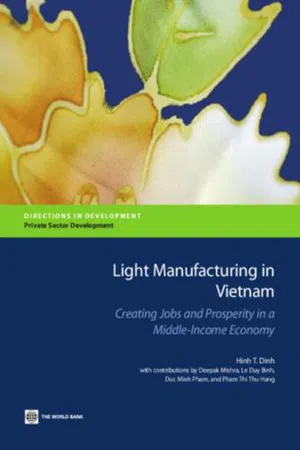
eBook - PDF
Light Manufacturing in Vietnam
Creating Jobs and Prosperity in a Middle-Income Economy
- 155 pages
- English
- PDF
- Available on iOS & Android
eBook - PDF
About this book
Information
Subtopic
ManufacturingIndex
BusinessTable of contents
- Front Cover
- Contents
- Foreword
- Acknowledgments
- About the Author
- About the Contributors
- Abbreviations
- Overview
- Chapter 1 Industrial Growth in the Overall Development Context
- Chapter 2 Industrial Structure and Sectoral Issues
- Chapter 3 Strengthening Light Manufacturing
- Chapter 4 Apparel
- Chapter 5 Leather
- Chapter 6 Wood Products
- Chapter 7 Metal Products
- Chapter 8 Agribusiness
- Chapter 9 Synthesis, Reforms, and Policy Implementation
- Appendix A The Methodology of the Comparative Value Chain Analysis
- Box
- Figures
- Tables
Trusted by 375,005 students
Access to over 1.5 million titles for a fair monthly price.
Study more efficiently using our study tools.
Frequently asked questions
Yes, you can cancel anytime from the Subscription tab in your account settings on the Perlego website. Your subscription will stay active until the end of your current billing period. Learn how to cancel your subscription
No, books cannot be downloaded as external files, such as PDFs, for use outside of Perlego. However, you can download books within the Perlego app for offline reading on mobile or tablet. Learn how to download books offline
Perlego offers two plans: Essential and Complete
- Essential is ideal for learners and professionals who enjoy exploring a wide range of subjects. Access the Essential Library with 800,000+ trusted titles and best-sellers across business, personal growth, and the humanities. Includes unlimited reading time and Standard Read Aloud voice.
- Complete: Perfect for advanced learners and researchers needing full, unrestricted access. Unlock 1.5M+ books across hundreds of subjects, including academic and specialized titles. The Complete Plan also includes advanced features like Premium Read Aloud and Research Assistant.
We are an online textbook subscription service, where you can get access to an entire online library for less than the price of a single book per month. With over 1.5 million books across 990+ topics, we’ve got you covered! Learn about our mission
Look out for the read-aloud symbol on your next book to see if you can listen to it. The read-aloud tool reads text aloud for you, highlighting the text as it is being read. You can pause it, speed it up and slow it down. Learn more about Read Aloud
Yes! You can use the Perlego app on both iOS and Android devices to read anytime, anywhere — even offline. Perfect for commutes or when you’re on the go.
Please note we cannot support devices running on iOS 13 and Android 7 or earlier. Learn more about using the app
Please note we cannot support devices running on iOS 13 and Android 7 or earlier. Learn more about using the app
Yes, you can access Light Manufacturing in Vietnam by Hinh T. Dinh in PDF and/or ePUB format, as well as other popular books in Business & Manufacturing. We have over 1.5 million books available in our catalogue for you to explore.