Despite the spread of automation and new supply chain management paradigms, logistics remains dependent on a rather specific set of skills and competencies, whether for managerial, administrative, or blue-collar jobs, such as trucking or warehousing. This dependence implies that the logistical performance of businesses, industries, and nation states is strongly influenced by the quantity and quality of the workforce. Insufficient resources of a competent and properly trained workforce in logistics adversely affect the quality of service, reduce productivity in sectors dependent on logistics, and ultimately reduce trade competitiveness. While other interventions that affect logistics performance—such as international infrastructures, trade corridors, regulations, and services—have already been reviewed extensively, this report is the first to cover the contributions of human resources and explore how to develop skills and improve competencies, especially in developing countries. The study proposes a framework for the skills needed according to the logistics activity (such as transportation or warehousing) or the type and level of responsibility. Based on several sources, including recent surveys carried out by the World Bank and the Kühne Logistics University, the report uncovers where the skills constraints are according to the type of job or countries. Findings include that logistics is an industry struggling to hire skilled workers, although with differences between developed countries (where trucker shortages are more acute) and developing economies (where managerial shortages are more widespread). Typically, blue-collar logistics jobs have lower status and lower pay than blue-collar jobs in other industries; they are thus less attractive for skilled workers. In developing countries with a potentially available workforce, lack of vocational preparation for careers in logistics means that less-skilled workers are not easily re-skilled. Logistics tasks at the upper end of the occupational hierarchy and those with high information technology content often require an upskilling of employees to keep pace with new technology. Yet the problem is not confined to recruitment. The surveys point to limited resources, money, and staff time allocated to training, especially in developing countries. Realizing the promise of quality jobs from the growth of logistics worldwide requires a coordinated effort by logistics companies, professional associations, training providers, and policy makers. Through a combination of facilitation, regulation, advice, financial instruments, and land use planning, governments can exert significant influence.
eBook - PDF
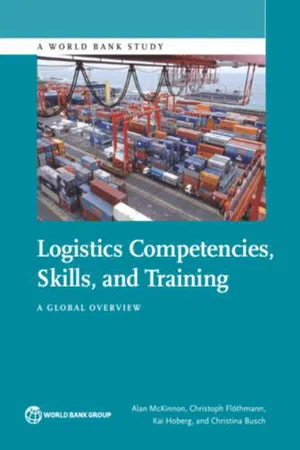
Logistics Competencies, Skills, and Training
A Global Overview
- 111 pages
- English
- PDF
- Available on iOS & Android
eBook - PDF
Logistics Competencies, Skills, and Training
A Global Overview
About this book
Information
Subtopic
Business SkillsIndex
BusinessTable of contents
- Front Cover
- Contents
- Acknowledgments
- About the Authors
- Executive Summary
- Abbreviations
- Chapter 1 Introduction
- Chapter 2 Methodology and Sources
- Chapter 3 The Quest for Logistics Competence: Survey Evidence
- Chapter 4 Sector Case Studies
- Chapter 5 Training and Skills Development
- Chapter 6 Recruitment and Retention
- Chapter 7 The Role of the Public Sector in Enhancing Logistics Competence
- Chapter 8 Logistics Competence Maturity Matrix
- Chapter 9 Conclusion
- Appendix A Selected Literature Related to Logistics Skills, Competence, and Training
- Appendix B Example of Continuing Professional Development (CPD) for Logistics
- Appendix C Supplementary Survey Results
- Appendix D Self-Assessment Tool
- Appendix E Results from the World Bank Logistics Performance Index Survey 2015/2016
- Box
- Figures
- Map
- Tables
Trusted by 375,005 students
Access to over 1.5 million titles for a fair monthly price.
Study more efficiently using our study tools.
Frequently asked questions
Yes, you can cancel anytime from the Subscription tab in your account settings on the Perlego website. Your subscription will stay active until the end of your current billing period. Learn how to cancel your subscription
No, books cannot be downloaded as external files, such as PDFs, for use outside of Perlego. However, you can download books within the Perlego app for offline reading on mobile or tablet. Learn how to download books offline
Perlego offers two plans: Essential and Complete
- Essential is ideal for learners and professionals who enjoy exploring a wide range of subjects. Access the Essential Library with 800,000+ trusted titles and best-sellers across business, personal growth, and the humanities. Includes unlimited reading time and Standard Read Aloud voice.
- Complete: Perfect for advanced learners and researchers needing full, unrestricted access. Unlock 1.5M+ books across hundreds of subjects, including academic and specialized titles. The Complete Plan also includes advanced features like Premium Read Aloud and Research Assistant.
We are an online textbook subscription service, where you can get access to an entire online library for less than the price of a single book per month. With over 1.5 million books across 990+ topics, we’ve got you covered! Learn about our mission
Look out for the read-aloud symbol on your next book to see if you can listen to it. The read-aloud tool reads text aloud for you, highlighting the text as it is being read. You can pause it, speed it up and slow it down. Learn more about Read Aloud
Yes! You can use the Perlego app on both iOS and Android devices to read anytime, anywhere — even offline. Perfect for commutes or when you’re on the go.
Please note we cannot support devices running on iOS 13 and Android 7 or earlier. Learn more about using the app
Please note we cannot support devices running on iOS 13 and Android 7 or earlier. Learn more about using the app
Yes, you can access Logistics Competencies, Skills, and Training by Alan McKinnon, Christoph Flöthmann, Kai Hoberg, Christina Busch in PDF and/or ePUB format, as well as other popular books in Business & Business Skills. We have over 1.5 million books available in our catalogue for you to explore.