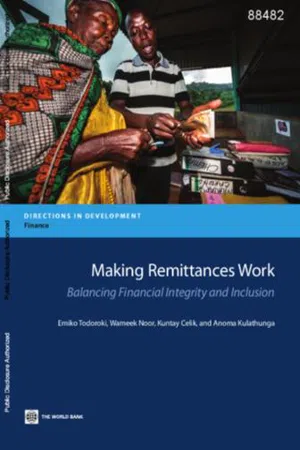
The September 11, 2001, terrorist attacks on the United States exposed the use of remittance channels for financing terrorism. Acting on this, the international community, through the financial action task force (FATF), issued first international standard to require the licensing or registration of money transfer businesses (MTBs) and to make them subject to anti-money laundering and combating the financing of terrorism (AML and CFT) requirements. This study aims to assess current practices, draw lessons learned, and assist policy makers in designing an effective regulatory and supervisory framework governing remittances that not only meets AML and CFT international standards, but also supports a country's overall financial inclusion objectives. The study's assessments and recommendations are based on extensive research and analysis, including primary survey data received from 26 remittance sending and receiving countries. The report follows on the 15 bilateral remittance corridor analyses (BRCAs) undertaken during 2004-10 by the financial market integrity (FMI) unit of the World Bank and three BRCAs undertaken by the Government of the Netherlands using the methodology developed by the FMI unit of the World Bank. The study is organized as follows: chapter one analyzes the various business models for remittance services currently in existence, and the various types of agent networks of MTBs available for the distribution of remittances. Chapter two elaborates on AML and CFT risks related to products, market structure, regulation, and supervision; discusses how innovative products and services for remittance transfers such as mobile money and internet-based money transfer may pose new threats and risks; and includes a discussion on the appropriate risk mitigation techniques so as not to constrain the remittance market from developing and innovating. Chapter three describes the various regulatory frameworks that MTBs encounter around the world, including different types of laws and regulations affecting them, sheds light on how AML and CFT requirements can be implemented, and provides a comprehensive analysis of customer due diligence (CDD) requirements as a crucial element to effectively fight money laundering and the financing of terrorism. Chapter four discusses licensing and registration regimes for, and appropriate regulatory approaches toward, MTBs; examines the conditions that must be fulfilled in order to apply for licensing or registration. Chapter five discusses the various AML and CFT supervisory models and identifies potential strengths and weaknesses in each of these models; elaborates on the supervisory practices of competent authorities, along with the challenges faced by MTBs in implementing relevant supervisory requirements; and discusses the risk-based approach (RBA) to supervision of MTBs. Finally, chapter six focuses on establishing an effective AML and CFT regime while supporting broader financial inclusion and highlights key policy recommendations underlined by a RBA that encourages flexible implementation of the AML and CFT framework.
eBook - PDF
Making Remittances Work
Balancing Financial Integrity and Inclusion
- 267 pages
- English
- PDF
- Available on iOS & Android
eBook - PDF
Making Remittances Work
Balancing Financial Integrity and Inclusion
About this book
Information
Table of contents
- Front Cover
- Contents
- Foreword
- Acknowledgments
- About the Authors
- Overview
- Abbreviations
- Introduction
- Part 1 How Remittance Markets Operate
- Part 2 Regulating and Supervising the Remittance Markets
- Appendix A Remittance Regulatory Survey
- Appendix B Source Tables
- Appendix C An Example of an ML/FT Risk Assessment Tool for Remittances
- Appendix D New Remittance Transfer Mechanisms
- Appendix E Private Sector Adaptation Leading to Greater Financial Inclusion
- Appendix F Latest Financial Action Task Force Recommendations
- Appendix G General Principles for International Remittance Services
- Appendix H FATF Recommendations Relevant to Remittance Services
- Appendix I Tip Sheet for Regulation and Supervision of Remittance Market
- Appendix J Balancing Financial Integrity and Financial Inclusion
- Glossary
- Boxes
- Figures
- Map
- Tables
Trusted by 375,005 students
Access to over 1.5 million titles for a fair monthly price.
Study more efficiently using our study tools.
Frequently asked questions
Yes, you can cancel anytime from the Subscription tab in your account settings on the Perlego website. Your subscription will stay active until the end of your current billing period. Learn how to cancel your subscription
No, books cannot be downloaded as external files, such as PDFs, for use outside of Perlego. However, you can download books within the Perlego app for offline reading on mobile or tablet. Learn how to download books offline
Perlego offers two plans: Essential and Complete
- Essential is ideal for learners and professionals who enjoy exploring a wide range of subjects. Access the Essential Library with 800,000+ trusted titles and best-sellers across business, personal growth, and the humanities. Includes unlimited reading time and Standard Read Aloud voice.
- Complete: Perfect for advanced learners and researchers needing full, unrestricted access. Unlock 1.5M+ books across hundreds of subjects, including academic and specialized titles. The Complete Plan also includes advanced features like Premium Read Aloud and Research Assistant.
We are an online textbook subscription service, where you can get access to an entire online library for less than the price of a single book per month. With over 1.5 million books across 990+ topics, we’ve got you covered! Learn about our mission
Look out for the read-aloud symbol on your next book to see if you can listen to it. The read-aloud tool reads text aloud for you, highlighting the text as it is being read. You can pause it, speed it up and slow it down. Learn more about Read Aloud
Yes! You can use the Perlego app on both iOS and Android devices to read anytime, anywhere — even offline. Perfect for commutes or when you’re on the go.
Please note we cannot support devices running on iOS 13 and Android 7 or earlier. Learn more about using the app
Please note we cannot support devices running on iOS 13 and Android 7 or earlier. Learn more about using the app
Yes, you can access Making Remittances Work by Emiko Todoroki, Wameek Noor, Kuntay Celik, Anoma Kulathunga in PDF and/or ePUB format, as well as other popular books in Business & Finance. We have over 1.5 million books available in our catalogue for you to explore.