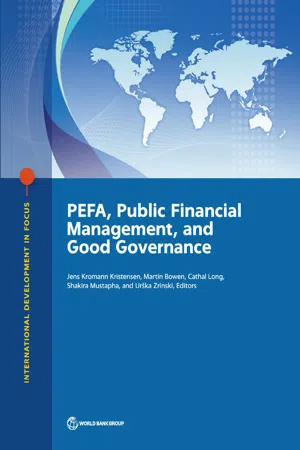
This project, based on the Public Expenditure and Financial Accountability (PEFA) data set, researched how PEFA can be used to shape policy development in public financial management (PFM) and other major relevant policy areas such as anticorruption, revenue mobilization, political economy analysis, and fragile states. The report explores what shapes the PFM system in low- and middle-income countries by examining the relationship between political institutions and the quality of the PFM system. Although the report finds some evidence that multiple political parties in control of the legislature is associated with better PFM performance, the report finds the need to further refine and test the theories on the relationship between political institutions and PFM. The report addresses the question of the outcomes of PFM systems, distinguishing between fragile and nonfragile states. It finds that better PFM performance is associated with more reliable budgets in terms of expenditure composition in fragile states, but not aggregate budget credibility. Moreover, in contrast to existing studies, it finds no evidence that PFM quality matters for deficit and debt ratios, irrespective of whether a country is fragile or not. The report also explores the relationship between perceptions of corruption and PFM performance. It finds strong evidence of a relationship between better PFM performance and improvements in perceptions of corruption. It also finds that PFM reforms associated with better controls have a stronger relationship with improvements in perceptions of corruption compared to PFM reforms associated with more transparency. The last chapter looks at the relationship between PEFA indicators for revenue administration and domestic resource mobilization. It focuses on the credible use of penalties for noncompliance as a proxy for the type of political commitment required to improve tax performance. The analysis shows that countries that credibly enforce penalties for noncompliance collect more taxes on average.
eBook - PDF
PEFA, Public Financial Management, and Good Governance
- 169 pages
- English
- PDF
- Available on iOS & Android
eBook - PDF
PEFA, Public Financial Management, and Good Governance
About this book
Information
Subtopic
Public FinanceIndex
EconomicsTable of contents
- Front Cover
- Contents
- Preface
- Acknowledgments
- About PEFA
- About the Authors and Editors
- Summary
- Abbreviations
- 1 Introduction: What Is PFM and Why Is It Important?
- 2 Measuring PFM Performance through PEFA: Approach and Methodology
- 3 Political Institutions and PFM Performance
- 4 Budget Credibility, Fiscal Outcomes, and PFM Performance in Fragile and Nonfragile Countries
- 5 PFM and Perceptions of Corruption Cathal Long
- 6 Revenue Administration Performance and Domestic Resource Mobilization
- Box
- Figures
- Tables
Trusted by 375,005 students
Access to over 1.5 million titles for a fair monthly price.
Study more efficiently using our study tools.
Frequently asked questions
Yes, you can cancel anytime from the Subscription tab in your account settings on the Perlego website. Your subscription will stay active until the end of your current billing period. Learn how to cancel your subscription
No, books cannot be downloaded as external files, such as PDFs, for use outside of Perlego. However, you can download books within the Perlego app for offline reading on mobile or tablet. Learn how to download books offline
Perlego offers two plans: Essential and Complete
- Essential is ideal for learners and professionals who enjoy exploring a wide range of subjects. Access the Essential Library with 800,000+ trusted titles and best-sellers across business, personal growth, and the humanities. Includes unlimited reading time and Standard Read Aloud voice.
- Complete: Perfect for advanced learners and researchers needing full, unrestricted access. Unlock 1.5M+ books across hundreds of subjects, including academic and specialized titles. The Complete Plan also includes advanced features like Premium Read Aloud and Research Assistant.
We are an online textbook subscription service, where you can get access to an entire online library for less than the price of a single book per month. With over 1.5 million books across 990+ topics, we’ve got you covered! Learn about our mission
Look out for the read-aloud symbol on your next book to see if you can listen to it. The read-aloud tool reads text aloud for you, highlighting the text as it is being read. You can pause it, speed it up and slow it down. Learn more about Read Aloud
Yes! You can use the Perlego app on both iOS and Android devices to read anytime, anywhere — even offline. Perfect for commutes or when you’re on the go.
Please note we cannot support devices running on iOS 13 and Android 7 or earlier. Learn more about using the app
Please note we cannot support devices running on iOS 13 and Android 7 or earlier. Learn more about using the app
Yes, you can access PEFA, Public Financial Management, and Good Governance by Jens Kromann Kristensen, Martin Bowen, Cathal Long, Shakira Mustapha, Urška Zrinski in PDF and/or ePUB format, as well as other popular books in Economics & Public Finance. We have over 1.5 million books available in our catalogue for you to explore.