Education is a source of national pride in Lebanon. When the general public was asked how the education system was performing, 76 percent of respondents had a positive opinion; and these satisfaction rates have been consistently high over the years. However, perception of education quality does not reflect the reality of the sector; and learning outcomes, which are the determining metrics of success in education, have been lower than the international average, with a declining trend since 2007. This volume seeks to uncover why the education system in Lebanon is not reaching its full potential. It uses a political economy approach to study the drivers and factors that guide education operations to produce and utilize education outcomes. This includes the study of context, stakeholders, and processes that shape education policies, institutions, and activities. It also aims to identify enablers of and constraints on policy change and implementation, as well as the achievement of results. In this context, the analysis encompasses how education policies are developed; how education consumables—such as curricula, textbooks, and learning materials—are produced, distributed, and used by learners; how education services are delivered and monitored; and how achieved results are measured. It includes the identification of the most influential actors in the education arena, as well as their vested interests. It also examines unfavorable frameworks for action that are likely to block the adoption of reforms and delay or derail their implementation. The system-level analysis presented in this volume used a mixed-method approach. Qualitative and quantitative analyses were conducted based on a review and analysis of more than 1,900 research papers, articles, and books; laws and policies; expenditures; trends; and enrollment and outcome indicators. Primary methods of inquiry were also used and included interviews, focus group discussions, and a household-based perception survey.
eBook - PDF
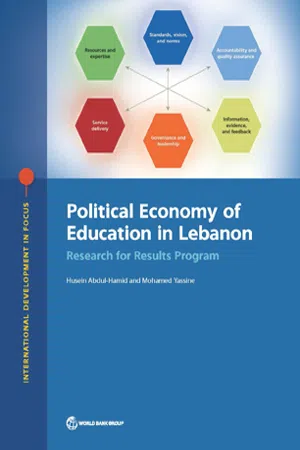
Political Economy of Education in Lebanon
Research for Results Program
- 237 pages
- English
- PDF
- Available on iOS & Android
eBook - PDF
Political Economy of Education in Lebanon
Research for Results Program
About this book
Information
Topic
EducationSubtopic
Educational PolicyTable of contents
- Front Cover
- Contents
- Acknowledgments
- About the Authors
- Abbreviations
- Overview
- Chapter 1: Background, Methodology, Research, and Evidence
- Chapter 2: A Historical Perspective on Education in Lebanon
- Chapter 3: Public Perception of Education versus Reality
- Chapter 4: Government Commitment to Education
- Chapter 5: Analysis of the Cornerstones of Education
- Chapter 6: The Path to the Future of Education
- Appendix A Bibliography
- Appendix B Public Perception Study Methodology
- Appendix C Dialogue and Protocol for Policy Uptake
- Boxes
- Figures
- Map
- Tables
Trusted by 375,005 students
Access to over 1.5 million titles for a fair monthly price.
Study more efficiently using our study tools.
Frequently asked questions
Yes, you can cancel anytime from the Subscription tab in your account settings on the Perlego website. Your subscription will stay active until the end of your current billing period. Learn how to cancel your subscription
No, books cannot be downloaded as external files, such as PDFs, for use outside of Perlego. However, you can download books within the Perlego app for offline reading on mobile or tablet. Learn how to download books offline
Perlego offers two plans: Essential and Complete
- Essential is ideal for learners and professionals who enjoy exploring a wide range of subjects. Access the Essential Library with 800,000+ trusted titles and best-sellers across business, personal growth, and the humanities. Includes unlimited reading time and Standard Read Aloud voice.
- Complete: Perfect for advanced learners and researchers needing full, unrestricted access. Unlock 1.5M+ books across hundreds of subjects, including academic and specialized titles. The Complete Plan also includes advanced features like Premium Read Aloud and Research Assistant.
We are an online textbook subscription service, where you can get access to an entire online library for less than the price of a single book per month. With over 1.5 million books across 990+ topics, we’ve got you covered! Learn about our mission
Look out for the read-aloud symbol on your next book to see if you can listen to it. The read-aloud tool reads text aloud for you, highlighting the text as it is being read. You can pause it, speed it up and slow it down. Learn more about Read Aloud
Yes! You can use the Perlego app on both iOS and Android devices to read anytime, anywhere — even offline. Perfect for commutes or when you’re on the go.
Please note we cannot support devices running on iOS 13 and Android 7 or earlier. Learn more about using the app
Please note we cannot support devices running on iOS 13 and Android 7 or earlier. Learn more about using the app
Yes, you can access Political Economy of Education in Lebanon by Husein Abdul-Hamid, Mohamed Yassine in PDF and/or ePUB format, as well as other popular books in Education & Educational Policy. We have over 1.5 million books available in our catalogue for you to explore.