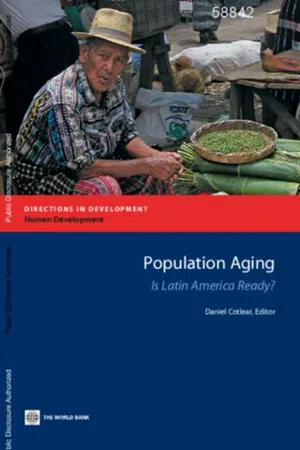
The past half-century has seen enormous changes in the demographic makeup of Latin America and the Caribbean (LAC). In the 1950s, LAC had a small population of about 160 million people, less than today's population of Brazil. Two-thirds of Latin Americans lived in rural areas. Families were large and women had one of the highest fertility rates in the world, low levels of education, and few opportunities for work outside the household. Investments in health and education reached only a small fraction of the children, many of whom died before reaching age five. Since then, the size of the LAC population has tripled and the mostly rural population has been transformed into a largely urban population. There have been steep reductions in child mortality, and investments in health and education have increased, today reaching a majority of children. Fertility has been more than halved and the opportunities for women in education and for work outside the household have improved significantly. Life expectancy has grown by 22 years. Less obvious to the casual observer, but of significance for policy makers, a population with a large fraction of dependent children has evolved into a population with fewer dependents and a very large proportion of working-age adults. This overview seeks to introduce the reader to three groups of issues related to population aging in LAC. First is a group of issues related to the support of the aging and poverty in the life cycle. Second is the question of the health transition. Third is an understanding of the fiscal pressures that are likely to accompany population aging and to disentangle the role of demography from the role of policy in that process.
- 324 pages
- English
- PDF
- Available on iOS & Android
eBook - PDF
About this book
Information
Topic
Sciences socialesSubtopic
DémographieTable of contents
- Contents
- Preface
- Acknowledgments
- About the Authors
- Abbreviations
- Chapter 1 Population Aging: Is Latin America Ready?
- Chapter 2 Demographic Trends in Latin America and the Caribbean
- Chapter 3 Poverty, the Aging, and the Life Cycle in Latin America
- Chapter 4 How Age Influences the Demand for Health Care in Latin America
- Chapter 5 The Economics of Happiness and Health Policy: How Health Norms Vary across Cohorts in Latin America
- Chapter 6 Who Benefits from Public Transfers? Incidence across Income Groups and across Generations in Brazil and Chile
- Chapter 7 The Fiscal Impact of Demographic Change in Ten Latin American Countries: Projecting Public Expenditures in Education, Health, and Pensions
- Index
- Figures
- Tables
Trusted by 375,005 students
Access to over 1.5 million titles for a fair monthly price.
Study more efficiently using our study tools.
Frequently asked questions
Yes, you can cancel anytime from the Subscription tab in your account settings on the Perlego website. Your subscription will stay active until the end of your current billing period. Learn how to cancel your subscription
No, books cannot be downloaded as external files, such as PDFs, for use outside of Perlego. However, you can download books within the Perlego app for offline reading on mobile or tablet. Learn how to download books offline
Perlego offers two plans: Essential and Complete
- Essential is ideal for learners and professionals who enjoy exploring a wide range of subjects. Access the Essential Library with 800,000+ trusted titles and best-sellers across business, personal growth, and the humanities. Includes unlimited reading time and Standard Read Aloud voice.
- Complete: Perfect for advanced learners and researchers needing full, unrestricted access. Unlock 1.5M+ books across hundreds of subjects, including academic and specialized titles. The Complete Plan also includes advanced features like Premium Read Aloud and Research Assistant.
We are an online textbook subscription service, where you can get access to an entire online library for less than the price of a single book per month. With over 1.5 million books across 990+ topics, we’ve got you covered! Learn about our mission
Look out for the read-aloud symbol on your next book to see if you can listen to it. The read-aloud tool reads text aloud for you, highlighting the text as it is being read. You can pause it, speed it up and slow it down. Learn more about Read Aloud
Yes! You can use the Perlego app on both iOS and Android devices to read anytime, anywhere — even offline. Perfect for commutes or when you’re on the go.
Please note we cannot support devices running on iOS 13 and Android 7 or earlier. Learn more about using the app
Please note we cannot support devices running on iOS 13 and Android 7 or earlier. Learn more about using the app
Yes, you can access Population Aging by Daniel Cotlear in PDF and/or ePUB format, as well as other popular books in Sciences sociales & Démographie. We have over 1.5 million books available in our catalogue for you to explore.