The stagnation of productivity in the developing world, and indeed, across the globe, over the last two decades dictates a rethinking of productivity measurement, analysis, and policy. This volume presents a 'second wave' of thinking in three key areas of productivity analysis and its implications for productivity policies. It calls into question the measurement and relevance of distortions as the primary barrier to productivity growth; urges a broader concept of firm performance that goes beyond efficiency to quality upgrading and demand expansion; and explores what it takes to generate an experimental and innovative society where entrepreneurs have the personal characteristics to identify new technologies and manage risk within an entrepreneurial ecosystem that facilitates them doing so. It also reviews arguments surrounding industrial policies. The authors argue for an integrated approach to productivity analysis that incorporates both the need to reduce economic distortions and generate the human capital capable of identifying the opportunities offered to follower countries and upgrade firm capabilities. Finally, it offers guidance on prioritizing policies when there is uncertainty around diagnostics and limited government capability.
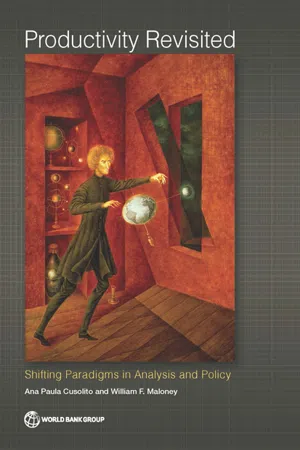
eBook - PDF
Productivity Revisited
Shifting Paradigms in Analysis and Policy
- 203 pages
- English
- PDF
- Available on iOS & Android
eBook - PDF
Productivity Revisited
Shifting Paradigms in Analysis and Policy
About this book
Information
Subtopic
Development EconomicsIndex
EconomicsTable of contents
- Cover
- Half Title
- Title
- Copyright
- Contents
- Preface
- Acknowledgments
- Abbreviations
- Executive Summary: The Elusive Promise of Productivity
- 1. The Elusive Promise of Productivity
- 2. Enhancing Firm Performance
- 3. Misallocation, Dispersion, and Risk
- 4. Entry and Exit: Creating Experimental Societies
- 5. Productivity Policies
- Appendix A. Measuring the Productivity Residual: From Theory to Measurement
- Boxes
- Figures
- Tables
Trusted by 375,005 students
Access to over 1.5 million titles for a fair monthly price.
Study more efficiently using our study tools.
Frequently asked questions
Yes, you can cancel anytime from the Subscription tab in your account settings on the Perlego website. Your subscription will stay active until the end of your current billing period. Learn how to cancel your subscription
No, books cannot be downloaded as external files, such as PDFs, for use outside of Perlego. However, you can download books within the Perlego app for offline reading on mobile or tablet. Learn how to download books offline
Perlego offers two plans: Essential and Complete
- Essential is ideal for learners and professionals who enjoy exploring a wide range of subjects. Access the Essential Library with 800,000+ trusted titles and best-sellers across business, personal growth, and the humanities. Includes unlimited reading time and Standard Read Aloud voice.
- Complete: Perfect for advanced learners and researchers needing full, unrestricted access. Unlock 1.5M+ books across hundreds of subjects, including academic and specialized titles. The Complete Plan also includes advanced features like Premium Read Aloud and Research Assistant.
We are an online textbook subscription service, where you can get access to an entire online library for less than the price of a single book per month. With over 1.5 million books across 990+ topics, we’ve got you covered! Learn about our mission
Look out for the read-aloud symbol on your next book to see if you can listen to it. The read-aloud tool reads text aloud for you, highlighting the text as it is being read. You can pause it, speed it up and slow it down. Learn more about Read Aloud
Yes! You can use the Perlego app on both iOS and Android devices to read anytime, anywhere — even offline. Perfect for commutes or when you’re on the go.
Please note we cannot support devices running on iOS 13 and Android 7 or earlier. Learn more about using the app
Please note we cannot support devices running on iOS 13 and Android 7 or earlier. Learn more about using the app
Yes, you can access Productivity Revisited by Ana Paula Cusolito, William F. Maloney in PDF and/or ePUB format, as well as other popular books in Economics & Development Economics. We have over 1.5 million books available in our catalogue for you to explore.