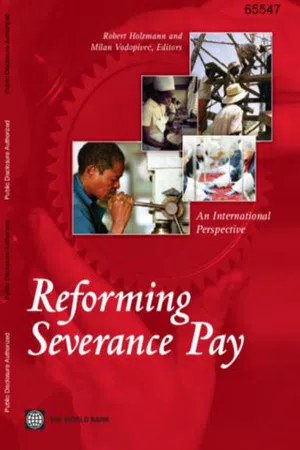
Throughout the developed and developing world there is growing demand for policies that would facilitate access to jobs by the most vulnerable, improve their earnings, and reduce their dependency on public support. As a result, governments are increasingly focused on removing obstacles faced by employers to create jobs and on instilling incentives for individuals to re-enter the labor market or to move toward more productive employment possibilities. Severance pay a program compensating formal workers for dismissal by employers or with an end-of-service benefit is often blamed for distorting employer hiring and firing decisions. Together with restrictive labor market regulations and other formal labor market features, this program is held responsible for excessive job protection with a negative impact on labor market outcomes, in particular affecting the most vulnerable. Despite this strong negative assessment among many labor market economists, surprisingly little is known about this program that exists in most countries around the world as a legally mandated benefit. This lack of knowledge may derive from the special 'positioning' of the program between labor code and social insurance; its origins were in the first policy domain, but its objectives for key programs were replicated in the second domain in particular unemployment and retirement benefits. This is the first-ever book to shed light on this program in a comprehensive manner its historical origins, its rationale, and its characteristics across the world. It reviews the soundness of the empirical accusation, assesses recent country reforms, and offers policy reform alternatives and policy guidance. The policy directions include folding severance pay into existing social insurance programs, where they exist, and to make severance pay contractual between market partners as a way to enhance efficiency in a knowledge-based economy. Folding severance pay into employment benefits may also be an opportunity to move away from unemployment insurance, which is fraught by moral hazard, toward a promising 'hybrid' system of unemployment insurance savings accounts supplemented by social pooling.
- 320 pages
- English
- PDF
- Available on iOS & Android
eBook - PDF
About this book
Information
Subtopic
Labour EconomicsIndex
EconomicsTable of contents
- Contents
- Preface
- Acknowledgments
- Abbreviations
- 1. Severance Pay under Review: Key Issues, Policy Conclusions, and Research Agenda
- 2. Severance Pay Programs around the World: History, Rationale, Status, and Reforms
- 3. Mandated Severance Pay and Firing Cost Distortions: A Critical Review of the Evidence
- 4. The Firing Cost Implications of Alternative Severance Pay Designs
- 5. Effects of the Austrian Severance Pay Reform
- 6. Severance Pay Reform in the Republic of Korea
- 7. Unemployment Insurance Savings Accounts in Latin America: Overview and Assessment
- 8. The Welfare Consequences of Alternative Designs of Unemployment Insurance Savings Accounts
- 9. The New Chilean Unemployment Insurance System: Combining Individual Accounts and Redistribution in an Emerging Economy
- 10. Reemployment Incentives under the Chilean Hybrid Unemployment Benefit Program
- Contributors
- Boxes
- Figures
- Tables
Trusted by 375,005 students
Access to over 1.5 million titles for a fair monthly price.
Study more efficiently using our study tools.
Frequently asked questions
Yes, you can cancel anytime from the Subscription tab in your account settings on the Perlego website. Your subscription will stay active until the end of your current billing period. Learn how to cancel your subscription
No, books cannot be downloaded as external files, such as PDFs, for use outside of Perlego. However, you can download books within the Perlego app for offline reading on mobile or tablet. Learn how to download books offline
Perlego offers two plans: Essential and Complete
- Essential is ideal for learners and professionals who enjoy exploring a wide range of subjects. Access the Essential Library with 800,000+ trusted titles and best-sellers across business, personal growth, and the humanities. Includes unlimited reading time and Standard Read Aloud voice.
- Complete: Perfect for advanced learners and researchers needing full, unrestricted access. Unlock 1.5M+ books across hundreds of subjects, including academic and specialized titles. The Complete Plan also includes advanced features like Premium Read Aloud and Research Assistant.
We are an online textbook subscription service, where you can get access to an entire online library for less than the price of a single book per month. With over 1.5 million books across 990+ topics, we’ve got you covered! Learn about our mission
Look out for the read-aloud symbol on your next book to see if you can listen to it. The read-aloud tool reads text aloud for you, highlighting the text as it is being read. You can pause it, speed it up and slow it down. Learn more about Read Aloud
Yes! You can use the Perlego app on both iOS and Android devices to read anytime, anywhere — even offline. Perfect for commutes or when you’re on the go.
Please note we cannot support devices running on iOS 13 and Android 7 or earlier. Learn more about using the app
Please note we cannot support devices running on iOS 13 and Android 7 or earlier. Learn more about using the app
Yes, you can access Reforming Severance Pay by Robert Holzmann, Milan Vodopivec in PDF and/or ePUB format, as well as other popular books in Economics & Labour Economics. We have over 1.5 million books available in our catalogue for you to explore.