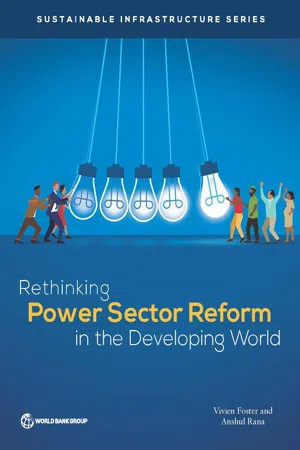
A new paradigm for power sector reform emerged during the 1990s, under the influence of the Washington Consensus, and began to spread across the developing world. This approach advocated restructuring of national power utilities to create scope for competition, while delegating responsibilities to the private sector under a clear regulatory framework. After 25 years, few developing countries have managed to adopt the model in its entirety, while many others encountered political and economic challenges along the way. This book provides a comprehensive evaluation of developing country power sector reform, sifting the evidence of whether reforms have contributed to improved sector outcomes. It also examines to what extent the reform paradigm remains relevant to the new social and environmental policy agenda of the twenty-first century, and is capable of adaptation to emerging technological disruption.
- 359 pages
- English
- PDF
- Available on iOS & Android
eBook - PDF
Rethinking Power Sector Reform in the Developing World
About this book
Information
Table of contents
- Front Cover
- Contents
- Foreword
- Acknowledgments
- About the Authors
- Background Papers
- Abbreviations
- Key Messages
- Overview: Key Findings and Policy Implications
- Part I: Setting the Stage
- Part II: Building Blocks of Reform
- Part III: Gauging Impact
- Boxes
- Figures
- Maps
- Tables
Trusted by 375,005 students
Access to over 1.5 million titles for a fair monthly price.
Study more efficiently using our study tools.
Frequently asked questions
Yes, you can cancel anytime from the Subscription tab in your account settings on the Perlego website. Your subscription will stay active until the end of your current billing period. Learn how to cancel your subscription
No, books cannot be downloaded as external files, such as PDFs, for use outside of Perlego. However, you can download books within the Perlego app for offline reading on mobile or tablet. Learn how to download books offline
Perlego offers two plans: Essential and Complete
- Essential is ideal for learners and professionals who enjoy exploring a wide range of subjects. Access the Essential Library with 800,000+ trusted titles and best-sellers across business, personal growth, and the humanities. Includes unlimited reading time and Standard Read Aloud voice.
- Complete: Perfect for advanced learners and researchers needing full, unrestricted access. Unlock 1.5M+ books across hundreds of subjects, including academic and specialized titles. The Complete Plan also includes advanced features like Premium Read Aloud and Research Assistant.
We are an online textbook subscription service, where you can get access to an entire online library for less than the price of a single book per month. With over 1.5 million books across 990+ topics, we’ve got you covered! Learn about our mission
Look out for the read-aloud symbol on your next book to see if you can listen to it. The read-aloud tool reads text aloud for you, highlighting the text as it is being read. You can pause it, speed it up and slow it down. Learn more about Read Aloud
Yes! You can use the Perlego app on both iOS and Android devices to read anytime, anywhere — even offline. Perfect for commutes or when you’re on the go.
Please note we cannot support devices running on iOS 13 and Android 7 or earlier. Learn more about using the app
Please note we cannot support devices running on iOS 13 and Android 7 or earlier. Learn more about using the app
Yes, you can access Rethinking Power Sector Reform in the Developing World by Vivien Foster, Anshul Rana in PDF and/or ePUB format, as well as other popular books in Politica e relazioni internazionali & Politica ambientale ed energetica. We have over 1.5 million books available in our catalogue for you to explore.