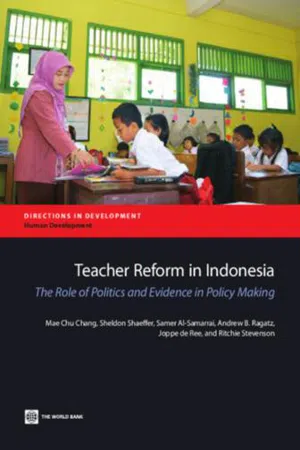
With close to three million teachers, Indonesia has one of the largest and most diverse cadres of teachers in the world. The evolving nature of its education system and the increasingly complex challenges facing individual teachers and the teaching profession as a whole are of immense importance to the nation's future development. In 2005 the Indonesian government approved a comprehensive Teacher and Lecturer Law that radically reformed the nation's teacher management and development process. This book explores this uniquely comprehensive reform by focusing on the nature of Indonesia's teaching profession before and after the Teacher Law; the educational and political economy context of the law; the structures, strategies, and processes that arose from the law including a comprehensive system of teacher appraisal and salary increases which effectively doubled the income of certified teachers; the political and economic factors which distorted the reform process; its impact on teacher knowledge, skills, and motivation and student outcomes; and the (in)efficiencies derived from the reform in terms of the system's financing and the distribution of its teachers. This book's framework promotes an approach to teacher reforms through improving the nature of recruitment into the profession; pre-service education; induction, mentoring, and probation; formal certification; continuing professional development; teacher performance appraisal; and ongoing career development. It should therefore be of particular interest to Ministries of Education and development agencies contemplating similar comprehensive reforms. The lessons and recommendations from this analysis include the following: • The doubling of teacher income has increased the status of the teaching profession and attracted better candidates to apply to teacher training institutions. • The mere fact of certification and the consequent doubling of teacher income have not achieved the better teaching and learning that was expected. • A quality assurance framework needs to be put in place from the beginning of any reform process. • The costs of extending the certification program to all teachers are associated with significant trade-offs within the education sector. Estimates suggest that spending on teacher compensation will need to absorb a much larger share of the education budget and require reductions in spending in other areas.
eBook - PDF
Teacher Reform in Indonesia
The Role of Politics and Evidence in Policy Making
- 259 pages
- English
- PDF
- Available on iOS & Android
eBook - PDF
Teacher Reform in Indonesia
The Role of Politics and Evidence in Policy Making
About this book
Information
Topic
EducationSubtopic
Educational PolicyTable of contents
- Front Cover
- Contents
- Foreword
- Acknowledgments
- About the Authors and Contributors
- Abbreviations
- Overview
- Introduction
- Chapter 1 Indonesia as a Case Study for Comprehensive Teacher Reform
- Chapter 2 Teachers as the Cornerstone of Educational Quality
- Chapter 3 The Comprehensive Reform of Institutions, Mechanisms, Strategies, and Processes
- Chapter 4 The Impact of the Reform on Teacher Quality and Student Outcomes
- Chapter 5 Looking Inside the Classroom Black Box
- Chapter 6 The Impact of the Reforms on the Efficiency and Equity of Public Spending
- Chapter 7 Conclusions and Recommendations
- Appendixes
- Boxes
- Figures
- Tables
Trusted by 375,005 students
Access to over 1.5 million titles for a fair monthly price.
Study more efficiently using our study tools.
Frequently asked questions
Yes, you can cancel anytime from the Subscription tab in your account settings on the Perlego website. Your subscription will stay active until the end of your current billing period. Learn how to cancel your subscription
No, books cannot be downloaded as external files, such as PDFs, for use outside of Perlego. However, you can download books within the Perlego app for offline reading on mobile or tablet. Learn how to download books offline
Perlego offers two plans: Essential and Complete
- Essential is ideal for learners and professionals who enjoy exploring a wide range of subjects. Access the Essential Library with 800,000+ trusted titles and best-sellers across business, personal growth, and the humanities. Includes unlimited reading time and Standard Read Aloud voice.
- Complete: Perfect for advanced learners and researchers needing full, unrestricted access. Unlock 1.5M+ books across hundreds of subjects, including academic and specialized titles. The Complete Plan also includes advanced features like Premium Read Aloud and Research Assistant.
We are an online textbook subscription service, where you can get access to an entire online library for less than the price of a single book per month. With over 1.5 million books across 990+ topics, we’ve got you covered! Learn about our mission
Look out for the read-aloud symbol on your next book to see if you can listen to it. The read-aloud tool reads text aloud for you, highlighting the text as it is being read. You can pause it, speed it up and slow it down. Learn more about Read Aloud
Yes! You can use the Perlego app on both iOS and Android devices to read anytime, anywhere — even offline. Perfect for commutes or when you’re on the go.
Please note we cannot support devices running on iOS 13 and Android 7 or earlier. Learn more about using the app
Please note we cannot support devices running on iOS 13 and Android 7 or earlier. Learn more about using the app
Yes, you can access Teacher Reform in Indonesia by Mae Chu Chang, Sheldon Shaeffer, Samer Al-Samarrai, Andrew B. Ragatz, Joppe de Ree, Ritchie Stevenson in PDF and/or ePUB format, as well as other popular books in Education & Educational Policy. We have over 1.5 million books available in our catalogue for you to explore.