The context of the education system in Malawi is strongly marked by demographic pressure, a high prevalence of HIV/AIDS, striking poverty, and very low human and social development. The Malawian education system has to develop within a heavier demographic context than that of its neighboring countries. Malawi's population, estimated at 13 million inhabitants in 2008, is increasing at the rate of 2.4 percent per year. The 5-16 year old age group represents 37 percent of the total population. This is the highest proportion of that age group in the entire Southern African Development Community (SADC) region. It is estimated that the population growth rate will slowly decrease, but that the primary school age group (6-13 years old) will increase by 20 percent between now and 2018. If universal primary education is reached before 2018, primary school places for 4.8 million children will be needed in 2018.This represents 45 percent more primary school places compared to 2008.
eBook - PDF
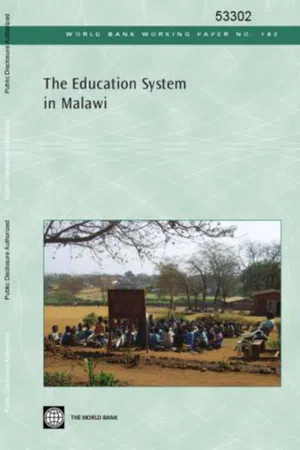
The Education System in Malawi
About this book
Information
Topic
EducationSubtopic
Education AdministrationTable of contents
- Contents
- Foreword from the Minister of Education, Government of Malawi
- Foreword from the World Bank
- Acknowledgments
- Acronyms and Abbreviations
- Executive Summary
- 1. Demographics, Social Development, and Macroeconomic Conditions
- 2. Enrollment Patterns
- 3. Education Expenditure and Financing
- 4. Internal Efficiency, Learning Outcomes, and Management Issues
- 5. Equity and Disparities
- 6. Technical, Entrepreneurial, and Vocational Education and Training
- 7. Higher Education
- 8. External Efficiency
- Appendixes
- Appendix 9: Tracer Study of TEVET and Higher Education Completers
- Part I: General Background
- Part II: Higher Education Tracer Study
- Part III: TEVET Tracer Study
- Part IV: Final Remarks
- References
- Table 1: STR in Public Schools by Level of Education (2007)
- Table 2: Higher Education Teachers’ Average Salary, as Units of GDP Per Capita for Countries with GDP per Capita Lower than US$500 (2007 or last year available)
- Table 3: Annual Average Income and Expected Annual Income According to Level of Education
- Table 1.1: Evolution in Real GDP Growth, Inflation, and Exchange Rate (MK/US$)
- Table 1.2: Evolution in Total Government Revenue and Expenditure and Deficit
- Table 1.3: GDP Per Capita and Domestic Resources as a Percentage of GDP for SADC Countries (ca. 2006)
- Table 1.4: Annual External Aid for Education as Percentage of GDP (2004–2006 Average)
- Table 2.1: Enrollment Trends per Education Level (1998–2007)
- Table 2.2: Schooling Coverage by Level of Education (2000–2007)
- Table 2.3: International Comparison on GER (SADC countries)
- Table 2.4: Percent of Repeaters in Primary Education According to Different Data Sources (in %)
- Table 2.5: Construction of Survival Profile
- Table 2.6: Share of Schools and Pupils According to the Number of Standards Supplied
- Table 2.7: Percentage of Pupils Who Cannot Continue on to the Next Standard in the Same School, 2006–07 (in %)
- Table 2.8: Main Reasons for Dropping Out of School Declared by School Heads (in %)
- Table 2.9: Main Reasons for Dropping Out of School, Declared by Pupils (in %)
- Table 3.1 Education Public Recurrent Expenditure
- Table 3.2: Percentages for Education in Public Recurrent Expenditure, SADC countries
- Table 3.3: Breakdown of Total Public Recurrent Expenditure by Nature of Spending and by Level of Education (in %)
- Table 3.4: Breakdown of Public Recurrent Expenditure (revised 07/08 budget) by level of Schooling
- Table 3.5: Distribution of Recurrent Expenditure by Level of Schooling, SADC Countries, (2008 or last year available)
- Table 3.6: Public Recurrent Unit Costs by Level of Schooling
- Table 3.7: Primary and Secondary Public Recurrent Unit Costs, SADC Countries (2007 or last year available)
- Table 3.8: Higher Education Teachers’ Average Salary, as Units of GDP Per Capita for Countries with GDP per Capita Lower than US$500 (2007 or last year available)
- Table 3.9: Student-Teacher Ratios in Public Schools, 2007
- Table 3.10: Estimated Breakdown of the Household Expenditure by Level of Education and Household Unit Costs, 2007
- Table 3.11: Decomposition of Household Education Expenditure (in %)
- Table 3.12: Cross-country Comparison of Distribution of Household Education Expenditure
- Table 3.13: Share of Education in Household Expenditure by Quintile of Household Income
- Table 3.14: Donor Financing and Extra Budgetary Grants to Education (MK Millions)
- Table 3.15: Unit Construction Costs in Primary School Construction (US$)
- Table 4.1: Trend in Repetition Rates by Standard in Primary Schools of All Types (1999 and 2006) (in %)
- Table 4.2: Repetition Rates by Form in Secondary Schools of All Types (2006) (in %)
- Table 4.3: Dropout Rates at the Primary Level in All Types of Schools (1999 and 2006) (in %)
- Table 4.4: Dropout Rates at the Secondary level in All Types of Schools (2006) (in %)
- Table 4.5: Internal Efficiency Coefficient in Primary and Secondary Schooling (1999/00–2006/07)
- Table 4.6: Reading (English) and Mathematics Scores and Percentage of Students Reaching Minimum and Desirable Levels of Reading Mastery (SACMEQ I and II)
- Table 4.7: Leaving School Examination Results at the Primary Level by School Type in % (2006)
- Table 4.8: JCE and MSCE Examination Results (2006)
- Table 4.9: JCE and MSCE Examinations Pass Rates by School Types in % (2006)
- Table 4.10: Determinants of PSLE Results at the National Level (2006)–Marginal Effect
- Table 4.11: Determinants of MSCE Results at the National Level (2006)–Marginal Effect
- Table 4.12: Teacher Status by Location (in %), Government-Funded Primary Schools (2007)
- Table 4.13: Teacher Distribution by Gender and Location (in %), Government-Funded Primary Schools (2007)
- Table 4.14: Teacher Qualifications and Training Status by Location and Gender (in %), Government-Funded Primary Schools (2007)
- Table 4.15: Types of Training among Trained Teachers (in %), Government-Funded Primary Schools (2007)
- Table 4.16: Reasons for Attrition among Government-Funded Primary Schools
- Table 4.17: STR by Location in All Government-Funded Schools (1999 and 2007)
- Table 4.18: STRs and Class Size, Standards 1–8, in Government-Funded Public Schools (2000 and 2007)
- Table 4.19: Degree of Randomness at Division Level, Government-Funded Schools (2007)
- Table 4.20: Book Allocation by Standards in Government-Aided Schools (2007)
- Table 4.21: Book Allocation Coherence by Standards in Government-Aided Schools (2007) (in %)
- Table 4.22: Teacher Characteristics in Government-Funded Secondary Schools by Type of School (2007) (in %)
- Table 4.23: Teacher Attrition by Reason at the Secondary Level (2007)
- Table 4.24: STR by Types of Schools and Location, Government-Funded Secondary Schools (2007)
- Table 4.25: Recap of the Funds Allocated to Secondary Schools
- Table 4.26: Relationship between the Wage Unit Cost and the Number of Students at the Primary Level
- Table 4.27: Relationship between the Wage Unit Cost (Teachers Only) and the Number of Students at the Secondary Level
- Table 5.1: Social Structure by Highest Level of Education and Comparison Group, 5–24 Years Old (in %)
- Table 5.2: Gender Parity Indexes at Different Education Levels, 2000–2007
- Table 5.3: Percentage of Pupils Reaching Minimum and Desirable Levels of Reading Mastery (SACMEQ II)
- Table 5.4: Leaving School Examination Results at the Primary Level by Gender (2006)
- Table 5.5: JCE and MSCE Examination Results at the Secondary Level by Gender (2006)
- Table 5.6: Differences of Access and Completion Rates in Primary and Secondary Education
- Table 5.7: Survival Rates and Transition Across Levels (in %)
- Table 5.8: Percentage of Pupils Reaching Minimum and Desirable Levels of Reading Mastery (SACMEQ II)
- Table 5.9: Distribution of Public Education Spending According to the Highest Level Attended (Pseudo-Cohort of 100 Children)
- Table 5.18: Benefit Incidence
- Table 6.1: Synopsis of Different TEVET Provider Types in Malawi
- Table 6.2 Number of Regular and Parallel Students in Technical Colleges (2007)
- Table 6.3: Sources of TEVET Funding by Training Provider System
- Table 6.4: Total Public Spending for TEVET 2007/08 (MK)
- Table 6.5: Summary per Trainee of Public Allocations to TCs, 2007/08
- Table 6.6: Expenditure in TC 2007/08 (Revised Budget) by Subprograms (in %)
- Table 6.7: TEVETA Income from 2003–2007 (MK)
- Table 6.8: TEVETA Expenditure Structure 2002/03 to 2006/07 (in %)
- Table 6.9: Qualifications of Teachers in TCs (2007)
- Table 7.1: Enrollment, Actual Number, and Number per 100,000 Inhabitants
- Table 7.2: Fields of Study (2008)
- Table 7.3: Postgraduate Students by Fields of Study and College (2008)
- Table 7.4: Comparison of Fees in Public and Private Universities (in MK)
- Table 7.5: Surplus and Deficit in Expenditures
- Table 7.6a: Unit Cost Per Expenditure Category: UNIMA (in MK)
- Table 7.6b: Unit Cost per Expenditure Category: MZUNI (in MK)
- Table 7.7: Staff Profile in Public and Private Universities
- Table 7.8: Qualifications of Staff in Public Institutions
- Table 7.9: Student/Staff Ratios for 2008
- Table 7.10: Cumulative University Graduate Output (2003–2007)
- Table 7.11: Enrollment of Women by Fields of Study (2008)
- Table 8.1: Simulated Net Impact of Education on Social Behaviors in Malawi
- Table 8.2: Impact of a Mother’s Education on Various Adult Behaviors (Share for the Different Cycles) (in %)
- Table 8.3: Distribution of Workforce by Level of Education and Type of Employment in Percentages for 15-years-old and Over (2004)
- Table 8.4: Annual Average Income and Expected Annual Income According to Level of Schooling
- Table 8.5: Months Needed by HE Graduates to Properly Carry out Professional Tasks
- Table 8.7: Employment Status of TEVET Completers
- Table 8.8: Employment (of All Kinds) Rate of TEVET Graduates or Leavers, Aged 25–34 and 35–59 in Different African Countries (in %)
- Table 8.9: Position of TEVET Completers at First Employment and Time of Study (in %)
- Table 8.10: Private and Social Rates of Return to Education
- Table 8.11: ROR in Malawi Compared to Selected Other African Countries
- Table 8.12: Percentage of Firms that Report Labor Regulations and Skill Levels of Workers as a Major or Severe Constraint in Malawi
- Table 1A.1: 5-16-Year-Old Population as % of Total, SADC Countries (2008)
- Table 1A.2: Population Living Below Poverty Lines and Gini Index (2005 or Closest Year) (in %)
- Table 1A.3: Orphans (0–17 Years) Due to AIDS, SADC Countries (2007)
- Table 1A.4: African Context Indexes
- Table 1A.5: Other Social Development Indicators
- Table 2A.1: Outreach Population by Literacy Programs
- Table 2A.2: Expected School-Age Population for 2006 and 2007, NSO Projections
- Table 2A.3: Differences of Estimates (2006)
- Table 2A.4: Comparison of Some Schooling Indicators According to the Sources of Data Used for the Population Estimates (2006)
- Table 2A.5: Evolution of Gross Intake Rate (Access Rate to Standard 1) since 2000
- Table 2A.6: Model for Access Rate to Standard 1 Using Household Survey Data
- Table 2A.7: Main Reason Declared for Having Never Attended School (in %)
- Table 2A.8: Results of Econometric Model Explaining Retention Rate at the School Level
- Table 2A.9: ASR and School-Life Expectancy Calculation for Malawi (2007)
- Table 2A.10: School Life Expectancy, Recurrent Expenditure for Education as a Share of GDP and Index, Low-Income African Countries (2007 or closest Year)
- Table 3A.1: Methodology of Recalibration to a 6–7 Year Duration Structure
- Table 3A.2: Recalibration of Malawian 2008 Recurrent Expenditure Data
- Table 3A.3: Breakdown of Public Recurrent Expenditure in Higher Education, African Countries (2007 or last year available)
- Table 3A.4: Primary Education Salaries
- Table 3A.5: Secondary Education Salaries
- Table 4A.1: Degree of Randomness (1 – R2) in Public Teacher Allocations in Various African Countries (2002–2007)
- Table 4A.2: Reading and Mathematics Skill Levels
- Table 4A.3: Correlates of PSLE Results at National Level (2006)—Basic Statistics
- Table 4A.4: Correlates of MSCE Results at National Level (2006)—Basic Statistics
- Table 4A.5: Some Characteristics of CSSs and CDSSs
- Table 4A.6: Consistency of Teacher Allocation across Government-Funded Primary Schools at District Level (2007)
- Table 4A.7: Consistency in Book Allocation across Government-Funded Primary Schools, by Divisions: R2 Analysis
- Table 5A.1: Repetition Rate Trends by Standard in Primary, 1999 and 2006 (All Types of Schools)
- Table 5A.2: Repetition Rates by Form in Secondary, 2007 (All Types of Schools)
- Table 5A.3 Dropout Rates in Primary By Gender, 1999 and 2006 (All Types of Schools)
- Table 5A.4 Dropout Rates in Secondary by Gender, 2006 (All Types of Schools)
- Table 5A.5: GER and PCR for the 28 Administrative Districts (2007)
- Table 5A.6: Leaving School Examination Results at the Primary Level by School Types, Location, Division and Gender (2006)
- Table 5A.7: JCE and MSCE Examination Pass Rates by School Types, Location, Division, and Gender (2006)
- Table 5A.8: Access Rates to Standard 8 and GER, According to Education Division and Gender
- Table 5A.9: Access Rates to Different Forms and GER on Secondary Education, According to Region, Education Division, and Gender
- Table 5A.10: Probability of Enrollment in Standards 1–8 of Primary School, by District
- Table 5A.11: Probability of Enrollment in Forms 1–4 of Secondary School, by District
- Table 6A.1: Number of Regular and Parallel Students in Technical Colleges (2007)
- Table 6A.2: Records of the TEVET Provider Directory 1999
- Table 6A.3: Enrollment in Regular Apprenticeship Programs (2003–2007)
- Table 6A.4: Female Participation in TEVETA-Sponsored Courses by Applications, Short Listing, and Enrollment from 2001 to 2008
- Table 6A.5: Girls’ Participation in Malawi Craft and Malawi Advanced Craft Examinations (in %)
- Table 6A.6: Expenditure in Public Technical Colleges 2007/08 (Revised Budgeted) by Subprograms (in %)
- Table 6A.7: Budget Execution Rates for Technical Colleges (2005/06)
- Table 6A.8: TEVETA Expenditure 2002/03–2006/7, in ’000 MK
- Table 6A.9: Examination Fees for Malawian Qualification
- Table 6A.10: Calculation of Private Cost (Tuition Fees, Boarding, Testing Fees) for Formal TEVET in Technical Colleges (Prices as of 2008)
- Table 6A.11: Synopsis of Programs Offered and Qualifications Achieved in the Malawian TEVET Environment
- Table 6A.12: STR in Technical Colleges (2007)
- Table 6A.13: Trade Test Participation by Grade
- Table 6A.14: Trade Testing Candidates by Trade and Gender (2003–2008)
- Table 6A.15: Trade Testing Pass Rate by Type of Institution
- Table 7A.1: Categories of Expenditure as Percentage of Total Expenditure: UNIMA
- Table 7A.2: Categories of Expenditure as Percentage of Total Expenditure: MZUNI
- Table 7A.3: Categories of Expenditure as Percentage of Total Expenditure: Livingstonia
- Table 7A.4: Categories of Expenditure as Percentage of Total Expenditure: Catholic
- Table 7A.5: Enrollments in Higher Education by Gender
- Table 7A.6: Sources of Income for UNIMA
- Table 7A.7: Percentages of Sources of Income for UNIMA
- Table 7A.8: Sources of Income for MZUNI
- Table 7A.9: Percentages of Sources of Income for MZUNI
- Table 7A.10: UNIMA Actual Expenditure: 2003/04 to 2006/07
- Table 7A.11: MZUNI Actual Expenditure: 2003/04 to 2006/07
- Table 7A.12: Unit Cost by Institution
- Table 7A.13: Percentage of Females in Postgraduate Studies
- Table 8A.1: Mincerian Earning Function of Malawi (2004)
- Table 8A.2: Job Sector of Employed People According to Their Education Level, 15+Years Old
- Table 8A.3: Means of Variables Other Than the Highest Grade Completed
- Table 8A.4: Logarithm of Annual Income According to Education Level
- Table 8A.5: Expected Income According to Education Level, 15+ Years Old
- Table 8A.6: Schooling Duration, Unit Cost, and Rates of the Different Education Levels
- Table 8A.7: Mean Income by Education Level as Units of GDP per Capita in Selected African Countries
- Table 8A.8: Expected Annual Income by Job Sector Taking into Account Unemployment Risk (MK)
- Sampling Frame
- Table A9.1: Rating of Study Condition and Provision
- Table A9.2: General Satisfaction with Studies
- Table A9.3: Rating Usefulness of Studies
- Table A9.4: Occupational Situation after Graduation and Present (in %)
- Table A9.5: Extent of Use of Qualification
- Table A9.6: Degree of Abilities and Knowledge of the Graduates
- Table A9.7: Extent of Appropriateness of Professional Situation
- Sampling Frame
- Table A9.8: Type and Grade of Qualification
- Table A9.9: Duration of Training Courses
- Table A9.10: Changes as Result of Program/Course
- Table A9.11: Weaknesses of Program/Course
- Table A9.12: Current Employment Status
- Table A9.13: Duration of Employment Seeking
- Table A9.13: Level of Position
- Table A9.14: Number of Employees
- Table A9.15: Relative Risk of Unemployment for High Risk Groups
- Table A9.16: Mean Income by Positional Level
- Table A9.17: Mean Income by Occupational Status
- Table A9.18: Mean Income by Way of Getting Skills
- Table A9.19: Mean Income by Field of Occupation
- Table A9.20: Mean Income by Type and Level of Certificates
- Table A9.21: Degree of Abilities and Knowledge of TEVET Completers by Type and Level
- Figure 1: Educational Pyramids for Malawi and Sub-Saharan Africa
- Figure 2: Access Rate to Each Grade (2007)
- Figure 3: SACMEQ Scores in English and Mathematics (SACMEQ II)
- Figure 4: Teacher Allocation in Government-Funded Schools (2007)
- Map 1a: STR at the District Level
- Map 1b. SqTR at the District Level
- Figure 5: Access Rates to the Different Grades According to Wealth Index
- Figure 6: Share of Public Education Expenditure for the 10 Percent Most Educated, Africa Region
- Map 2a: Primary Completion Rates by District
- Map 2b: Secondary Completion Rates by District
- Figure 7: Evolution of the Distribution of Recurrent Expenditure by Level of Schooling
- Figure 8: Contribution of Public Financing by Level of Education (2007)
- Figure 9: Flows of Funds to TEVET
- Figure 10: Number of Higher Education Students per 100,000 Inhabitants in Sub-Saharan Africa
- Figure 11: Higher Education Public Recurrent Unit Costs (2007 or last year available)
- Figure 12: Job Insertion Rate (Modern Sector Only) of Higher Education Leavers
- Figure 13: Mean Income by Education Level in Relation to GDP Per Capita
- Figure 14: Unmet Labor Demand as a Percentage of Employed in Selected TEVET Occupations
- Figure 1.1: Trends and Projections of School-Age Populations (1998–2018)
- Figure 1.2: Evolution in Real GDP Per Capita (1987–2008)
- Figure 2.1: Cross-Sectional Schooling Profile with Revised Repetition Structure from IHS-2
- Figure 2.2: International Comparison for Gross Intake Rate and Primary Completion Rate (Access Rate to Grade 6 to Be Comparable Across Countries)
- Figure 2.3: Percentage of People Who Have Ever Attended Primary School (by Age)
- Figure 2.4: Probalistic Schooling Profile
- Figure 2.5: Evolution of Survival Profile in Primary and Secondary Education, 2003–2007
- Figure 2.6: Educational Pyramid for Malawi (2007)
- Figure 2.7: Educational Pyramid for Sub-Saharan Africa (2005/06)
- Figure 3.1: Domestic Resources as a Percentage of GDP and Budget Allocation Towards Education, SSA Countries
- Figure 3.2: Evolution of the Distribution of Recurrent Expenditure by Level of Schooling
- Figure 3.3: Distribution of Recurrent Expenditure by Level of Schooling, SADC Countries, (2008 or Last Available Year)
- Figure 3.4: Higher Education Public Recurrent Unit Costs, Sub-Saharan Countries (2007 or last year available)
- Figure 3.5: Contribution of Public Financing by Level of Education (2007)
- Figure 4.1: Repetition Rate at Primary and Secondary Levels in SADC Countries (2006 or Closest Year) (in %)
- Figure 4.2: Percentage of Students Reaching Literacy and Mathematics Competency Levels in Malawi (SACMEQ II)
- Figure 4.3: Mean for the Reading and Mathematics Test Scores of Learners in All SACMEQ Countries (SACMEQ II)
- Figure 4.4: STR at the Primary Level, SADC Countries (2006 or Closest Year)
- Figure 4.5: Teacher Allocation in Government-Funded Schools (2007)
- Figure 4.6: STRs by Location (1999 and 2007)
- Figure 4.7: STR in Government-Funded Primary Schools, by Division (2000 and 2007)
- Map 4.1a: STR at the District Level
- Map 4.1b: SqTR at the District Level
- Figure 4.8: Relationship between the Wage Unit Cost and the Number of Students (School Level) at the Primary Level
- Figure 4.9: Relationship between the Unit Cost (for Teachers and All School Staff) and the Number of Students at the Secondary Level
- Figure 4.10: Relation between PSLE Results and Spending on Cost per Student at the Primary Level (Government-Funded Schools)
- Figure 5.1: Access to and Completion of the Different Levels by Gender
- Figure 5.2: Access to and Completion of the Different Levels by Wealth Quintile
- Figure 5.3: Access Probability to the Different Grades According to Living Area
- Figure 5.4: PCR Urban /PCR Rural in Some African Countries
- Figure 5.5: Regional Disparities
- Map 5.1a: Access Rate to S1 by District
- Map 5.1b: Primary Completion Rate by District
- Maps 5.2a: Access Rate to Form 1 by District
- Map 5.2b: Secondary Completion Rate by District
- Figure 5.6: Education Lorenz Curve
- Figure 5.7: Share of Public Resources for the 10 percent Most Educated, African Countries
- Figure 6.1: Number of Formal Apprentices Recruited
- Figure 6.2: TEVET Students per 100,000 Inhabitants in Selected SADC Countries
- Figure 6.3: Female Participation in Malawi (Advanced) Craft Examinations (2003–2007)
- Figure 6.4: Malawi Craft Pass Rates by Gender and Year
- Figure 6.5: Poverty and TEVET Admission by District (2005 Compared to 2008)
- Figure 6.6: Pass Rates for MC and MAC Examinations by Trades (2003–2007)
- Figure 6.7: STRs in TCs for Regular Programs and Total Enrollment (2007)
- Figure 7.1: Enrollments in Higher Education in Malawi (2003–2008)
- Figure 7.2: Percentage of Non-Residential Students (2003–2008)
- Figure 7.3: Postgraduate Students in the Total Enrollment (% of)
- Figure 7.4: Sources of Income for UNIMA Colleges and Central Office (2004/05–2007/08)
- Figure 7.5: Sources of Income for MZUNI: 2002/03–2004/05
- Figure 7.6: Unit Cost (in relation to GDP Per Capita
- Figure 7.7: Trends in Graduate Output by Institution by Year
- Figure 7.8: Trends in Graduate Output by Field of Study
- Figure 7.9: Masters Graduates by Gender and by Institution (2003–2008)
- Figure 8.1: Relations between Education, Income, and Behavior
- Figure 8.2: Mean Income by Level of Education in Relation to GDP per Capita (in %)
- Figure 8.3: Occupational Situation of HE graduates by Field of Study
- Figure 8.4: Employment Rate (Modern Sector Only) of Higher-Education Leavers in Different Age Groups in Different African Countries
- Figure 8.5: Mean Monthly Income of HE Graduates by Field of Study, Degree, and Work Situation
- Figure 8.6: Duration of Job Search of TEVET Completers: Findings from Two Tracer Studies (2008) (in %)
- Figure 8.7: Net Income per Month of TEVET Graduates (MK)
- Figure 8.8: Level of Position of TEVET Graduates in Employment (in %)
- Figure 8.9: Mean Monthly Net Income of TEVET Completers
- Figure 8.10: Distribution of Employed by Economic Sector
- Figure 8.11: Unmet Labor Demand as a Percentage of Employed in Selected TEVET Occupations (in %)
- Map 1A.1: Population Density by District (2008)
- Figure 2A.1: Structure of the Education System in Malawi
- Figure 2A.2: Enrollment Trends in Primary Education (in Thousands)
- Figure 2A.3: Enrollment Trends in Secondary Education Since 2000, by Provider (in Thousands)
- Figure 2A.4: Projections of the Malawian Population, Based on the 1998 National Census (1999–2023)
- Figure 2A.5: Projections of Single-Age Population
- Figure 2A.6: Population Projections for the Rural Blantyre District
- Figure 2A.7: Single-Age Population for Malawi in 2006 According to MICS Data
- Figure 2A.8: Projections of Malawian Population, Compared to the UN and NSO
- Figure 2A.9: Malawian Population per Age for 1998, Comparison between NSO and UN
- Figure 2A.10: Malawian Population Projections per Single Ages, According to the UN
- Figure 2A.11: Difference between the Two Estimates (2007)
- Figure 2A.12: Cross-Sectional Schooling Profile, School Year 2006 and 2007
- Figure 2A.13: Educational Pyramid
- Figure 2A.14: International Comparison on School-Life Expectancy (2007 or Closest Year)
- Figure 2A.15: School Life Expectancy and Current Expenditure for Education as a Share of GDP for Some Low Income African Countries (2007 or Closest Year)
- Figure 3A.1: Teachers’ Average Salary (Primary and Secondary) as Units of GDP Per Capita for Countries with GDP Per Capita Lower than US$500 (2007 or last year available)
- Figure 3A.2: Public Recurrent Expenditure Excluding Teachers’ Salaries As a Percentage of Total Recurrent Expenditure (Primary Education) (2007 or last year available)
- Figure 3A.3: Household Education Expenditure As a Percentage of GDP
- Figure 3A.4: Education Household Expenditure as a Percentage of Total Household Expenditure
- Figure 3A.5: Evolution of Budget Allocation to ECD and Adult Literacy (in MK Millions)
- Figure 4A.1: Trend of Repetition Rates by Cycle (2000–2006)
- Figure 4A.2: Student Flow Efficiency Index in Various SADC Countries, (2006 or Closest Year)
- Figure 4A.3: Internal Efficiency Coefficient (IEC) in SADC Countries (2006 or Closest Year)
- Figure 4A.4: Consistency of Allocation of ORT at the Primary Level According to Enrollment at the District Level (2007/08)
- Figure 4A.5: Teacher Allocation in All Secondary Publicly Funded Schools (2007)
- Figure 4A.6: Coherence on Allocation of ORT Funds at the Secondary School Level (For Cost Center Schools and Grant-Aided Secondary Schools)
- Figure 4A.7: Relation between JCE Results and Spending on Cost of Salaries per Student at the Secondary Level (Government-Funded Schools)
- Figure 4A.8: Relation between MSCE Results and Spending on Cost of Salaries per Student at the Secondary Level (Government-Funded Schools)
- Figure 5A.1: Urban Completion Rate/Rural Completion Rate for Lower Secondary in Some African Countries (ca. 2007)
- Figure 6A.1: TEVET Public Recurrent Unit Cost as a Percentage of GDP per Capita in Selected African Countries
- Figure 6A.2: Trade-Testing Candidates by Training Background and Year
- Figure 6A.3: Trade Test Candidates by Gender and Year (2003–2008)
- Figure 6A.4: Trade Testing Pass Rates by Gender (2003–2008)
- Figure 7A.1: Comparison of Enrollments per 100,000 Inhabitants in SSA
- Figure 7A.2: Percent of Sources of Income for UNIMA Colleges and Central Office (2004/05–2007/0)
- Figure 7A.3: Percent of Sources of Income for UNIMA Colleges and Central Office (2004/05–2007/08)
- Figure 7A.4: Percentage of Female Enrollment by Type of Institution
- Figure 7A.5: Comparison of Average Annual Change in Enrollments per 100,000 Inhabitants
- Figure 7A.6: Enrollment by Institution: 2003–2008
- Figure 7A.7: Postgraduate Enrollments by Field of Study (2003–2008)
- Figure 7A.8: Education Expenditure in Tertiary as a Percentage of Total Education Expenditure
- Figure 7A.9: Student/Lecturer Ratios for Selected SSA Countries (2006)
- Figure 7A.10: Percentage of Females Enrolled in Fields of Study
- Figure 8A.1: Duration of Job Search after Leaving University, HE Grads/Dropouts
- Figure 8A.2: Probability of Antenatal Care According to Education Level (in %)
- Figure 8A.3: Probability of Using Iron Tablets During Pregnancy, According to Education Level (in %)
- Figure 8A.4: Probability for Women to Be Assisted at Delivery, According to Education Level (in %)
- Figure 8A.5: Probability of Using Anti-Malaria Treatments for Children Under the Age of Five (in %)
- Figure 8A.6: Average Woman’s Age at Her First Birth
- Figure 8A.7: Birth Interval (in Years)
- Figure 8A.8: Knowledge about HIV/AIDS (on [0–11] Scale)
- Figure 8A.9: Probability for Women to Be Literate According to Education Level (in %)
- Figure A9.1: Predominant Job Situation since Graduation by Year of Completing
- Figure A9.2: General Satisfaction with Professional Situation (in %)
- Figure A9.3: Gross Income per Month in Malawi Kwacha
- Figure A9.4: Average Income in the First and the Actual Occupation by Cohort
- Figure A9.5: Differences between Graduates from Different Institutions
- Figure A9.6: Reasons for Dropping Out (in %)
- Figure A9.7: Rating of Professional Opportunities in the Next Years (in %)
- Figure A9.8: Rating of Usefulness of Training (in %)
- Figure A9.9: Net Income per Month in Malawi Kwacha (in %)
- Figure A9.10: Differences between Completers from Different Institutions (in %)
- Box 3.1: Why Use the Reference to GDP Per Capita?
- Box 4.1: The Impact of Repetition on Schooling Efficiency
- Box 6.1: More about the TEVET Levy Fund
- Box 6.2: The Malawian TEVET Landscape—A Jungle of Qualifications and Programs
- Box 2A.1: Data Used by the UN Population Unit to Estimate and Project the Population for Malawi
- Box 6A.1: Financial Management Issues in Technical Colleges
Trusted by 375,005 students
Access to over 1.5 million titles for a fair monthly price.
Study more efficiently using our study tools.
Frequently asked questions
Yes, you can cancel anytime from the Subscription tab in your account settings on the Perlego website. Your subscription will stay active until the end of your current billing period. Learn how to cancel your subscription
No, books cannot be downloaded as external files, such as PDFs, for use outside of Perlego. However, you can download books within the Perlego app for offline reading on mobile or tablet. Learn how to download books offline
Perlego offers two plans: Essential and Complete
- Essential is ideal for learners and professionals who enjoy exploring a wide range of subjects. Access the Essential Library with 800,000+ trusted titles and best-sellers across business, personal growth, and the humanities. Includes unlimited reading time and Standard Read Aloud voice.
- Complete: Perfect for advanced learners and researchers needing full, unrestricted access. Unlock 1.5M+ books across hundreds of subjects, including academic and specialized titles. The Complete Plan also includes advanced features like Premium Read Aloud and Research Assistant.
We are an online textbook subscription service, where you can get access to an entire online library for less than the price of a single book per month. With over 1.5 million books across 990+ topics, we’ve got you covered! Learn about our mission
Look out for the read-aloud symbol on your next book to see if you can listen to it. The read-aloud tool reads text aloud for you, highlighting the text as it is being read. You can pause it, speed it up and slow it down. Learn more about Read Aloud
Yes! You can use the Perlego app on both iOS and Android devices to read anytime, anywhere — even offline. Perfect for commutes or when you’re on the go.
Please note we cannot support devices running on iOS 13 and Android 7 or earlier. Learn more about using the app
Please note we cannot support devices running on iOS 13 and Android 7 or earlier. Learn more about using the app
Yes, you can access The Education System in Malawi by World Bank in PDF and/or ePUB format, as well as other popular books in Education & Education Administration. We have over 1.5 million books available in our catalogue for you to explore.