The great recession of 2008-9 caused a negative shock to the global economy that is comparable with the great depression of the 1930s. The major advanced nations experienced painful economic contraction, severe dislocation to industrial production and sharp spikes in unemployment. Trade flows collapsed across all the regions of the world. The rest of this introductory chapter proceeds as follows. Next, the report provide a more detailed timeline and summary of events in the great recession, including its macroeconomic and trade impacts, the uncertainty over trade policy in 2008-9, and the response to calls for additional monitoring of trade policy. In particular, section one highlight the real time monitoring efforts of the World Bank's global antidumping database and subsequent temporary trade barriers (TTBs) database. These contributions have addressed some of the immediate concern about the unknown scale of protectionism taking place in 2008-9, but they have also revealed a lack of informational preparedness that has ultimately spurred this volume's research. In section two, the author introduce a relatively simple methodological framework to improve intertemporal assessment of the scope of TTB use, an approach that many of the volume's chapters adopt or modify to construct better measures of the 'stock' and 'flow' of imported products that countries subject to TTBs. (A more technical description of the methodology is provided in the Appendix (section six), along with details of the many common data sources used across the subsequent chapters.) What are the empirical results? Section three provides a simple application of this methodology and finds that, during the crisis, these economies collectively increased by 25 percent the imported products that they subjected to TTB import protection. Nevertheless, it turns out this collective expansion in TTB coverage during 2008-9 was dominated by emerging economies. Developing countries used TTBs to cover 39 percent more imported products by the end of 2009 compared with 2007, whereas recession-ravaged high-income economies surprisingly increased their coverage by only 4 percent. However, it is also clear from the data that understanding these crisis changes demands recognition of longer term trends. Thus, given these high-level results, Section 4 turns to a number of common questions that the subsequent chapters investigate, on an economy-by-economy basis, in more detail. This section provides a short preview of how the volume's authors subsequently address these questions by placing the trade policy changes of 2008-9 into historical context. Section five then concludes.
eBook - PDF
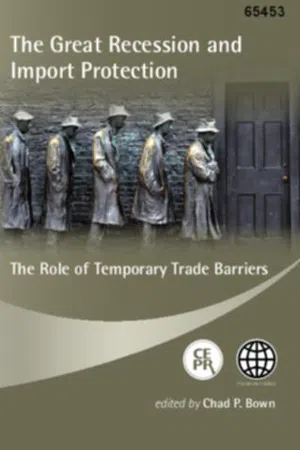
The Great Recession and Import Protection
The Role of Temporary Trade Barriers
- 491 pages
- English
- PDF
- Available on iOS & Android
eBook - PDF
About this book
Information
Subtopic
International EconomicsIndex
EconomicsTable of contents
- Bown-CEPR-final
- Bown-CEPR-rear-cover
Trusted by 375,005 students
Access to over 1.5 million titles for a fair monthly price.
Study more efficiently using our study tools.
Frequently asked questions
Yes, you can cancel anytime from the Subscription tab in your account settings on the Perlego website. Your subscription will stay active until the end of your current billing period. Learn how to cancel your subscription
No, books cannot be downloaded as external files, such as PDFs, for use outside of Perlego. However, you can download books within the Perlego app for offline reading on mobile or tablet. Learn how to download books offline
Perlego offers two plans: Essential and Complete
- Essential is ideal for learners and professionals who enjoy exploring a wide range of subjects. Access the Essential Library with 800,000+ trusted titles and best-sellers across business, personal growth, and the humanities. Includes unlimited reading time and Standard Read Aloud voice.
- Complete: Perfect for advanced learners and researchers needing full, unrestricted access. Unlock 1.5M+ books across hundreds of subjects, including academic and specialized titles. The Complete Plan also includes advanced features like Premium Read Aloud and Research Assistant.
We are an online textbook subscription service, where you can get access to an entire online library for less than the price of a single book per month. With over 1.5 million books across 990+ topics, we’ve got you covered! Learn about our mission
Look out for the read-aloud symbol on your next book to see if you can listen to it. The read-aloud tool reads text aloud for you, highlighting the text as it is being read. You can pause it, speed it up and slow it down. Learn more about Read Aloud
Yes! You can use the Perlego app on both iOS and Android devices to read anytime, anywhere — even offline. Perfect for commutes or when you’re on the go.
Please note we cannot support devices running on iOS 13 and Android 7 or earlier. Learn more about using the app
Please note we cannot support devices running on iOS 13 and Android 7 or earlier. Learn more about using the app
Yes, you can access The Great Recession and Import Protection by Chad P. Bown in PDF and/or ePUB format, as well as other popular books in Economics & International Economics. We have over 1.5 million books available in our catalogue for you to explore.