Since Schumpeter, economists have argued that vast productivity gains can be achieved by investing in innovation and technological catch-up. Yet, as this volume documents, developing country firms and governments invest little to realize this potential, which dwarfs international aid flows. Using new data and original analytics, the authors uncover the key to this innovation paradox in the lack of complementary physical and human capital factors, particularly firm managerial capabilities, that are needed to reap the returns to innovation investments. Hence, countries need to rebalance policy away from R&D-centered initiatives – which are likely to fail in the absence of sophisticated private sector partners – toward building firm capabilities, and embrace an expanded concept of the National Innovation System that incorporates a broader range of market and systemic failures. The authors offer guidance on how to navigate the resulting innovation policy dilemma: as the need to redress these additional failures increases with distance from the frontier, government capabilities to formulate and implement the policy mix become weaker. This book is the first volume of the World Bank Productivity Project, which seeks to bring frontier thinking on the measurement and determinants of productivity to global policy makers.
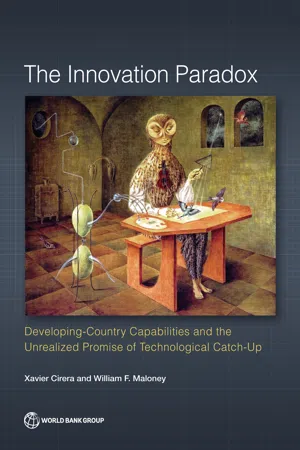
eBook - PDF
The Innovation Paradox
Developing-Country Capabilities and the Unrealized Promise of Technological Catch-Up
- 217 pages
- English
- PDF
- Available on iOS & Android
eBook - PDF
The Innovation Paradox
Developing-Country Capabilities and the Unrealized Promise of Technological Catch-Up
About this book
Information
Topic
Negocios y empresaSubtopic
Desarrollo empresarialTable of contents
- Cover
- Title
- Copyright
- Contents
- Foreword
- Preface
- Acknowledgments
- Abbreviations
- Executive Summary
- 1. The Innovation Paradox
- PART I: Understanding Innovation in Developing Countries
- PART II: Government Capabilities and Policy
- Boxes
- Figures
- Tables
Trusted by 375,005 students
Access to over 1.5 million titles for a fair monthly price.
Study more efficiently using our study tools.
Frequently asked questions
Yes, you can cancel anytime from the Subscription tab in your account settings on the Perlego website. Your subscription will stay active until the end of your current billing period. Learn how to cancel your subscription
No, books cannot be downloaded as external files, such as PDFs, for use outside of Perlego. However, you can download books within the Perlego app for offline reading on mobile or tablet. Learn how to download books offline
Perlego offers two plans: Essential and Complete
- Essential is ideal for learners and professionals who enjoy exploring a wide range of subjects. Access the Essential Library with 800,000+ trusted titles and best-sellers across business, personal growth, and the humanities. Includes unlimited reading time and Standard Read Aloud voice.
- Complete: Perfect for advanced learners and researchers needing full, unrestricted access. Unlock 1.5M+ books across hundreds of subjects, including academic and specialized titles. The Complete Plan also includes advanced features like Premium Read Aloud and Research Assistant.
We are an online textbook subscription service, where you can get access to an entire online library for less than the price of a single book per month. With over 1.5 million books across 990+ topics, we’ve got you covered! Learn about our mission
Look out for the read-aloud symbol on your next book to see if you can listen to it. The read-aloud tool reads text aloud for you, highlighting the text as it is being read. You can pause it, speed it up and slow it down. Learn more about Read Aloud
Yes! You can use the Perlego app on both iOS and Android devices to read anytime, anywhere — even offline. Perfect for commutes or when you’re on the go.
Please note we cannot support devices running on iOS 13 and Android 7 or earlier. Learn more about using the app
Please note we cannot support devices running on iOS 13 and Android 7 or earlier. Learn more about using the app
Yes, you can access The Innovation Paradox by Xavier Cirera, William F. Maloney in PDF and/or ePUB format, as well as other popular books in Negocios y empresa & Desarrollo empresarial. We have over 1.5 million books available in our catalogue for you to explore.