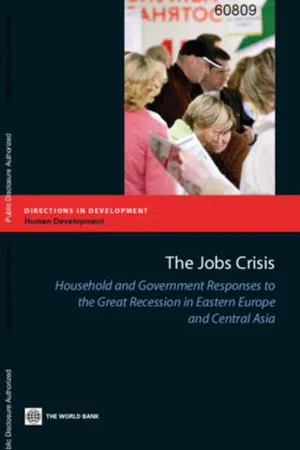
The financial crisis swiftly expanded into an economic crisis throughout America and Western Europe, from where it spread to developing countries that had depended on foreign direct investment, consumer and mortgage credit, trade, and remittances. By early 2009, it was clear that this economic downturn would be more severe than any crisis since the great depression, prompting some to it as the 'great recession.' Eastern European and Central Asian countries were hit particularly hard during 2009, global Gross Domestic Product (GDP) contracted for the first time since Second World War. The financial crisis and the ensuing economic downturn, the worst since the Great Depression in the 1930s, went hand in hand with tightening of credit markets, bank failures, firm closures, and high demand for social safety nets. This report, The jobs crisis: household and Government responses to the great recession in Eastern Europe and Central Asia, brings together evidence that World Bank teams have collected on the impact of the crisis on households and families in Eastern Europe and Central Asia. This report shows how the crisis was felt by Eastern European and Central Asian households. Not only did unemployment rise sharply but it also lasted longer. The report also shows that the pain of the recession was broader, with workers taking home smaller paychecks as firms offered lower wage rates and fewer hours of work to their workers. The jobs crisis finds that households used a variety of ways to cope with the crisis. The jobs crisis presents an account of how governments reacted to the crisis through social policy reforms and initiatives and how such responses could be improved in the future. Unemployment insurance benefits played a particularly important cushioning role, but coverage of the unemployed tended to be limited.
eBook - PDF
The Jobs Crisis
Household and Government Responses to the Great Recession in Eastern Europe and Central Asia
- 136 pages
- English
- PDF
- Available on iOS & Android
eBook - PDF
The Jobs Crisis
Household and Government Responses to the Great Recession in Eastern Europe and Central Asia
About this book
Information
Subtopic
Labour EconomicsIndex
EconomicsTable of contents
- Contents
- Foreword
- Acknowledgments
- Abbreviations
- Overview
- Chapter 1 Introduction
- Chapter 2 Labor Market Impacts
- Chapter 3 Household Coping Mechanisms
- Chapter 4 Social Policy Responses to Protect Households
- Chapter 5 Improving Responses to Subsequent Crises
- References
- Boxes
- Figures
- Tables
Trusted by 375,005 students
Access to over 1.5 million titles for a fair monthly price.
Study more efficiently using our study tools.
Frequently asked questions
Yes, you can cancel anytime from the Subscription tab in your account settings on the Perlego website. Your subscription will stay active until the end of your current billing period. Learn how to cancel your subscription
No, books cannot be downloaded as external files, such as PDFs, for use outside of Perlego. However, you can download books within the Perlego app for offline reading on mobile or tablet. Learn how to download books offline
Perlego offers two plans: Essential and Complete
- Essential is ideal for learners and professionals who enjoy exploring a wide range of subjects. Access the Essential Library with 800,000+ trusted titles and best-sellers across business, personal growth, and the humanities. Includes unlimited reading time and Standard Read Aloud voice.
- Complete: Perfect for advanced learners and researchers needing full, unrestricted access. Unlock 1.5M+ books across hundreds of subjects, including academic and specialized titles. The Complete Plan also includes advanced features like Premium Read Aloud and Research Assistant.
We are an online textbook subscription service, where you can get access to an entire online library for less than the price of a single book per month. With over 1.5 million books across 990+ topics, we’ve got you covered! Learn about our mission
Look out for the read-aloud symbol on your next book to see if you can listen to it. The read-aloud tool reads text aloud for you, highlighting the text as it is being read. You can pause it, speed it up and slow it down. Learn more about Read Aloud
Yes! You can use the Perlego app on both iOS and Android devices to read anytime, anywhere — even offline. Perfect for commutes or when you’re on the go.
Please note we cannot support devices running on iOS 13 and Android 7 or earlier. Learn more about using the app
Please note we cannot support devices running on iOS 13 and Android 7 or earlier. Learn more about using the app
Yes, you can access The Jobs Crisis by World Bank in PDF and/or ePUB format, as well as other popular books in Economics & Labour Economics. We have over 1.5 million books available in our catalogue for you to explore.