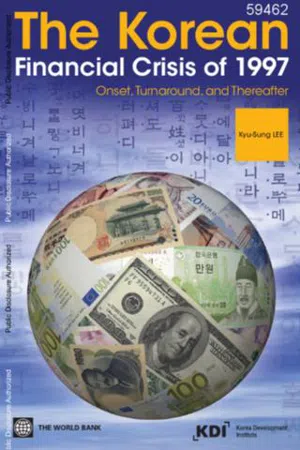
This book chronicles how Korea dealt with and overcame the crisis over time. The book is organized into eleven chapters. Chapter one outlines the troubling financial market conditions at home and abroad before the crisis. Chapter two then delves into the origin of the crisis and offers analyses on the shortcomings of the Korean economy and the instability of the international financial system. In chapter three, policy measures the government executed in the wake of the onset of the crisis are described and analyzed. Chapter four probes the steps taken to reduce the risk of sovereign insolvency in the face of the cool market reaction to the initial package of crisis response measures announced by the International Monetary Fund in December 1997. Chapter five describes the background within which the government established the institutional framework necessary for corporate, financial, and labor market restructuring between December 1997 and April 1998. The government efforts to secure additional foreign currency liquidity through the markets and to devise initiatives to counter the massive unemployment are discussed in detail. In chapter six, the situation during May and June 1998 is explored with a focus on the closure of nonviable corporate and financial companies and the efforts to drive down interest rates and revive credit flows. This is followed, in chapter seven, by an analysis of the first phase of financial sector restructuring, which started in the third quarter of 1998, and the measures adopted to shore up potential growth and cope with the pressing problem of unemployment. Chapters eight and nine deal separately with the restructuring of the top five chaebols (the large family-controlled and family-run groups that dominate business in Korea), the economic stimulus packages applied during the fourth quarter of 1998, the efforts to restore financial market stability and economic growth, and the initial phase of foreign exchange liberalization measures, which were implemented during the first half of 1999. Chapter ten then discusses the situation during the second half of 1999, with a particular focus on the collapse of the Daewoo business group, including the steps taken to contain the resulting fallout, as well as measures aimed at expanding the economic recovery. Chapter eleven, the final chapter, offers a diagnosis of the Korean economy, along with an analysis of the policy implications and the responses for the future.
- 474 pages
- English
- PDF
- Available on iOS & Android
eBook - PDF
About this book
Information
Subtopic
Economic ConditionsIndex
EconomicsTable of contents
- Contents
- Preface
- About the Author
- Abbreviations
- 1 The Unfolding of the Korean Financial Crisis
- 2 Origin of the Crisis
- 3 Overview of Korea’s Postcrisis Responses
- 4 Initial Responses to the Crisis, December 1997
- 5 Securing Foreign Currency Liquidity and Laying the Groundwork for Reform and Restructuring, December 1997–April 1998
- 6 Restructuring Led by Business Closures and the Push for Lower Interest Rates, May–June 1998
- 7 Completion of First-Phase Restructuring and Policies Aimed at Boosting Potential Growth, July–September 1998
- 8 Getting the Economy Back on Track and Quickening the Pace of Restructuring, October–December 1998
- 9 Restoring Financial Stability and Realizing Positive Economic Growth, January–June 1999
- 10 The Settlement of the Daewoo Shock and the Expanded Economic Recovery, July–December 1999
- 11 Korea’s Economic Renewal: Challenges and Solutions for the Transition to the Next Level
- References and Other Sources
- Index
- Figure
- Tables
Trusted by 375,005 students
Access to over 1.5 million titles for a fair monthly price.
Study more efficiently using our study tools.
Frequently asked questions
Yes, you can cancel anytime from the Subscription tab in your account settings on the Perlego website. Your subscription will stay active until the end of your current billing period. Learn how to cancel your subscription
No, books cannot be downloaded as external files, such as PDFs, for use outside of Perlego. However, you can download books within the Perlego app for offline reading on mobile or tablet. Learn how to download books offline
Perlego offers two plans: Essential and Complete
- Essential is ideal for learners and professionals who enjoy exploring a wide range of subjects. Access the Essential Library with 800,000+ trusted titles and best-sellers across business, personal growth, and the humanities. Includes unlimited reading time and Standard Read Aloud voice.
- Complete: Perfect for advanced learners and researchers needing full, unrestricted access. Unlock 1.5M+ books across hundreds of subjects, including academic and specialized titles. The Complete Plan also includes advanced features like Premium Read Aloud and Research Assistant.
We are an online textbook subscription service, where you can get access to an entire online library for less than the price of a single book per month. With over 1.5 million books across 990+ topics, we’ve got you covered! Learn about our mission
Look out for the read-aloud symbol on your next book to see if you can listen to it. The read-aloud tool reads text aloud for you, highlighting the text as it is being read. You can pause it, speed it up and slow it down. Learn more about Read Aloud
Yes! You can use the Perlego app on both iOS and Android devices to read anytime, anywhere — even offline. Perfect for commutes or when you’re on the go.
Please note we cannot support devices running on iOS 13 and Android 7 or earlier. Learn more about using the app
Please note we cannot support devices running on iOS 13 and Android 7 or earlier. Learn more about using the app
Yes, you can access The Korean Financial Crisis of 1997 by Kyu-Sung Lee in PDF and/or ePUB format, as well as other popular books in Economics & Economic Conditions. We have over 1.5 million books available in our catalogue for you to explore.