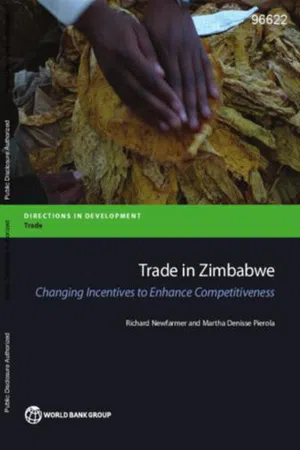
In Zimbabwe trade has been a driver of economic growth, rising incomes, and progressive empowerment of Zimbabweans through rising standards of living and the promise of better jobs. Since 1980, through good years and bad years, increases in exports have been positively associated with increases in national income. Zimbabwe's location and resource base, together with a low-cost but relatively well educated labor force, have endowed it with a naturally high trade ratio built on a diversified base that facilitates using trade as an engine of growth. While trade volumes have rebounded smartly from the deep recession of 2007-2008, these do not offset other worrisome longer-term trends: 1) export growth during the last decade has been lackluster and failed to drive high growth; 2) agricultural exports, other than tobacco, have lost their once dominant role in the region, and are no longer a source of diversification; 3) manufacturing has withered in a continuing secular decline; and 4) Zimbabwe's export basket has become less diversified and more dependent on a narrow range of mineral and, to a lesser extent, agricultural products. In short, exports have become less diversified, less-technologically sophisticated, and less labor-intensive, and ever more dependent on a few large mining activities to provide foreign exchange and employment. This report traces the roots of this poor performance to several policy issues: poor predictability of macroeconomic policy and economic governance has created an unfavorable climate for private investment and trade; a tariff structure that dampens export profitability; industrial policies (indigenization policy in particular) that undermine investor confidence and inhibits private investment; and finally, competition-limiting policies toward services that limit connectivity of Zimbabweans and raise trade costs. The good news arising from the study is that the remedies for these policy shortcomings lie in Zimbabwean hands. If the government were to adopt reforms that reconfigure economy-wide incentives and trade and industrial policies, it could promote sustained growth, economic diversification and empowerment of poor people.
eBook - PDF
Trade in Zimbabwe
Changing Incentives to Enhance Competitiveness
- 169 pages
- English
- PDF
- Available on iOS & Android
eBook - PDF
Trade in Zimbabwe
Changing Incentives to Enhance Competitiveness
About this book
Information
Topic
EconomíaSubtopic
Exportaciones e importacionesTable of contents
- Front Cover
- Contents
- Acknowledgments
- About the Authors
- Abbreviations
- Overview and Summary of Major Conclusions
- Chapter 1 Trade as an Engine of Growth: Patterns, Potential, and Problems
- Chapter 2 Revamping Incentives: Trade Policies
- Chapter 3 Revamping Incentives: Industrial Policy
- Chapter 4 Enhancing Connectivity in Goods Markets
- Chapter 5 Enhancing Connectivity through Services Trade Reform
- Boxes
- Figures
- Tables
Trusted by 375,005 students
Access to over 1.5 million titles for a fair monthly price.
Study more efficiently using our study tools.
Frequently asked questions
Yes, you can cancel anytime from the Subscription tab in your account settings on the Perlego website. Your subscription will stay active until the end of your current billing period. Learn how to cancel your subscription
No, books cannot be downloaded as external files, such as PDFs, for use outside of Perlego. However, you can download books within the Perlego app for offline reading on mobile or tablet. Learn how to download books offline
Perlego offers two plans: Essential and Complete
- Essential is ideal for learners and professionals who enjoy exploring a wide range of subjects. Access the Essential Library with 800,000+ trusted titles and best-sellers across business, personal growth, and the humanities. Includes unlimited reading time and Standard Read Aloud voice.
- Complete: Perfect for advanced learners and researchers needing full, unrestricted access. Unlock 1.5M+ books across hundreds of subjects, including academic and specialized titles. The Complete Plan also includes advanced features like Premium Read Aloud and Research Assistant.
We are an online textbook subscription service, where you can get access to an entire online library for less than the price of a single book per month. With over 1.5 million books across 990+ topics, we’ve got you covered! Learn about our mission
Look out for the read-aloud symbol on your next book to see if you can listen to it. The read-aloud tool reads text aloud for you, highlighting the text as it is being read. You can pause it, speed it up and slow it down. Learn more about Read Aloud
Yes! You can use the Perlego app on both iOS and Android devices to read anytime, anywhere — even offline. Perfect for commutes or when you’re on the go.
Please note we cannot support devices running on iOS 13 and Android 7 or earlier. Learn more about using the app
Please note we cannot support devices running on iOS 13 and Android 7 or earlier. Learn more about using the app
Yes, you can access Trade in Zimbabwe by Richard Newfarmer, Martha Denisse Pierola in PDF and/or ePUB format, as well as other popular books in Economía & Exportaciones e importaciones. We have over 1.5 million books available in our catalogue for you to explore.