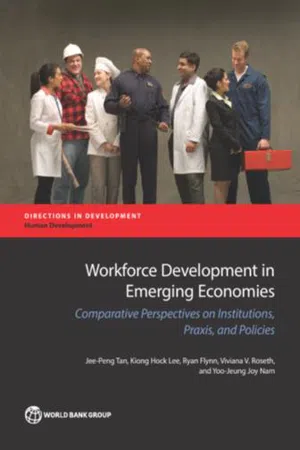
Investing in skills has risen to the top of the policy agenda today in rich and poor countries alike. The World Bank supports its partner countries on this agenda in multiple ways: development finance, research and analysis, global knowledge exchange, and technical assistance. This report was originally conceived as a contribution to this catalog of the World Bank's work, but its topic and findings are relevant to all policy makers and analysts interested in skills-building to drive economic growth and improve human well-being. The book examines workforce development (WfD) systems in emerging economies around the world and presents novel systems-level data generated by the Systems Approach for Better Education Results (SABER)-WfD benchmarking tool, which was created to implement the World Bank's 10-year Education Sector Strategy launched in 2012. A key theme in the book is that WfD entails a multi-layered engagement involving high-level policy makers, system-level managers, as well as leaders at individual institutions. Too often, the conversation and actions are fragmented by intellectual, administrative and operational silos which undermine effective cooperation to solve the deep challenges of building job-relevant skills. The book's findings, based on cross-sectional data for nearly 30 countries and time-series data for five countries, identify successes and common issues across countries in the sample. In lagging countries, the biggest difficulties relate to: forming and sustaining strategic partnerships with employers; ensuring equitable and efficient funding for vocational education; and putting in place mechanisms to enhance training providers' accountability for results defined by their trainees' job market performance. By framing WfD in the broader skills-for-growth context and drawing on lessons from countries where well-designed WfD strategies have helped to drive sustained growth, this book offers clear guidance on how to enable a more effective approach to the inevitably complex challenges of workforce development in emerging economies.
eBook - PDF
Workforce Development in Emerging Economies
Comparative Perspectives on Institutions, Praxis, and Policies
- 119 pages
- English
- PDF
- Available on iOS & Android
eBook - PDF
Workforce Development in Emerging Economies
Comparative Perspectives on Institutions, Praxis, and Policies
About this book
Information
Subtopic
Human Resource ManagementIndex
BusinessTable of contents
- Front Cover
- Contents
- Acknowledgments
- About the Authors
- Executive Summary
- Abbreviations
- Chapter 1 Introduction
- Chapter 2 Education and Skills for Growth in Emerging Economies
- Chapter 3 A Framework and Tool for Dialogue on Workforce Development
- Chapter 4 Data and Highlights from the Application of the SABER-WfD Tool
- Chapter 5 Underpinnings of the Dimension-Level SABER-WfD Scores
- Chapter 6 SABER-WfD and the Agenda for Systems Development
- Appendix A Market and Government Roles in Workforce Development
- Boxes
- Figures
- Table
Trusted by 375,005 students
Access to over 1.5 million titles for a fair monthly price.
Study more efficiently using our study tools.
Frequently asked questions
Yes, you can cancel anytime from the Subscription tab in your account settings on the Perlego website. Your subscription will stay active until the end of your current billing period. Learn how to cancel your subscription
No, books cannot be downloaded as external files, such as PDFs, for use outside of Perlego. However, you can download books within the Perlego app for offline reading on mobile or tablet. Learn how to download books offline
Perlego offers two plans: Essential and Complete
- Essential is ideal for learners and professionals who enjoy exploring a wide range of subjects. Access the Essential Library with 800,000+ trusted titles and best-sellers across business, personal growth, and the humanities. Includes unlimited reading time and Standard Read Aloud voice.
- Complete: Perfect for advanced learners and researchers needing full, unrestricted access. Unlock 1.5M+ books across hundreds of subjects, including academic and specialized titles. The Complete Plan also includes advanced features like Premium Read Aloud and Research Assistant.
We are an online textbook subscription service, where you can get access to an entire online library for less than the price of a single book per month. With over 1.5 million books across 990+ topics, we’ve got you covered! Learn about our mission
Look out for the read-aloud symbol on your next book to see if you can listen to it. The read-aloud tool reads text aloud for you, highlighting the text as it is being read. You can pause it, speed it up and slow it down. Learn more about Read Aloud
Yes! You can use the Perlego app on both iOS and Android devices to read anytime, anywhere — even offline. Perfect for commutes or when you’re on the go.
Please note we cannot support devices running on iOS 13 and Android 7 or earlier. Learn more about using the app
Please note we cannot support devices running on iOS 13 and Android 7 or earlier. Learn more about using the app
Yes, you can access Workforce Development in Emerging Economies by Jee-Peng Tan, Kiong Hock Lee, Ryan Flynn, Viviana V. Roseth, Yoo-Jeung Joy Nam in PDF and/or ePUB format, as well as other popular books in Business & Human Resource Management. We have over 1.5 million books available in our catalogue for you to explore.