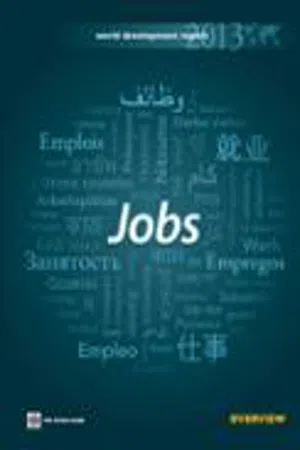
Jobs provide higher earnings and better benefits as countries grow, but they are also a driver of development. Poverty falls as people work their way out of hardship and as jobs empowering women lead to greater investments in children. Efficiency increases as workers get better at what they do, as more productive jobs appear, and less productive ones disappear. Societies flourish as jobs bring together people from different ethnic and social backgrounds and provide alternatives to conflict. Jobs are thus more than a byproduct of economic growth. They are transformational—they are what we earn, what we do, and even who we are. High unemployment and unmet job expectations among youth are the most immediate concerns. But in many developing countries, where farming and self-employment are prevalent and safety nets are modest at best, unemployment rates can be low. In these countries, growth is seldom jobless. Most of the poor work long hours but simply cannot make ends meet. And the violation of basic rights is not uncommon. Therefore, the number of jobs is not all that matters: jobs with high development payoffs are needed. Confronted with these challenges, policy makers ask difficult questions. Should countries build their development strategies around growth, or should they focus on jobs? Can entrepreneurship be fostered, especially among the many microenterprises in developing countries, or are entrepreneurs born? Are greater investments in education and training a prerequisite for employability, or can skills be built through jobs? In times of major crises and structural shifts, should jobs, not just workers, be protected? And is there a risk that policies supporting job creation in one country will come at the expense of jobs in other countries? The World Development Report 2013: Jobs offers answers to these and other difficult questions by looking at jobs as drivers of development—not as derived labor demand—and by considering all types of jobs—not just formal wage employment. The Report provides a framework that cuts across sectors and shows that the best policy responses vary across countries, depending on their levels of development, endowments, demography, and institutions. Policy fundamentals matter in all cases, as they enable a vibrant private sector, the source of most jobs in the world. Labor policies can help as well, even if they are less critical than is often assumed. Development policies, from making smallholder farming viable to fostering functional cities to engaging in global markets, hold the key to success.
- 423 pages
- English
- PDF
- Available on iOS & Android
eBook - PDF
About this book
Information
Subtopic
Labour EconomicsIndex
EconomicsTable of contents
- Cover
- Contents
- Foreword
- Acknowledgments
- Abbreviations and data notes
- Overview: Moving jobs center stage
- 1 The jobs challenge
- Part 1 Jobs are transformational
- Part 2 What are good jobs for development?
- Part 3 Policies through the jobs lens
- Appendixes
- Glossary
- Bibliographical note
- Background papers and notes
- Selected indicators
- Index
- Boxes
- Figures
- Maps
- Tables
Trusted by 375,005 students
Access to over 1.5 million titles for a fair monthly price.
Study more efficiently using our study tools.
Frequently asked questions
Yes, you can cancel anytime from the Subscription tab in your account settings on the Perlego website. Your subscription will stay active until the end of your current billing period. Learn how to cancel your subscription
No, books cannot be downloaded as external files, such as PDFs, for use outside of Perlego. However, you can download books within the Perlego app for offline reading on mobile or tablet. Learn how to download books offline
Perlego offers two plans: Essential and Complete
- Essential is ideal for learners and professionals who enjoy exploring a wide range of subjects. Access the Essential Library with 800,000+ trusted titles and best-sellers across business, personal growth, and the humanities. Includes unlimited reading time and Standard Read Aloud voice.
- Complete: Perfect for advanced learners and researchers needing full, unrestricted access. Unlock 1.5M+ books across hundreds of subjects, including academic and specialized titles. The Complete Plan also includes advanced features like Premium Read Aloud and Research Assistant.
We are an online textbook subscription service, where you can get access to an entire online library for less than the price of a single book per month. With over 1.5 million books across 990+ topics, we’ve got you covered! Learn about our mission
Look out for the read-aloud symbol on your next book to see if you can listen to it. The read-aloud tool reads text aloud for you, highlighting the text as it is being read. You can pause it, speed it up and slow it down. Learn more about Read Aloud
Yes! You can use the Perlego app on both iOS and Android devices to read anytime, anywhere — even offline. Perfect for commutes or when you’re on the go.
Please note we cannot support devices running on iOS 13 and Android 7 or earlier. Learn more about using the app
Please note we cannot support devices running on iOS 13 and Android 7 or earlier. Learn more about using the app
Yes, you can access World Development Report 2013 by World Bank in PDF and/or ePUB format, as well as other popular books in Economics & Labour Economics. We have over 1.5 million books available in our catalogue for you to explore.