- 80 pages
- English
- ePUB (mobile friendly)
- Available on iOS & Android
eBook - ePub
About this book
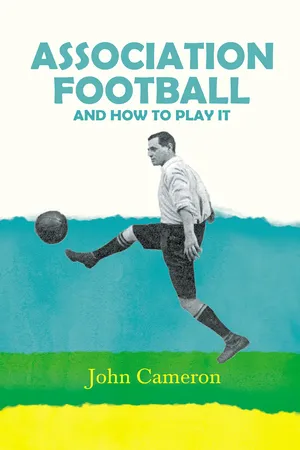
This book contains a detailed guide to the history, tactics, positions, and the contemporary state of football written by one of its earliest celebrities, John Cameron. Contents include: "Full-Back Play", "The Middle Lineard Play", "Training", "Hints to Juniors", "Captaincy", "Refereeing", "Football as a Profession", "Continental Football", "Football Reform", "Present Day Football", "Famous Cup-Ties", and "Laws of the Game". A classic guide to football not to be missed by collectors of vintage literature related to the subject. John Cameron (1872–1935) was a Scottish footballer and manager. He was a forward for Everton, Scotland and Queen's Park, as well as player-manager at Tottenham Hotspur who led them to victory in the 1901 FA Cup. He was appointed first secretary of the Association Footballers' Union in 1896 and was interned in a civilian detention camp in Germany during WWI after coaching Dresdner SC. When the war finished, he started a career as a football journalist, author and publisher. Macha Press is publishing this classic work now in a new edition complete with the original text and artwork for a new generation of football lovers.
Information
Print ISBN
9781443786256
Subtopic
Sport & Exercise ScienceAssociation Football
CHAPTER I
GOALKEEPERS AND GOALKEEPING
Goalkeepers, like poets, are born, not made. It is really the most difficult position on the field to occupy. If the half-back makes a mistake it can be rectified by the man behind him, but if the goalkeeper makes a blunder it is fatal. It is the one position on the field that I have never occupied, and I never had any desire to figure there. My ideal for that position would be a man who stood six feet and weighed at least thirteen stone, with an eye as keen as that of a hawk. He must be able to divine where and when the opposing forward is about to shoot. All the great goalkeepers have been of a fearless disposition, practically throwing themselves at the ball, even at the risk of receiving a kick from the attacking forward. Fearlessness is undoubtedly a tremendous asset in the making of a great goalkeeper. He must also have a perfect understanding with his backs, and they must trust him infinitely, which makes his responsibility all the greater.
I have often been asked the question whether the goalkeeper should train as regularly as any member of the eleven, and I have replied without any hesitation "Certainly." In one way he does not require such a severe course as a half-back, who has to go through much more work than he does. He should go in for plenty of short sprinting, so that when running out of his goal to meet any forward who has broken through he will be able to meet the ball quicker than his opponent. The reason for this is obvious, as half a yard in twenty will make all the difference between a goal being scored or not. I do not believe a great deal in gymnastics for footballers in general, but this method of training does a goalkeeper a world of good.
Punch-ball exercises are some of the best he can practise, and nearly all clubs have a ball fitted up in their training room. He ought to also practise place kicking, and endeavour to do so with both feet. I have often seen a goal scored simply through a poor return by the goalkeeper. Many allow one of the backs to take the goal kicks, but this is a big mistake, as it entails extra work on him, and he probably has as much to do as he can get through. I always like to see the ball thrown or kicked to the wings instead of the centre, where the play is generally concentrated. It is a mistake to attempt to punch a ball when it is wet and greasy and there is plenty of time to give it a lusty kick. Many a match has been won and lost through the goalkeeper attempting the former. The inauguration of the penalty kick has made the position more difficult than in the olden days. Critics say that eleven goals should be scored out of twelve. This is all very well in theory, but in practice it is another matter. It is, however, from both points of view a most trying time in any game, especially when the result of the match depends upon whether a goal is scored or saved. I shall never forget last year at Chelsea, when in the closing moments of the game Notts County were allowed a penalty, from which they scored.
That goal saved them from going down to the Second Division of the English League, and also saved thousands of pounds for the County.
When I was Manager of the 'Spurs I always made a rule that a goalkeeper should have plenty of practice in this department.
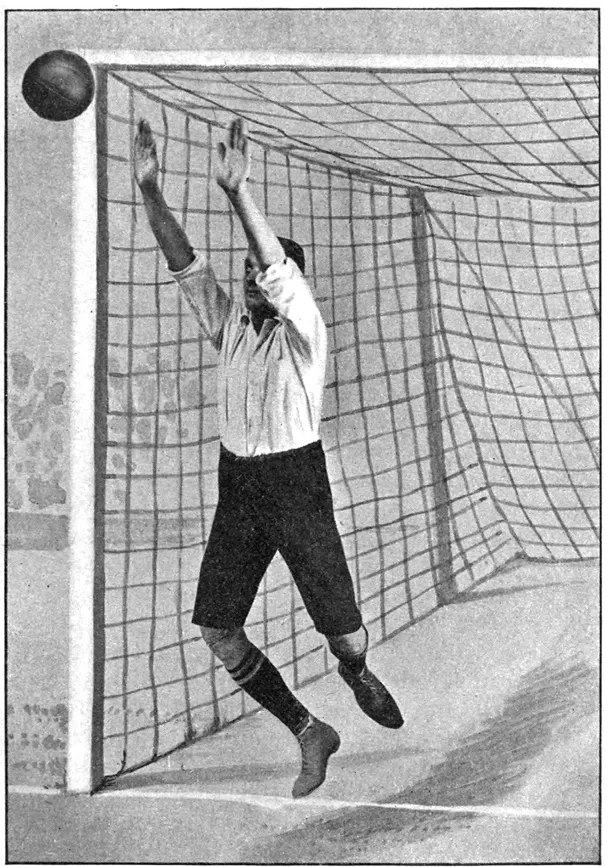
Saving a "High-Flyer"
I found that in a big match things were certainly different, and especially if there was a large crowd present. The eye of the multitude is concentrated on the keeper and the kicker, and there is a great strain on both, although to my mind the goalkeeper has the advantage in this way. If a goal is scored no one blames him, as it is expected. If the forward fails there is usually a loud groan.
L. R. Roose, the great Welsh International, in a well-written article for a standard book, has very well defined the chief duties that fall to his lot.
1. To prevent the ball passing between the space bounded by the upright posts.
2. To kick off when the ball has been sent behind the goal-line by one of his opponents.
Another great point where the goalkeeper must use special discretion is whether to run out to meet the forward or to "stay at home," as it is called in the football world. Undoubtedly if the forward is clear of the other players he should leave his post and endeavour to meet the forward. Every yard he goes out means that he leaves less space to be guarded. It is a well-known fact that the more work the goalie has to do the better he shines, and it often happens that the side that has been resting for half an hour breaks away and a goal results. A forward or a half-back is always in the midst of it, and gets warmed whether his side are losing or winning, but the keeper has often to exercise the faculty of patience. There have been many great goalkeepers, and it is very hard to pick out even half a dozen who stand out for their fame. In Scotland, when I was a boy, Macaulay was considered to be the principal goalkeeper, and quite deservedly so, if only for the simple reason that in International matches, especially against England, he always rose to the occasion. Moon, of the Corinthians; A. Trainor, of Preston North End; Toone, of Notts County; and, later on, Sutcliffe, of Bolton, and Robinson, of Southampton, were always to the fore, and of the pair it is very difficult to say which was the better. Both have played for England on many occasions, and at no time were they ever disgraced. Their methods in many ways were different, but the one thing they had in common was that they both knew the right moment to go for the ball. Robinson was without hesitation the more fearless, but Sutcliffe made up for it in many other ways. I have played against both on several occasions, and cannot honestly say that one is greater than the other, for what one is deficient in the other makes up for in some other way or by some other method. The goalkeeper, like the policeman, has a very happy time in comparison with fifteen years ago. In the olden days one could practically do as he liked, and it was not at all uncommon to see the goalie bundled over the line ere the ball came near him. He is protected now in every way, and he cannot now be charged except when in actual contact with the ball. This is a good rule, and has done a great deal for the game.
CHAPTER II
FULL-BACK PLAY
One associates the full back with long and lusty kicking, but he must possess many more qualifications. He must be speedy, a fine tackler, and, above all, a good header of the ball.
He must also keep himself thoroughly fit, although in one way he has not so much to do as the men in front of him. He must be strong in defence, but again, when his side is having the most of the play he should be able to put in many a good shot. It is also requisite that he should be able to kick as well with one foot as the other, and boys especially should study this point. It is simply a case of practice. Every opportunity should be utilised in developing the left foot, which is rather weaker than the other, and every eleven out of twelve are greatly inclined to use the right foot, but if you keep on practising, it will not be long before you will be quite as proficient with your left as your right. To become a good artist you must study kicking the ball from any position or angle that it may come to you. There is what we call the drop kick, the free kick, the overhead kick, the place kick, and taking the ball on the run. The overhead kick is practically one to be avoided, except in a grave case of emergency, because you are never certain of it coming off, or of placing it to any advantage. The drop kick also takes a great deal of practice to be accomplished with anything like success, but the essential thing is to be able to keep the ball on the run and kick it where you desire. A back should be of a steady disposition and always keep cool, for if he loses his head he is of little or no use to the side. It is also necessary to know when to head or kick the ball. It is often imperative that a back, for the good of his side, should punt the ball over the touch-line, but when doing so he should not make a lusty kick and put it over the grand stand. All that is wanted is a gentle touch to the railings, which is the proper thing to do. As I have already remarked, to know how to head the ball is of the utmost importance, and it is effective in clearing the line, especially from corner kicks. Heading is quite an art of its own, and takes a long time to master. You should be able to get at the ball not only with the forehead, but with either side of the head.
There should be a general understanding between the two backs, and also between them and the goalie. Each should understand the other's play to a nicety, and cover one another's mistakes to a certain extent. They must have confidence in their goalie, and should give him plenty of room in which to operate. It is also important to know when to pass back to the goalkeeper, and to do so correctly. I have seen many goals scored from faultiness in this respect. In tackling, a back must be quick in turning, so that if the forward beats him he has a chance of overtaking his opponent. This has always been a strong point in the play of all our greatest backs, and should be cultivated by all those who wish to succeed. To the uninitiated it seems that when the ball comes to a back he should return it vigorously, and nothing more. This is far from being correct. Many of our best backs have been moderate kickers, but when they did kick they did so with discretion and judgment, placing the ball to the half-back if he was free or to the outside right or left, as the run of the play might be. Above all, a back should be a fine tactician, knowing when to go for the ball or when to put it quickly into touch, thus giving his fellow players time to get back and save the position. There have been many fine full backs during the last decade of football history, and probably the greatest were the brothers Walters, of Corinthian fame; Nick Ross, of Preston North End; and Walter Arnott, of Queen's Park. The two Walters understood each other thoroughly, and as a pair were second to none. Arnott was the prettiest back to watch that I have ever seen, and Ross was about the most effective. The latter was cer...
Table of contents
- A History of Football
- PREFACE
- CHAPTER I
- CHAPTER II
- CHAPTER III
- CHAPTER IV
- CHAPTER V
- CHAPTER VI
- CHAPTER VII
- CHAPTER VIII
- CHAPTER IX
- CHAPTER X
- CHAPTER XI
- CHAPTER XII
- CHAPTER XIII
- LAWS OF THE GAME
Trusted by 375,005 students
Access to over 1.5 million titles for a fair monthly price.
Study more efficiently using our study tools.
Frequently asked questions
Yes, you can cancel anytime from the Subscription tab in your account settings on the Perlego website. Your subscription will stay active until the end of your current billing period. Learn how to cancel your subscription
No, books cannot be downloaded as external files, such as PDFs, for use outside of Perlego. However, you can download books within the Perlego app for offline reading on mobile or tablet. Learn how to download books offline
Perlego offers two plans: Essential and Complete
- Essential is ideal for learners and professionals who enjoy exploring a wide range of subjects. Access the Essential Library with 800,000+ trusted titles and best-sellers across business, personal growth, and the humanities. Includes unlimited reading time and Standard Read Aloud voice.
- Complete: Perfect for advanced learners and researchers needing full, unrestricted access. Unlock 1.5M+ books across hundreds of subjects, including academic and specialized titles. The Complete Plan also includes advanced features like Premium Read Aloud and Research Assistant.
We are an online textbook subscription service, where you can get access to an entire online library for less than the price of a single book per month. With over 1.5 million books across 990+ topics, we’ve got you covered! Learn about our mission
Look out for the read-aloud symbol on your next book to see if you can listen to it. The read-aloud tool reads text aloud for you, highlighting the text as it is being read. You can pause it, speed it up and slow it down. Learn more about Read Aloud
Yes! You can use the Perlego app on both iOS and Android devices to read anytime, anywhere — even offline. Perfect for commutes or when you’re on the go.
Please note we cannot support devices running on iOS 13 and Android 7 or earlier. Learn more about using the app
Please note we cannot support devices running on iOS 13 and Android 7 or earlier. Learn more about using the app
Yes, you can access Association Football by John Cameron in PDF and/or ePUB format. We have over 1.5 million books available in our catalogue for you to explore.