- 166 pages
- English
- ePUB (mobile friendly)
- Available on iOS & Android
eBook - ePub
About this book
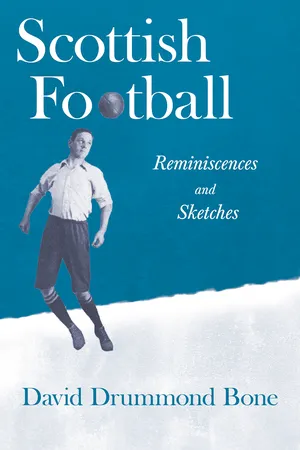
"Scottish Football - Reminiscences and Sketches" is a 1890 work by David William Bone. It contains an account of significant Scottish football teams, matches, managers, and more from the late nineteenth century, as well as general information about the contemporary state of the game and its history. Highly recommended for those with an interest in Scottish football and its humble beginnings. Contents include: "Football: Ancient And Modern", "The Football Wave", "A 'Sweep For The Cup'; Or, How Pate Brown Kept His Engagement", "Famous Association Players—Past And Present", "The Pioneers Of Association Football In Scotland; Or, 'The Conqueror's Football Boots'", "How Clubs Were Started Long Ago", etc. David Drummond Bone (1841–1911) was a prominent newspaper publisher in Glasgow. Macha Press is publishing this classic work now in a new edition complete with the original text and artwork for a new generation of football lovers.
Information
Print ISBN
9781528717274
Subtopic
Sport & Exercise ScienceIV
FAMOUS ASSOCIATION PLAYERS—
PAST AND PRESENT
Little did the comparatively small but orderly group of enthusiastic spectators who met around the ropes at Hamilton Crescent Ground, Partick, eighteen years ago, to witness the first International Association match, imagine the ultimate development of the Association style of play in Scotland, and in after years the triumphs which awaited her sons in contests with England. I was present, and shall never forget the manner in which the teams—both Scotch and English—acquitted themselves, and made a drawn game of it.
THE FIVE DEAD INTERNATIONALISTS
The ranks of the past crack players are beginning to get thinned by the common enemy of mankind. When I think of the busy feet, blithe and happy faces, and merry voices that joined in the game twenty years ago, a sense of sadness comes over me which it is difficult to dispel. "The first International, sir;" yes. Five of the gallant eleven who fought Scotland's battle are dead. Poor Gardner, Smith, Weir, Leckie, and Taylor, football players, have cause to remember thee! It was a hard struggle to keep up football in those days, and as there were no club funds all the items of expenditure had to be brought forth from the capacious pockets of the members. They loved the game, however, those primitive players, and engaged in it for its own sake, without ever thinking of reward. In the words of a great poetess, "We shall sing their praise ere long;" and while it may be thousands of dribblers of the present never heard their names, it is but right that the young ones should not forget what they owe to the Association football pioneers. Yes, the boys of the old brigade are falling out of the ranks in which they served so well, never to muster again on this side the grave; while others, still toiling on, are "scattered far and wide, by mountain, stream, and sea."
JOSEPH TAYLOR
The admitted chief of the five who have gone to their rest was Joseph Taylor. Of a quiet and unassuming disposition, blended with remarkable firmness, no man who captained the Queen's Park was so much respected both on the field and in private life. None hated unfair or rough play more. He could not endure it in a club companion, and this was particularly so if his team were playing a comparatively junior combination. Taught in the early school of Association football, when the rules were much more exacting than they are now, he had, along with his colleagues in the Queen's Park, to fight their preliminary battles, and overcome the prejudices consequent on introducing the "reformation," so to speak, in football. Taylor developed into a first-class back when comparatively young, and was chosen to play for his club against England in 1872, when the Queen's Park met that country single-handed, and played a drawn contest. Considering his light weight, he was a fine tackler, returned very smartly to his forwards, and, possessing remarkable speed, completely astonished an opponent by clearing the ball away before the forwards of the opposing club were able to obtain any advantage. He had always a kind and encouraging word to young players, and in 1875 and 1876 was chosen captain of the Scotchmen, and played, in all, five times against England. He died in Govanhill about three years ago.
ROBERT GARDNER
As the first captain of the Queen's Park in the International of 1872, and also chosen to that post next season in London, Gardner, who has also joined the great majority, was the most extraordinary player of his day. He was so versatile that I have seen him at work in all the different positions of the field—goalkeeper, back, half-back, and even forward—but it was as a goalkeeper that he excelled. A very indifferent kicker out in front, when the ball came up, he sometimes made mistakes with the feet; but when I remember the brilliant men who have since stood between the posts in Internationals and final cup ties, each in their line famous, I must confess that none ever used their hands and weight to greater advantage than Gardner. Possessing a peculiarity of temper which had much of the Scotchmen's sturdy independence, he had a difference with some of his friends, and left the Queen's Park to join the Clydesdale, and did much to assist that club to attain at the time the second position in Scottish Association football. Members of both clubs will not easily forget the manner in which Gardner kept goal for his new combination against the Queen's Park in a cup tie, when three matches had to be completed before the senior club won. He retired from the game some time before his death, which took place at South Queensferry a year and a half ago.
JAMES E. WEIR
Who could dribble and keep possession of the ball like Weir? In a football sense he was in everybody's mouth sixteen years ago, when crack forwards were few, and neat dribblers fewer. In all the contests the Queen's Park engaged in for ten years, none was more popular among the spectators, and emulated by the then young generation of players, than Weir. He always worked on the right side, and with William M'Kinnon, Angus Mackinnon, H. M'Neil, T. Lawrie, and T. C. Highet for companions, the exhibition of dribbling and passing, with the six forwards, was finer than is the case now with the five. The ball had then to touch the ground after being thrown in straight from the line before being played. Under those circumstances, heading by the forwards was never seen in the field, unless after a corner-flag kick. Well can I remember the match at Hampden Park against the London Wanderers, whom the Queen's Park defeated by six goals to none, when Weir, being tackled by the Hon. A. F. Kinnaird and C. W. Alcock, put his foot on the ball, shook off the two powerful Englishmen, and made a goal. The sad news only arrived lately from Australia, whither Weir had gone some years ago, of his demise. Deceased played in two Internationals, including that of 1872, and no finer dribbler ever toed a ball. He was, in fact, at the time designated the "Prince of Dribblers."
JOSEPH LECKIE
In every condition of life, no matter the sphere in which one is placed, he has his own peculiarities, and, in a football sense, Leckie, above all the gallant throng who have disappeared for ever from the field, had his. Comparatively short of stature and powerfully knit together, with splendidly moulded limbs, Leckie was one of the most tenacious forwards. While dribbling past an opponent with the ball at his toe, his peculiarity asserted itself in such a way that, once seen, could never be forgotten. Weir, Smith, W. M'Kinnon, H. M'Neil, and, later on, Fraser, Highet, and Richmond, among the army of forwards brought out by the Queen's Park; to say nothing of M'Lintock, M'Intyre, and Baird (Vale of Leven), J. R. Wilson and Anderson (Clydesdale), T. Vallance and P. Campbell (Rangers), and A. Kennedy and J. Hunter (3rd L.R.V.), of whom I will say something later on, had all their imitators in the younger clubs, but Leckie had none. He was, in fine, a player by himself. When he obtained possession of ball, he guarded his body with extended arms drooping from his side, with the back of his hands in front of the thighs, and thus formed a barrier to an opponent who attempted to tackle or take the ball from him. He took part in the first International. He died about three years ago in South Africa.
JAMES SMITH
The least known, perhaps, of the original International men, but one whose name will ever be honoured by many of the older school of players, and locally Queen's Park members, is Mr. James Smith, who died some years ago in London. Mr. Smith was, in conjunction with his brother Robert, early associated with the game in Scotland, and was an original member of the Queen's Park. Mr. Archibald Rae, the first secretary of the Scottish Football Association, and at one time an active member of the Queen's Park (and a beautiful dribbler in his day), tells an amusing anecdote of Smith, while playing against the Hamilton Club, leaping on the top of a hedge to win a touch-down, which in those days counted a point in the game. This entirely coincided with poor Smith's play, as he was sometimes very impetuous. He played in the International of 1872 as a forward.
WILLIAM M'KINNON
Dealing now with the past players who are with us in the body, for a long series of years, and, indeed, till within a short period of retiring from the field, no centre forward of his day, and very few since, have equalled M'Kinnon in that trying position. When the 3rd Lanark Rifle Volunteers started the dribbling game on the old drill ground at Govanhill, or rather when that small burgh was "No Man's Land," M'Kinnon was one of its most active players. It is in connection with his membership of the Queen's Park that I wish to recall incidents in his career. In 1874 I made my way over to the South-Side Park to witness a match between the Queen's and the Vale of Leven. Association football was then a very insignificant affair—the Rugby code, with such fine clubs as the Glasgow Academicals and West of Scotland as exponents—engaging all the public attention. The game was free to all. "Ladies and gentlemen, no charge for admission. Come and see our game. Kick-off, 3.30." Well, M'Kinnon, along with the rest of the team, emerged from the old toll-house, close by, to meet their gallant opponents, and Mr. Parlane, of the Vale of Leven (who kept goal so well for that club in many of her best matches), "chaffed" the Q.P. man in amusing manner about his boots (See "The Conqueror's Football Boots"), which were new, and differed considerably from the style then worn by players. All through the contest, which, by the way, was drawn, with no goals on either side, M'Kinnon was a little stiff, and scarcely played so well as was his wont. He never discarded his old companions, however, and those very boots in after years kicked many a goal both in Internationals and final cup ties. As an indication, in fact, of his genuine ability, he was chosen to play against England oftener than any man in Scotland, with the single exception of Mr. Charles Campbell, who was selected no fewer than ten times as a half-back. Mr. M'Kinnon was engaged in eight, including the first, and in these his country was victorious four times, and two were drawn matches. As a centre forward has to bear the brunt of an attack from the opposing side first, M'Kinnon was the very man to lead on the advance guard. His pluck was immense; and while he rather delighted to dodge an opponent and leave the charging to his backer up, he was a close and beautiful dribbler; could play a hard match without any outward signs of fatigue, and no man before or since could take a corner-flag kick like him. He used to practice this kick, and could place the ball within a few inches of the spot aimed at. Mr. M'Kinnon is still in our midst hale and hearty, and when a good thing in football is announced he generally turns out to see his favourite game, and is not afraid to criticise the form shown by his successors.
DAVID WOTHERSPOON
Mr. Wotherspoon was early associated with the Queen's Park; indeed, one of the original members, and did much in his day for football. When the senior club found it a matter of difficulty to get up an eleven to play in the country, some times at East Kilbride (for you mu...
Table of contents
- A History of Football
- PREFACE
- I
- II
- III
- IV
- V
- VI
- VII
- VIII
- IX
- X
- XI
Trusted by 375,005 students
Access to over 1.5 million titles for a fair monthly price.
Study more efficiently using our study tools.
Frequently asked questions
Yes, you can cancel anytime from the Subscription tab in your account settings on the Perlego website. Your subscription will stay active until the end of your current billing period. Learn how to cancel your subscription
No, books cannot be downloaded as external files, such as PDFs, for use outside of Perlego. However, you can download books within the Perlego app for offline reading on mobile or tablet. Learn how to download books offline
Perlego offers two plans: Essential and Complete
- Essential is ideal for learners and professionals who enjoy exploring a wide range of subjects. Access the Essential Library with 800,000+ trusted titles and best-sellers across business, personal growth, and the humanities. Includes unlimited reading time and Standard Read Aloud voice.
- Complete: Perfect for advanced learners and researchers needing full, unrestricted access. Unlock 1.5M+ books across hundreds of subjects, including academic and specialized titles. The Complete Plan also includes advanced features like Premium Read Aloud and Research Assistant.
We are an online textbook subscription service, where you can get access to an entire online library for less than the price of a single book per month. With over 1.5 million books across 990+ topics, we’ve got you covered! Learn about our mission
Look out for the read-aloud symbol on your next book to see if you can listen to it. The read-aloud tool reads text aloud for you, highlighting the text as it is being read. You can pause it, speed it up and slow it down. Learn more about Read Aloud
Yes! You can use the Perlego app on both iOS and Android devices to read anytime, anywhere — even offline. Perfect for commutes or when you’re on the go.
Please note we cannot support devices running on iOS 13 and Android 7 or earlier. Learn more about using the app
Please note we cannot support devices running on iOS 13 and Android 7 or earlier. Learn more about using the app
Yes, you can access Scottish Football by David Drummond Bone in PDF and/or ePUB format. We have over 1.5 million books available in our catalogue for you to explore.