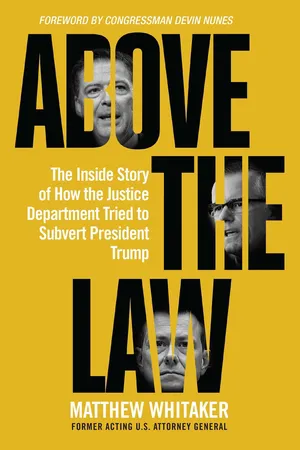
Above the Law
eBook - ePub

Above the Law

The Inside Story of How the Justice Department Tried to Subvert President Trump

  1. 256 pages
  2. English
  3. ePUB (mobile friendly)
  4. Available on iOS & Android
eBook - ePub

Above the Law

The Inside Story of How the Justice Department Tried to Subvert President Trump

About this book

Matthew Whitaker came to Washington to serve as chief of staff to Attorney General Jeff Sessions, and following Sessions's resignation, he was appointed Acting Attorney General of the United States. A former football player at the University of Iowa who had been confirmed by the Senate as a U.S. Attorney, Whitaker was devoted to the ideals of public service and the rule of law. But what he found when he led the Department of Justice on behalf of President Trump were bureaucratic elites with an agenda all their own. The Department of Justice had been steered off course by a Deep State made up of Washington insiders who saw themselves as above the law. Recklessly inverting, bending, and breaking the law to achieve their own political goals, they relentlessly undermined the Constitution by flaunting the rightful authority of a President they despised. Whitaker was an outsider with a desire to see justice done and democracy work. In his straightforward new book, Above the Law, he provides a stunning account of what he found in the swamp that is Washington. Whitaker reveals: • How former FBI Director James Comey and top figures in the Justice Department openly worked against President Trump • How the Deep State relies on the complicity of the mainstream media to achieve its ends • How the Deep State—drawing on elite universities and corporate law firms—perpetuates itself, keeping a small clique of people in power to ensure that nothing ever changes • How Robert Mueller's investigation into alleged Russian collusion quickly concluded there was no evidence of wrong- doing by the President or his campaign but nevertheless produced a massive report that was intended as an act of political subversion If you had any doubts that the Deep State actually exists, that it perpetuates a government of insiders, and that it inexorably pursues a political agenda of its own, then you will find Whitaker's first-person account eye-opening and utterly convincing.
Frequently asked questions

Yes, you can cancel anytime from the Subscription tab in your account settings on the Perlego website. Your subscription will stay active until the end of your current billing period. Learn how to cancel your subscription.
At the moment all of our mobile-responsive ePub books are available to download via the app. Most of our PDFs are also available to download and we're working on making the final remaining ones downloadable now. Learn more here.
Perlego offers two plans: Essential and Complete
  • Essential is ideal for learners and professionals who enjoy exploring a wide range of subjects. Access the Essential Library with 800,000+ trusted titles and best-sellers across business, personal growth, and the humanities. Includes unlimited reading time and Standard Read Aloud voice.
  • Complete: Perfect for advanced learners and researchers needing full, unrestricted access. Unlock 1.4M+ books across hundreds of subjects, including academic and specialized titles. The Complete Plan also includes advanced features like Premium Read Aloud and Research Assistant.
Both plans are available with monthly, semester, or annual billing cycles.
We are an online textbook subscription service, where you can get access to an entire online library for less than the price of a single book per month. With over 1 million books across 1000+ topics, we’ve got you covered! Learn more here.
Look out for the read-aloud symbol on your next book to see if you can listen to it. The read-aloud tool reads text aloud for you, highlighting the text as it is being read. You can pause it, speed it up and slow it down. Learn more here.
Yes! You can use the Perlego app on both iOS or Android devices to read anytime, anywhere — even offline. Perfect for commutes or when you’re on the go.
Please note we cannot support devices running on iOS 13 and Android 7 or earlier. Learn more about using the app.
Yes, you can access Above the Law by Matthew Whitaker in PDF and/or ePUB format, as well as other popular books in Politics & International Relations & American Government. We have over one million books available in our catalogue for you to explore.

CHAPTER ONE DOUBLE STANDARDS

Hell can rain down on me, I remember thinking to myself, but under no condition would I allow partisan Democrats, above-the-law Justice Department leakers, and a biased media to deter me or keep me from doing my job. For starters, when I became Acting Attorney General right after the 2018 midterm election, I refused to immediately recuse myself from the Russia investigation. Instead, I went through the Justice Department’s normal vetting procedures for determining potential conflicts of interest. Every President is entitled to an Attorney General who can manage the totality of the Justice Department and its investigations.
Though as a private citizen I had been very critical of the Special Counsel regulation, I fully accepted that as Acting Attorney General I should behave impartially towards an investigation already underway; my guidelines would be the Justice Department’s mandated rules of fairness and regular order. But those who hated President Trump expected me to behave as unprofessionally as the sainted career officials in the Resistance.
Here is Daily Kos, in a panic, the day I became Acting Attorney General:
Whitaker may have already instituted changes in the Mueller investigation. Significant changes in staffing might be visible. Might. But some of the changes that Whitaker proposed, like severely limiting Mueller’s budget or setting the scope of the investigation so that everything other than a handful of actions were off limits, would not. It’s not as if Mueller is going to put out a press release, and Whitaker knows that. One sign of Whitaker’s effect on the investigation could be—no sign at all. In issuing new indictments, Mueller would likely have to go to Whitaker for approval. It’s unclear how this might affect existing indictments already under seal, but if there is a continued ringing silence from the Russia investigation, it could well be because pending actions are going from Whitaker’s inbox straight to the circular file.1
As soon as I was appointed by President Trump, Democratic Congressman Jerrold Nadler of New York, ranking member and soon to be Chair of the House Judiciary Committee, complained, “Under these conditions, it would be wholly inappropriate for Mr. Whitaker to supervise the Special Counsel investigation given his documented history of opposition to it. The Deputy Attorney General, Rod Rosenstein, should continue to oversee the investigation unhindered.…”2
New York Democratic Senator Charles Schumer objected to me on similar grounds “heightened by specific expressions of bias against the Special Counsel investigation that Mr. Whitaker made just last year.”3 The media jumped on board and Beltway elitists piled on with commentary. I’m disappointed but not surprised that 400 former Justice Department officials, almost entirely Clinton and Obama era, took the time to sign an open letter protesting my appointment. This became a trend, and in February 2020, 1100 former Justice Department officials signed a letter calling for my highly respected successor William Barr to resign. In my case, Nadler, Schumer, and their allies desperately wanted the Senate-confirmed Deputy Attorney General Rod Rosenstein not only overseeing the Special Counsel investigation but actually to be appointed Acting Attorney General. But appointing an Attorney General is the President’s prerogative.
Even the far-Left Mother Jones agreed that the President was within his rights to appoint me instead of Rosenstein, pointing out that different rules govern different executive agencies: “Unlike the [Director of National Intelligence] DNI-specific statute, which says the No. 2 official ‘shall’ serve in the event of a vacancy at the top, the law pertaining to the Justice Department only says the Deputy Attorney General ‘may’ fill the vacancy. This wiggle room gave Trump a legal advantage, even as Senate Democrats and more than a dozen state Attorneys General argued otherwise.”4
The Office of Legal Counsel, staffed by some of the smartest, most professional attorneys inside of the government, quickly ruled my appointment was valid, and the U.S. Supreme Court refused to hear challenges to it. But for three weeks, the adjectives “illegitimate” and “invalid” were in practically every media account of my appointment. It was a completely manufactured controversy, but one that dragged my name through the mud and made me consider whether I was willing to go through the Senate confirmation process if the President were to offer me the permanent position.
It was not my time. Better to focus on building the team and leaving the Department in a better place than I had found it in, which I think I did. As soon as I was appointed, my goal was to keep DOJ focused on its priorities, stabilize the Department, and insist that it operate consistent with regular order. To instill confidence, my first order of business was to call all of the U.S. Attorneys, Assistant Attorneys General, and component heads with this same message—that DOJ’s priorities remain the same, and we will follow regular order, making the transition to the new Attorney General seamless.
Interestingly, the law validating my temporary appointment absent Senate confirmation was the 1998 Federal Vacancies Reform Act, which President Bill Clinton successfully lobbied Congress to broaden. Chris Geidner provided a succinct analysis for BuzzFeed on December 9, 2018. It was titled, “Matthew Whitaker Is Now Acting AG Because Congress Gave In to Bill Clinton.”5 He wrote:
The key change relevant to today’s dispute about Whitaker’s appointment addressed the [Clinton] administration’s concerns about the narrow limits on who could be appointed. A new section was added, specifying that in addition to the first assistant or a Senate-confirmed presidential appointee being able to be acting officers, a wide swath of senior government officials within the agency also could fill in if the President so chose. Specifically, the bill provided that the President could “direct an officer or employee of such Executive agency to perform the functions and duties of the vacant office temporarily in an acting capacity,” if the person worked in the agency “for not less than 90 days” in the prior year and the person’s pay rate is “equal to or greater than the minimum rate of pay payable for a position at GS–15 of the General Schedule.”
There was no doubt that I met the legal requirements. I had been Sessions’s chief of staff for more than a year at the Department of Justice and met the pay rate threshold. Moreover, both Schumer and Nadler had voted for the Federal Vacancies Reform Act of 1998 (it was part of a 1999 appropriations bill) when they were both House members.6 But more important, I had been in the office of the Attorney General more than a year, I fully understood how DOJ operated, and I knew that I could navigate and lead it and its roughly 110,000 employees. It was the honor of a lifetime.
The Vacancy Reform Act double-standard—approved when proposed by a Democrat, condemned when employed by a Republican—was only one of many I would notice inside the Justice Department. Double standards were constantly applied to Trump appointees and used to question their qualifications and alleged conflicts of interest.

In the Democrats’ version of reality, Jeff Sessions’s objectivity as Attorney General was compromised because he had met with Russian Ambassador Sergey Kislyak several times in the same year that Sessions was campaigning for Donald Trump. In his confirmation hearings, Sessions denied having any knowledge of Russian efforts to influence the election. His occasional interactions with Kislyak were so routine for a Senate Foreign Relations Committee member, which he was in 2016, that he didn’t even bother to mention them in his confirmation hearings.
A lot has been written about Jeff Sessions’s recusal, but as I found out firsthand, recusal is a very personal, fact-driven decision. I can easily imagine the overwhelming pressure he felt from the Obama administration holdovers surrounding him inside the Justice Department between February 8, 2017, when he was confirmed along party lines, and March 2, 2017, when he recused himself. He had less than a month to make one of the most consequential decisions of his life without his full team in place. Of course, President Trump’s opponents were thrilled, but Sessions was being held to a blatant double standard.
When my team asked Justice Department officials about how I should be vetted for conflicts of interest as Acting Attorney General, I was told that Session’s Obama-era predecessor, Loretta Lynch, simply made a ten-minute phone call to the Department’s ethics office and determined she didn’t have a conflict of interest overseeing the FBI’s investigation of Hillary Clinton’s mishandling of classified information on her home email server. Lynch, it should be remembered, had accepted a thirty-minute private meeting with Bill Clinton while his wife was running for President and under FBI investigation. Bill Clinton was the President who had selected Lynch to be a U.S. Attorney in 1999. But Lynch and her fellow Democrats saw no conflict of interest and no reason why she should recuse herself.
One month later, FBI Director Comey inexplicably announced he wouldn’t be prosecuting Hillary Clinton, even though she had been “extremely careless” in handling classified information because “no reasonable prosecutor” would charge her. (Peter Strzok, or someone else using his computer keyboard, replaced the words “gross negligence,” which is a chargeable offense under federal law, with “extremely careless,” which means the same thing but isn’t a chargeable offense.7)
Lisa Page didn’t think that Strzok’s close friend and neighbor, federal Judge Rudolph Contreras, who accepted Michael Flynn’s guilty plea, needed to recuse himself just because Strzok was the lead agent charging Michael Flynn. “I can’t imagine either one of you could talk about anything in detail meaningful enough to warrant recusal,” she texted Strzok.
Strzok, who didn’t recuse himself and admits he didn’t disclose his biased texts that included an “insurance plan” with Page to Mueller when they joined the Special Counsel’s team, also didn’t disclose his connection to Judge Contreras, who later recused himself from the Flynn case.8 According to the Wall Street Journal:
Mr. Contreras didn’t explain the reasons for stepping aside at such an unusual juncture. It’s rare for a judge to recuse himself from a case, especially after overseeing a plea hearing. But the texts exchanged between FBI agent Peter Strzok of the Federal Bureau of Investigation and FBI lawyer Lisa Page, appear to shed light on the decision.9
Strzok was terminated by the FBI once his machinations were revealed, though he contends his First Amendment rights were violated because he was merely expressing his personal opinions about President Trump when he texted—on a government phone—that Trump was a “douche” and that he and Page would “stop” him from becoming President.10
But there’s a significant difference between what you do as a private citizen and what you do as a government official (using a government phone). For instance, when I retweeted a Philadelphia Inquirer op-ed titled “Note to Trump’s Lawyer: Do Not Cooperate with Mueller’s Lynch Mob,” and noted it was “worth a read,” I was a private citizen living and working in Iowa, not a government official.11 But a government official, especially one involved in an investigation, should not do or say anything that could be prejudicial to what he is working on. So I agree with Alan Dershowitz’s assessment of Strzok: “He should have recused himself. He’s a professional. And his failure to recuse himself, I think, is what led to his firing.”12
Dershowitz feels similarly about Rod Rosenstein, whom Congressman Nadler wanted running the Russia investigation. “[Rosenstein] also creates the impression of bias. Not, again, from personal feelings but because he’s a witness in the case, he’s the main witness in the case,” Dershowitz said. “You can’t be the main prosecutor and the main witness in the same case. That creates an obvious conflict of interest.”
The New York Times, through leaks, shed some light on what was happening at DOJ and the environment that allowed Andrew McCabe to include the President as a target of the investigation: “The President’s reliance on his memo [critical of Comey] caught Mr. Rosenstein by surprise, and he became angry at Mr. Trump, according to people who spoke to Mr. Rosenstein at the time. He grew concerned that his reputation had suffered harm. A determined Mr. Rosenstein began telling associates that he would ultimately be ‘vindicated’ for his role in the matter.”13
Senate Minority Leader Chuck Schumer warned that “this story must not be used as a pretext for the corrupt purpose of firing Deputy Attorney General Rosenstein in order install an official who will allow the President to interfere with the Special Counsel’s investigation.”14
With Schumer and his fellow Democrats providing cover, neither Rod Rosenstein nor Andrew McCabe felt the need to recuse himself from the investigation. According to the New York Times, they each made the case for the other’s recusal:
An atmosphere of mistrust had quickly taken hold at the top levels of law enforcement: Mr. McCabe believed that Mr. Rosenstein should recuse himself from any investigation into Mr. Comey’s firing because of his role in it, according to people familiar with Mr. McCabe’s thinking. In turn, Mr. Rosenstein and other Justice Department officials questioned whether Mr. McCabe should recuse himself to avoid the appearance of political bias because his wife had run a failed State Senate campaign in Virginia and accepted hundreds of thousands of dollars from a political committee run by a longtime ally of the Clintons.15
At Jim Comey’s urging, McCabe recused himself from the FBI’s investigation into whether donations to the Clinton Foundation influenced Secretary of State Hillary Clinton, but he “did not fully comply” with that recusal in at least three separate occasions according to the 2018 Inspector General report.16 The report also found that Assistant Attorney General Peter Kadzik never bothered to recuse himself from that investigation, even though he tried to get his son a job on the Clinton campaign and then provided John Podesta, Counselo...

Table of contents

  1. Cover
  2. Title Page
  3. Dedication
  4. Foreword
  5. Introduction: Justice Triumphant Vs. Justice Defeated
  6. Chapter One: Double Standards
  7. Chapter Two: Presumption of Guilt
  8. Chapter Three: Coastal Elitism
  9. Chapter Four: The Sovereign District of New York
  10. Chapter Five: How the Special Counsel Undermines the Constitution
  11. Chapter Six: Criminalizing the Political
  12. Conclusion: The Case for a Strong Unitary Executive
  13. Appendix A: Acting Attorney General and Secretary of Homeland Security Submit Joint Report on Impact of Foreign Interference on Election and Political/Campaign Infrastructure in 2018 Elections
  14. Appendix B: Attorney General William Barr’s Summary of the Mueller Report
  15. Appendix C: May 4, 2018, Menendez Joint Letter to General Prosecutor of Ukraine on Mueller Investigation
  16. Appendix D: Selected Speeches by Matthew Whitaker
  17. Appendix E: For Reader Reference: The Constitution of the United States
  18. Acknowledgements
  19. About the Author
  20. Notes
  21. Index
  22. Copyright