![]()
PART ONE
Generals
![]()
CHAPTER 1
Guo Kan
Military Exchanges between China and the Middle East
FLORENCE HODOUS
Guo Kan (1217–77) was a Chinese general who took part in the Mongol campaigns in Central and Western Asia and participated in the Mongol conquest of Baghdad in 1258. He led the mangonel engineers, Chinese specialists in siege warfare, who were instrumental in the Mongol armies’ success. While legendary feats and victories over Muslim and Christian kingdoms in the Middle East are further ascribed to Guo Kan, the general appears to have returned to China after the Mongol victory in Baghdad. Back home, he served in a military capacity under Qubilai Qa’an (r. 1260–94), founder of the Yuan dynasty. Guo Kan’s journey offers the opportunity to explore not only the transfer of military experts and warfare technologies across Mongol Eurasia but also speaks to the role that material artifacts played in Chinese imaginations of the Middle East and Europe, as well as to the expansion of Chinese knowledge on their geography and politics.
A WORTHY DESCENDANT
Our sole source on Guo Kan is his biography in the Yuanshi or the History of the Yuan Dynasty.1 There are no references to him in the Persian sources, making it impossible to corroborate details about Guo Kan’s military feats in the Islamic world. Still, we can draw an outline of Guo Kan’s life and career and compare it with other sources on the Mongols’ campaigns.2 Since Guo Kan’s Yuanshi biography was compiled years after his death, it is also valuable for exploring how later Chinese authors envisioned their relationship with and involvement in the Mongol westward expansion.
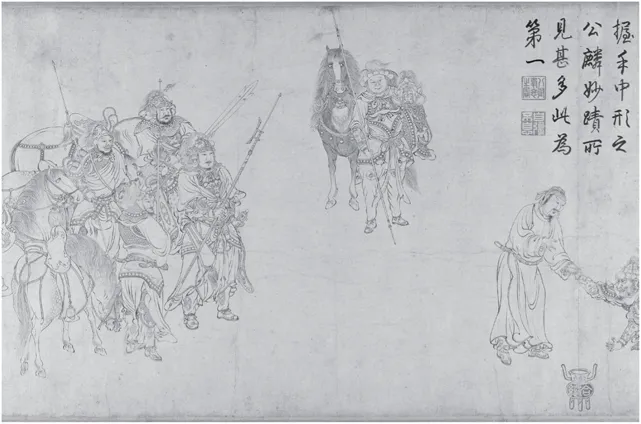
As his biography in the Yuanshi points out already at its opening, Guo Kan was a descendant of Guo Ziyi (697–781), a famous general of China’s Tang dynasty (618–907). In addition to quelling the An Lushan rebellion (755–63),3 Ziyi took part in several campaigns against the Tibetans and the Uighurs.4 Two traditional enemies (and occasionally allies) of the Tang dynasty, the Tibetans and the Uighurs would both later submit to the Mongols. Guo Kan’s next known ancestors are his grandfather, Guo Baoyu, and his father, Dehai, both of whom were also generals mainly active in the Chinese western frontiers in Central Asia and further west (see fig. 1.1).
FIGURE 1.1. Guo Ziyi Receiving the Homage of the Uighurs, Li Gonglin (eleventh century). Collection of the National Palace Museum, Taipei.
Although six centuries lapsed between the Tang general Ziyi and Guo Kan’s grandfather Guo Baoyu, the latter was likewise born and raised in Ziyi’s hometown Huazhou (in today’s Shaanxi province). Unlike Ziyi, however, Guo Baoyu seems to have been a rather minor mingghan commander (head of a unit of a thousand) under the Jin dynasty (1115–1234), in charge of defending Dingzhou (nowadays southwestern Hebei). As soon as Chinggis Khan’s general Muqali (1170–1223) and his forces advanced to northern China, Guo Baoyu defected, enlisting with the new Mongol overlords.5
Muqali then took the defector Baoyu to see Chinggis Khan, whom Baoyu impressed with his practical and bold advice. Receiving the post of general command officer of artillerymen,6 he accompanied Muqali on his campaign to subdue the Jin dynasty. More importantly for his future as well as for the prospects of his descendants, he managed to forge a close personal relationship with Chinggis Khan. His biography gives a vivid account of Baoyu’s injury during Chinggis Khan’s campaign against the Qara-Khitai (1124–1218) and Muḥammad Khwārazmshāh (r. 1200–20) in Central Asia: “Baoyu was hit in the chest with an arrow, so the Emperor [Chinggis Khan] ordered to cut open the belly of a cow and place him inside it, and in a short while he recovered.”7 The biography goes on to claim prodigious feats for him. It recounts how Baoyu quickly returned to battle after his injury and accepted the submission of the city of Beshbaliq (in north Xinjiang), before crossing the Jaxartes river to take Samarqand (modern-day Uzbekistan), and then crossing the Oxus River to advance until Merv (modern-day Turkmenistan).8
Baoyu is furthermore presented as instrumental in bringing Chinese inventions to the battlefield. The biography mentions that at the Oxus, he used huojian, literally “fire arrows,” against the enemy ships. Scholars have debated how to identify these “fire arrows.” By then, the Mongols had already encountered gunpowder weapons, particularly in the form of explosive gunpowder bombs, in their wars against the Jin in northern China. The presence of Chinese engineers such as Guo Kan in the Mongol armies conquering the West has led to the speculation that the Mongols may have imported such weapons into Western Asia.9 However, there is insufficient evidence to support this conclusion. It is more likely that the fire-arrows Baoyu introduced were not rockets, but arrows carrying incendiary charges.10 They may well have been an innovation from China, albeit falling short of being true gunpowder weapons.
In any case, in 1220–23, Guo Baoyu participated together with his son Dehai in the famous campaign of Chinggis Khan’s generals Jebe (d. 1223) and Sübe’etei (1175–1248), which circled the Caspian Sea and returned back to Mongolia via Russia and the Qipchaq Steppe. Dehai’s biography follows his father’s in the same chapter of the Yuanshi, and though the section on Dehai is very short, it nevertheless records that he quelled the rebellions of a Tibetan and an Uighur commander, just as his ancestor the Tang general Ziyi had fought centuries earlier with Tibetans and Uighurs. Dehai further contributed to the campaign against the Jin dynasty until his death from a battle wound in 1234.11 Baoyu and his son, though not quite as famous or central to their dynasty, nevertheless exceeded the accomplishments of Ziyi in terms of their geographical reach; and Dehai’s son Guo Kan was to do even more.
GUO KAN THE ARTILLERYMAN (CHAQMAQ)
Guo Kan was seventeen years old when his father died. Through the mediation of his father and grandfather, he was already well regarded by major figures of the Yuan dynasty, and the great general Shi Tianze (1202–75) himself hosted him in his house and educated him. At the age of twenty, he was appointed commander of a hundred, and accompanied Sübe’etei, and later Tianze himself, on campaign, rising to leader of a thousand.
Like his grandfather, he participated in a campaign to the west, this time the campaign led by Chinggis Khan’s grandson Hülegü (1218–65), brother of the reigning Qa’an Möngke (r. 1251–59). Hülegü’s campaign set out in 1253 and culminated in the establishment of the Ilkhanate and direct Mongol rule in the realm of greater Iran. The material contribution of Chinese personnel to the siege warfare on this campaign has been well documented.12 According to the Yuanshi: “In the year guichou [1253] the army [i.e., the vanguard commanded by Kitbuqa (d. 1260)] reached the realm of Munaixi [the realm of the so-called Assassins].13 . . . Guo Kan defeated the army of fifty thousand soldiers, took 128 cities, and decapitated it...