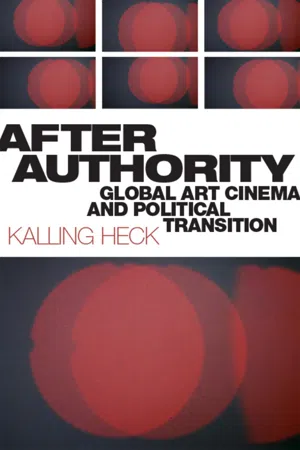
After Authority explores the tendency in art cinema to respond to political transition by turning to ambiguity, a system that ideally stems the reemergence of authoritarian logics in art and elsewhere. By comparing films from Italy, Hungary, South Korea, and the United States, this book contends that the aesthetic tradition of ambiguity in art cinema can be traced to post-authoritarian conditions and that it is in the context of a transition away from authoritarianism where art cinema aesthetics become legible. Art cinema, then, can be seen as a mode of cinematic practice that is at its core political, as its constitutive ambiguity finds its roots in the rejection of centralized and hierarchical configurations of authority. Ultimately, After Authority proposes a history of art cinema predicated on the potentials, possibilities, and politics of ambiguity.
- English
- ePUB (mobile friendly)
- Available on iOS & Android
eBook - ePub
About this book
Information
Publisher
Rutgers University PressYear
2020Print ISBN
9781978806986
9781978806993
eBook ISBN
9781978807006
Subtopic
Film & Video1
Authority Year Zero
On Germany Year Zero
Chief Nazi propagandist Joseph Goebbels put heavy emphasis on the relationship between art and politics. In fact, he equated the two and fixated on the central role of art in constructing his idealized vision of a public unified around the Nazi Party. According to Goebbels, “Politics, too, is an art, perhaps the highest and most far-reaching one of all, and we who shape modern German politics feel ourselves to be artistic people, entrusted with the great responsibility of forging out of the raw material of the masses a solid, well-wrought structure of a volk.”1 The key to Goebbels’s claims here is the relationship between raw materials and the solidity of a unified body or volk. For Goebbels, and indeed the totalitarian enterprise that he represents, the function of art (and for him its compatriot: politics) is to bring into being a cohesive and singular formation that can function and move with unified purpose. Indeed, as Rainer Stollmann observed, one of the primary functions of Nazi art seemed to be the unification of the inchoate actions and events of a national social life into a coherent and singular body.2
Given the context of the Nazis’ attempt at constituting an art dedicated to a unified front, the postwar cinema of Roberto Rossellini—and in particular his Germany Year Zero (1948)—takes on a very particular series of significations. It was Rossellini’s goal, this chapter contends, to undermine the centralized, unified, and ordered totalizing principle that Goebbels’s vision relied upon, and to replace it with a return to the inchoate raw material that the Nazis so wished to tame and direct. As we will see, one of the ways that this goal is achieved is by confusing the boundaries of the national, as this film is uniquely situated to respond to the differing contexts of the Nazis and the Italian Fascists, never exactly equating the two but proposing ambiguity as a rejoinder to both arrangements.
Susan Buck-Morss also touches upon the dark pursuit of making a coherent and legible whole by way of art. Speaking of Leni Riefenstahl’s seminal Nazi propaganda film Triumph of the Will (1935), Buck-Morss proposes the following: “The mobilized masses fill the ground of the Nuremberg Stadium and the cinema screen, so that the surface patterns provide a pleasing design of the whole, letting the viewer forget the purpose of the display, the militarization of society for the teleology of making war.”3 Again, a metaphoric body is built around a coherent, and in this case supposedly pleasing, series of images that unify a group of subjects and direct them to action. In opposition to this reading of Nazi cinema, Germany Year Zero proposes no pleasing pattern; it pushes the audience to pay attention to the circumstances on display but without the ordering function upon which Nazi cinema so heavily relied.
This chapter proceeds by introducing Germany Year Zero and exploring the openings to contingency and change that this film proposes. I then move to an analysis of the specific status of the ruin in Rossellini’s film and the way it orients audiences toward a particular (and perhaps productive) relationship to time and rebuilding. I follow this discussion of the ruin with an examination of Karl Marx’s own figuration of the inchoate masses and their historical formation into a public. Finally, the chapter ends with an investigation of the failures and drawbacks of Rossellini’s dedication to openness—focusing in particular on the way that the intense marketization that has come to be called neoliberalism has aimed to take advantage of just these claims to potential and change. This final section is central to this study, as it marks the beginning of the countermove that occupies much of this book: while hopeful, the flight from order of each of the four films analyzed makes them particularly vulnerable to the forms of authority—now a kind of absent authority—that have arisen in recent years.
Ultimately, this chapter examines the most clear and direct example of a post-authoritarian response. It is, however, the nuance of this particular film and the ways that it navigates the circumstances that contributed to its stance against authority that highlight post-authoritarian cinema’s unique systems for encountering and subsequently countering authority.
Germany Year Zero
Germany Year Zero is the third entry in what is commonly referred to as Roberto Rossellini’s war trilogy. Shot in Berlin and Rome, the film fits squarely into (what might be called the later portion of) the postwar Italian film movement known as “neorealism.” At once an exemplary work (in terms of the aesthetic principles of the movement) and an outlier (in terms of its concern with coherent nation building) of neorealism, Germany Year Zero provides a glimpse of rubble-strewn postwar Berlin and fulfills much of the documentary/narrative promise that this movement hoped to provide. But what is truly valuable about this film, I propose, is its reluctance to present a particular answer to the problems that it poses. It is this reluctance that allows Germany Year Zero to question after not only what is to be done with rubble-reduced Berlin (and the postwar world more broadly), but also what might be valuable about occupying a space that is yet to be rebuilt, and occupying a politics that is yet to take form.
Marsha Landy defines the “major project” of neorealism as “the demystification of the ideology and practices of fascism.”4 Of this relatively loose grouping of postwar Italian films, she writes, “In their content, they explored authoritarianism; bureaucracy and power; violence; consensus and conformity; the oppression of workers, and passive obedience to tradition, the law, and the state.”5 Similarly, Angelo Restivo, borrowing from Benedict Anderson, argues that “neo-realism can be looked at as … an attempt to create an imagined community to replace the (equally media-constructed) imagined community of the fascist period,” and he further traces the origin of this moment to “the collapse of a coherent national narrative that could be taken as meaningful by Italians.”6 Indeed Restivo argues that Rome, Open City (1945)—the first film of Rossellini’s war trilogy—“allegorizes the birth of the aesthetic of reality out of the bankruptcy of the fascist aesthetic,”7 and that “it is with Paisa [1946, the second film of the trilogy] that the new aesthetic seems to have achieved its full realization.”8
Of course, after Paisa and at the end of this lauded triptych lies Germany Year Zero. Whereas, for Restivo, the first two films of this trilogy serve as “a picture of the nation in the radical process of becoming,”9 Germany Year Zero relocates this process to a new setting, Berlin. Because of this move this film, rather than presenting a new imagined community, produces the moment before this imaginary, questioning after the damage that the process of imagining might entail. Its demystification, to return to Landy, surely concerns fascism (and authoritarianism more broadly), but it levels its critique not merely on the basis of the particular brutality of fascism, but on the unavoidable damage caused by the exclusions inherent in any political arrangement. This is not to say, of course, that the differences of particular political configurations are flattened, nor that democracy and fascism are equated here, but this argument does contend that the particular vision of the world presented in Germany Year Zero shifts the elsewhere-defined neorealist project from the re-evaluation of the Italian national identity to a more abstract politics that accounts for authority more broadly. The vantage of Germany Year Zero—looking backward as it does from a democratic moment only just developing to an authoritarian one—provides a unique opportunity to envision the potentials of a moment after an authoritarian regime but before democracy has fully arrived.
Whereas Rome, Open City and Paisa are clearly located within the borders of Italy and, as Restivo notes, concentrate on a particular reimagining of that nation, the locale of Germany Year Zero, Berlin, helps in expanding the purview commonly associated with neorealism (Italy) and the forging of a new national identity that it so commonly connotes. The unusual production process of this film—its interiors being shot in Rome and its exteriors in Berlin—serves to elide national specificity, and in so doing it depicts a world after authoritarianism, allegorizing the rubble of Berlin to broaden its perspective. This is a film, then, that allows for the thinking of political claims and political differences at the moment before they concretize into something new—the moment before a coherent narrative has taken hold. Its confused national allegiances help to extend the moment of contemplation by holding the ordering functions of narrative at bay and in so doing disrupting the possibility for a clear and singular reading. The asking of the question of whether this film is about Italy or Germany, then, guarantees a pause that the film strives to occupy, and the reluctance to produce an answer or a closure to this pause is one of the many systems whereby Germany Year Zero refuses to render a particular political project or solution.
But this reluctance to render a coherent answer to its political concerns also leads many to posit that Rossellini’s work (broadly) is better thought of as apolitical. Indeed, Geoffrey Nowell-Smith notes that much of the praise for Rossellini, particularly that of the critics of the Cahiers du Cinema, lionized the director on the basis of “aesthetic grounds” and likewise found that “his neo-realist trilogy stands aloof from the politics of the resistance and postwar reconstruction.”10 Nowell-Smith posits that, for those who find Rossellini to be lacking in terms of a politically or ideologically clear stance, “Rossellini’s great misfortune … was to be born into a world that was too political.”11 Much of the grounds for this apolitical understanding of Rossellini’s cinema are based on André Bazin’s positioning of him as a “spiritual” filmmaker.12 But Nowell-Smith contends that it is in fact Rossellini’s political identity that unifies much of his work.
According to Nowell-Smith, Rossellini’s politics are derived from a kind of intuition that does not adhere cleanly to the guideline of a postwar neorealist and antifascist left. For Nowell-Smith, “In a world marked by non-communication, suddenly something would be communicated, a flash of insight enabling the audience to see what these characters themselves saw or maybe were too blind to see, or enabling the characters themselves to go forward from an impasse.”13 It is this idea of noncommunication that is punctuated by sudden clarity that, for Nowell-Smith, serves to guide Rossellini’s project.
But my contention posits that Rossellini, at least in the case of Germany Year Zero, is concerned not with the spirit or power of communication, nor with the overcoming of its difficulties. What is invaluable about Germany Year Zero is its presentation of a damaged world that finds the very prospect of communication troubling. As Sandro Bernardi argues of the film’s landscapes, “The picture that Rossellini tries to give us is that of a world destroyed, whose shattered monuments are no more than the ruins of a culture swept away by an infernal ambition.”14 The world on display in this film is one destroyed by what Bernardi calls “the catastrophe of ideology”, a world ruined by violent attempts to orient meaning in a particular way.
Karl Schoonover argues that Rossellini’s war trilogy—Rome, Open City and Paisa in particular—facilitate a politics by engaging its characters, and indeed its audiences, in a certain style of looking. For Schoonover, “By placing ocular witnessing at the center of their narratives, these films seem to transform seeing from a passive state of consumption into a powerful means of moral reckoning.”15 For Schoonover, this positioning engenders a specific global view, and in so doing “these films promote a universalist conception of human compassion by reifying a particular response to violence as the exclusively moral one.”16 Ultimately, according to Schoonover, this system solidified a particular response to fascism that unified divergent critiques and addressed them outward in the hopes of supporting the Marshall Plan and other forms of international aid.17 Schoonover is speaking, though, primarily of Rome, Open City and Paisa. Germany Year Zero, I contend, defies this reification of a particular violence and instead leaves unarticulated the “appropriate” moral response to the horrors that guides the film. What differentiates Germany Year Zero from its predecessors, then, is that, through its spatial and narrative ambiguity, it refuses the figuration of a particular plea and instead asks after how to proceed at all. It does this by providing and attempting to expand an opening, an indeterminate moment, whereby actions (and responses) are left in stasis.
It is the promise of these kinds of stunted moments, these pauses, that this chapter focuses upon. I argue that this reluctance to forge a particular—this open-endedness and “apolitical” moment of noncommunication—serves as a politics all its own. Indeed, that the film refuses to render a particular future and insists instead on decay is exactly what makes it a political film, for through these pauses and disruptions Germany Year Zero casts doubt on those who might present a solution. It questions, that is, the authority that might propose to solve society’s problems, and in so doing brings into light its own relationship to authority and the possibility (always fleeting) of democratic art. Authority is of particular historical significance to this film by virtue of its having been made in two countries, Germany and Italy, who were in the throes of a transition from, respectively, totalitarian and authoritarian systems to democratic governance. This argument is complicated, though, by the relationship that art (and the meanings that it at times enfolds) has to authority itself. What this film can be said to examine, then, is not only what to do when authority fails, but how a film can be made without reinstituting authoritarian logics.
Authority
In the final shots of Germany Year Zero, Edmund, the thirteen-year-old protagonist of the film, looks out of what was formerly a window (and is now simply an opening) of the demolished building that he currently occupies. Across the street he sees the apartment where his family—along with a number of other families—currently resides. He watches as a small truck pulls up and quickly learns what it carries: a well-stacked collection of coffins. Edmund continues to look as those in the truck enter the building and then exit carrying another coffin; they place it with the others and then leave. After staring again briefly at his destroyed home, Edmund carefully hangs his jacket from an errant metal pillar. Disillusioned as he is, and as he has carefully been shown to become, by the prospect of existence in post–World War II Berlin, Edmund slides down the stanchion to a lower level of the building. He takes a final brief look again at his family’s apartment; fra...
Table of contents
- Cover
- Title Page
- Copyright
- Dedication
- Contents
- Introduction: Four Angels
- 1. Authority Year Zero: On Germany Year Zero
- 2. The Image That Waits: On Sátántangó
- 3. The End of Authority, the End of Democracy: On Woman on the Beach
- 4. Force, Hope, and Death: On Medium Cool
- Coda: Political Modernism and the Possibility for Action
- Acknowledgments
- Notes
- Index
- About the Author
Trusted by 375,005 students
Access to over 1.5 million titles for a fair monthly price.
Study more efficiently using our study tools.
Frequently asked questions
Yes, you can cancel anytime from the Subscription tab in your account settings on the Perlego website. Your subscription will stay active until the end of your current billing period. Learn how to cancel your subscription
No, books cannot be downloaded as external files, such as PDFs, for use outside of Perlego. However, you can download books within the Perlego app for offline reading on mobile or tablet. Learn how to download books offline
Perlego offers two plans: Essential and Complete
- Essential is ideal for learners and professionals who enjoy exploring a wide range of subjects. Access the Essential Library with 800,000+ trusted titles and best-sellers across business, personal growth, and the humanities. Includes unlimited reading time and Standard Read Aloud voice.
- Complete: Perfect for advanced learners and researchers needing full, unrestricted access. Unlock 1.5M+ books across hundreds of subjects, including academic and specialized titles. The Complete Plan also includes advanced features like Premium Read Aloud and Research Assistant.
We are an online textbook subscription service, where you can get access to an entire online library for less than the price of a single book per month. With over 1.5 million books across 990+ topics, we’ve got you covered! Learn about our mission
Look out for the read-aloud symbol on your next book to see if you can listen to it. The read-aloud tool reads text aloud for you, highlighting the text as it is being read. You can pause it, speed it up and slow it down. Learn more about Read Aloud
Yes! You can use the Perlego app on both iOS and Android devices to read anytime, anywhere — even offline. Perfect for commutes or when you’re on the go.
Please note we cannot support devices running on iOS 13 and Android 7 or earlier. Learn more about using the app
Please note we cannot support devices running on iOS 13 and Android 7 or earlier. Learn more about using the app
Yes, you can access After Authority by Kalling Heck in PDF and/or ePUB format, as well as other popular books in Media & Performing Arts & Film & Video. We have over 1.5 million books available in our catalogue for you to explore.