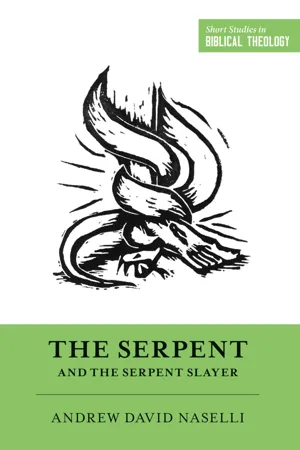
Although a story with a serpent, a damsel in distress, and a serpent slayer may sound like just another fairy tale, it is, in fact, part of the greatest true account ever told—the Bible. Epic tales resonate with readers because they echo the greatest story. In this new addition to the Short Studies in Biblical Theology series, Andrew David Naselli traces the theme of snakes and dragons from the serpent in the garden to the devouring dragon in Revelation, culminating with the return of the King. New and seasoned Christians alike will experience afresh the captivating unifying narrative behind all stories as they embark on a journey through the Bible with a trusted biblical scholar.
eBook - ePub
The Serpent and the Serpent Slayer
- 144 pages
- English
- ePUB (mobile friendly)
- Available on iOS & Android
eBook - ePub
The Serpent and the Serpent Slayer
About this book
Information
Topic
Theology & ReligionSubtopic
Christian Ministry1
The Deceitful Snake in Genesis 3
The serpent theme spans the entire Bible—from the beginning of Genesis to the end of Revelation.1 Let’s start with what the Bible teaches about the serpent at the story’s beginning. Genesis 3 teaches at least twelve notable truths about the snake.
Here’s a clarifying note about an aspect of this book’s format: I quote the Bible a lot. I do this for two reasons. First, it helps you engage directly with the Bible and not merely indirectly through what I say about the Bible. To help you connect specific God-breathed words with what I am arguing, I italicize portions of direct quotes. Second, it helps you realize, “Wow! The serpent theme is all over the Bible.” It is a prominent theme at the Bible’s bookends (the beginning of Genesis and end of Revelation) and in between.
The Snake Is Deceitful
Now the serpent was more crafty than any other beast of the field that the Lord God had made. (Gen. 3:1)
The grand story does not begin with the deceitful snake in Genesis 3. It begins with God’s creating the heavens and the earth in Genesis 1–2. The story begins with pure goodness. All is right with the world—until the crafty villain enters the scene.
In English, crafty means cunning or deceitful. But crafty in Genesis 3:1 translates a Hebrew word that is neutral on its own. It can be positive (e.g., Prov. 12:16—prudent as opposed to foolish) or negative (e.g., Job 5:12; 15:5). Here the word is initially ambiguous. But when you reread this story in light of the whole story, crafty is an excellent translation. The serpent is the craftiest wild animal. His first strategy is not to devour but to deceive.
The Snake Is a Beast That God Created
Now the serpent was more crafty than any other beast of the field that the Lord God had made. (Gen. 3:1)
God created the snake, so the snake is not God’s equal. God is uncreated; the snake is created. Aseity is true only of God—that is, only God exists from himself without depending on anything else for existence.2 Like every other creature, the snake is not independent of God.
The Snake Deceives by Questioning God
And the Lord God commanded the man, saying, “You may surely eat of every tree of the garden, but of the tree of the knowledge of good and evil you shall not eat, for in the day that you eat of it you shall surely die.” (Gen. 2:16–17)
He [i.e., the snake] said to the woman, “Did God actually say, ‘You shall not eat of any tree in the garden’?” And the woman said to the serpent, “We may eat of the fruit of the trees in the garden, but God said, ‘You shall not eat of the fruit of the tree that is in the midst of the garden, neither shall you touch it, lest you die.’” (Gen. 3:1–3)
The snake does not begin by directly contradicting God. He begins by questioning God.
The snake craftily reframes the situation. Instead of emphasizing that Adam and Eve may eat from every tree except one, the snake asks whether they may eat from any tree.
Instead of rebuking the snake, the woman entertains the idea that God is not benevolent and trustworthy. Maybe God made up that rule to limit her pleasure. Her words “neither shall you touch it” may even embellish what God commanded.
The Snake Deceives by Contradicting God
But the serpent said to the woman, “You will not surely die. For God knows that when you eat of it your eyes will be opened, and you will be like God, knowing good and evil.” (Gen. 3:4–5)
After the snake questions God, the snake intensifies his deceitful assault by contradicting God. He lies and blasphemes God as having selfish motives. This serpent sounds like the devil: “When he lies,” explains Jesus, “he speaks out of his own character, for he is a liar and the father of lies” (John 8:44).
Yes, the woman’s eyes will be opened, but not in a good way. She will know evil by becoming evil herself, and thus she will die spiritually. Little does she know in her innocence that this death will start the countdown to her physical death.
The Snake Deceives by Tempting with Worldliness
But the serpent said to the woman, “You will not surely die. For God knows that when you eat of it your eyes will be opened, and you will be like God, knowing good and evil.” So when the woman saw that the tree was good for food, and that it was a delight to the eyes, and that the tree was to be desired to make one wise . . . (Gen. 3:4–6)
Worldliness is loving the world (see 1 John 2:15–17).3 For us to “love the world” today (1 John 2:15) is to delight in the anti-God culture that permeates this fallen world, to take pleasure in worldly ways of thinking and acting, to take pleasure in what theologian John Frame ca...
Table of contents
- Cover
- Newsletter Signup
- Endorsements
- Other Crossway Books
- Title Page
- Copyright
- Dedication
- Contents
- Series Preface
- Preface
- Introduction
- 1 The Deceitful Snake in Genesis 3
- 2 Snakes and Dragons between the Bible’s Bookends—Part 1
- 3 Snakes and Dragons between the Bible’s Bookends—Part 2
- 4 The Devouring Dragon in Revelation 12 and 20
- Conclusion
- Appendix
- General Index
- Scripture Index
Trusted by 375,005 students
Access to over 1.5 million titles for a fair monthly price.
Study more efficiently using our study tools.
Frequently asked questions
Yes, you can cancel anytime from the Subscription tab in your account settings on the Perlego website. Your subscription will stay active until the end of your current billing period. Learn how to cancel your subscription
No, books cannot be downloaded as external files, such as PDFs, for use outside of Perlego. However, you can download books within the Perlego app for offline reading on mobile or tablet. Learn how to download books offline
Perlego offers two plans: Essential and Complete
- Essential is ideal for learners and professionals who enjoy exploring a wide range of subjects. Access the Essential Library with 800,000+ trusted titles and best-sellers across business, personal growth, and the humanities. Includes unlimited reading time and Standard Read Aloud voice.
- Complete: Perfect for advanced learners and researchers needing full, unrestricted access. Unlock 1.5M+ books across hundreds of subjects, including academic and specialized titles. The Complete Plan also includes advanced features like Premium Read Aloud and Research Assistant.
We are an online textbook subscription service, where you can get access to an entire online library for less than the price of a single book per month. With over 1.5 million books across 990+ topics, we’ve got you covered! Learn about our mission
Look out for the read-aloud symbol on your next book to see if you can listen to it. The read-aloud tool reads text aloud for you, highlighting the text as it is being read. You can pause it, speed it up and slow it down. Learn more about Read Aloud
Yes! You can use the Perlego app on both iOS and Android devices to read anytime, anywhere — even offline. Perfect for commutes or when you’re on the go.
Please note we cannot support devices running on iOS 13 and Android 7 or earlier. Learn more about using the app
Please note we cannot support devices running on iOS 13 and Android 7 or earlier. Learn more about using the app
Yes, you can access The Serpent and the Serpent Slayer by Andrew David Naselli,Andy Naselli, Dane Ortlund, Miles V. Van Pelt, Dane Ortlund,Miles V. Van Pelt,Dane C. Ortlund in PDF and/or ePUB format, as well as other popular books in Theology & Religion & Christian Ministry. We have over 1.5 million books available in our catalogue for you to explore.