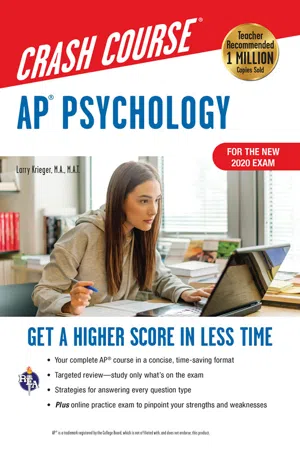
AP®  Psychology Crash Course, Book + Online
eBook - ePub

AP® Psychology Crash Course, Book + Online

Get a Higher Score in Less Time

  1. 288 pages
  2. English
  3. ePUB (mobile friendly)
  4. Available on iOS & Android
eBook - ePub

AP® Psychology Crash Course, Book + Online

Get a Higher Score in Less Time

About this book

AP® Psychology Crash Course® - up-to-date for today's exam A Higher Score in Less Time! At REA, we invented the quick-review study guide for AP® exams. A decade later, REA's Crash Course® remains the top choice for AP® students who want to make the most of their study time and earn a high score.
Here's why more AP® teachers and students turn to REA's AP® Psychology Crash Course® Targeted Review - Study Only What You Need to Know. REA's all-new3rd edition addresses all the latest test revisions. Our Crash Course ® is based on an in-depth analysis of the revised AP® Psychology course description outline and sample AP® test questions. We cover only the information tested on the exam, so you can make the most of your valuable study time. Expert Test-taking Strategies and Advice. Written by a veteran AP® Psychology teacher, the book gives you the topics and critical context that will matter most on exam day. Crash Course® relies on the author's extensive analysis of the test's structure and content. By following his advice, you can boost your score. Practice questions – a mini-test in the book, a full-length exam online. Are you ready for your exam? Try our focused practice set inside the book. Then go online to take our full-length practice exam. You'll get the benefits of timed testing, detailed answers, and automatic scoring that pinpoints your performance based on the official AP® exam topics – so you'll be confident on test day. When it's crucial crunch time and your Advanced Placement® exam is just around the corner, you need REA's Crash Course for AP® Psychology!

About the Author

Larry Krieger earned a B.A. in Psychology from the University of North Carolina at Chapel Hill and an M.S. from Wake Forest University. In a career spanning more that40 years, Mr. Krieger has taught a variety of AP® subjects. His popular courses were renowned for their energetic presentations, commitment to scholarship, and helping students achieve high AP® exam scores. All of Mr. Krieger's students scored above a 3 on their AP® exams, with most students scoring a 4 or a 5. In 2004 and 2005, the College Board® recognized Mr. Krieger as one of the nation's foremost AP® teachers. Mr. Krieger's success has extended far beyond the classroom. He has written several history textbooks and is a co-author of REA's Art History AP® test preparation guide. His latest venture, the AP® Crash Course® series, helps students strategically and effectively prepare for their AP® exams.

Frequently asked questions

Yes, you can cancel anytime from the Subscription tab in your account settings on the Perlego website. Your subscription will stay active until the end of your current billing period. Learn how to cancel your subscription.
No, books cannot be downloaded as external files, such as PDFs, for use outside of Perlego. However, you can download books within the Perlego app for offline reading on mobile or tablet. Learn more here.
Perlego offers two plans: Essential and Complete
  • Essential is ideal for learners and professionals who enjoy exploring a wide range of subjects. Access the Essential Library with 800,000+ trusted titles and best-sellers across business, personal growth, and the humanities. Includes unlimited reading time and Standard Read Aloud voice.
  • Complete: Perfect for advanced learners and researchers needing full, unrestricted access. Unlock 1.4M+ books across hundreds of subjects, including academic and specialized titles. The Complete Plan also includes advanced features like Premium Read Aloud and Research Assistant.
Both plans are available with monthly, semester, or annual billing cycles.
We are an online textbook subscription service, where you can get access to an entire online library for less than the price of a single book per month. With over 1 million books across 1000+ topics, we’ve got you covered! Learn more here.
Look out for the read-aloud symbol on your next book to see if you can listen to it. The read-aloud tool reads text aloud for you, highlighting the text as it is being read. You can pause it, speed it up and slow it down. Learn more here.
Yes! You can use the Perlego app on both iOS or Android devices to read anytime, anywhere — even offline. Perfect for commutes or when you’re on the go.
Please note we cannot support devices running on iOS 13 and Android 7 or earlier. Learn more about using the app.
Yes, you can access AP® Psychology Crash Course, Book + Online by Larry Krieger in PDF and/or ePUB format, as well as other popular books in Study Aids & Applied Psychology. We have over one million books available in our catalogue for you to explore.

Information

PART I
INTRODUCTION
Chapter 1
Eight Keys for Success on the AP® Psychology Exam
AP® Psychology textbooks are very thick and contain hundreds of terms, the names of famous psychologists, and landmark research studies. If all of these facts had an equal chance of appearing on your Advanced Placement® Psychology exam, studying would be a nightmare. Where would you begin? What would you emphasize? As you prepare for this exam, is there any information you can safely omit? Or must you study everything?
1.Understanding the AP® Psychology Scale
Many students believe they must make close to a perfect score to receive a 5. Nothing could be further from the truth. Each AP® Psychology exam contains a total of 150 points—100 for the multiple-choice and 50 for the two free-response questions. Here is the score range for the 2018 Released Exam:
Score Range AP® Grade Minimum Percent Correct
107–150 5 71%
88–106 4 58%
76–87 3 50%
63–75 2 39%
0–62 1 0–38%
This chart is not a misprint. As is clearly shown, you can earn a 5 by correctly answering just 71 percent of the questions, a 4 by correctly answering just 58 percent of the questions, and a 3 by correctly answering just 50 percent of the questions.
2.Understanding the AP® Psychology Course Outline
Many students believe that members of the AP® Psychology exam development committee have the freedom to write any questions they wish. This widespread belief is not true. AP® Psychology test writers use a detailed curriculum outline that tells them the topics that can be tested. The curriculum outline is freely available in the AP ® Psychology Course and Exam Description. Here are the nine units and the exam weighting for each unit.
AP® Psychology Unit Breakdown
Units Exam Weighting
Unit 1: Scientific Foundations of Psychology 10%–14%
Unit 2: Biological Bases of Behavior 8%–10%
Unit 3: Sensation and Perception 6%–8%
Unit 4: Learning 7%–9%
Unit 5: Cognitive Psychology 13%–17%
Unit 6: Developmental Psychology 7%–9%
Unit 7: Motivation, Emotion, and Personality 11%–15%
Unit 8: Clinical Psychology 12%–16%
Unit 9: Social Psychology 8%–10%
3.Understanding the Importance of the Released Exams
This Crash Course book is based upon a careful analysis of all released AP® Psychology multiple-choice and free-response questions from the College Board. These questions can be used to understand the priorities of the AP® Psychology test writers. It is important to understand that the test writers’ top priority is to create an exam that is a valid and reliable measure of a defined body of knowledge. As a result, test questions cluster around very predictable and often-repeated topics.
4.Understanding the Importance of Key Terms, Key Psychologists, and Key Theories
Key terms, key psychologists, and key theories dominate the multiple-choice questions. Approximately three-fourths of the multiple-choice questions test your knowledge of key terms. These questions typically ask you to identify either a definition of a term or the best example of a term. These key terms are defined and illustrated in Chapters 3 through 16. In addition, Chapter 2 provides a concise glossary of key terms.
The Course and Exam Description outline specifically identifies 62 psychologists who were major figures or key contributors in the 9 units covered on the AP® Psychology exam. About 15 percent of the multiple-choice questions test your ability to identify these psychologists and their theories. Chapter 17 provides a concise summary of famous psychologists and their key theories and research findings.
5.Understanding the Importance of Research Methodology
Research methodology is the single most important topic on the AP® Psychology exam. Taken together, the units on Scientific Foundations of Psychology (see Chapter 4) and Testing and Individual Differences (see Chapter 10) generate at least 15 multiple-choice questions that test your knowledge of methodology and statistics. In addition, one of your two essay questions will focus on research design and the analysis of quantitative data.
6.Understanding the Overlap Between the Multiple-Choice and Free-Response Questions
Both the multiple-choice and the free-response questions are taken from topics covered in the College Board’s course outline in the Course and Exam Description. This authoritative source contains a particularly detailed topical outline. This makes studying for the multiple-choice questions tantamount to studying for the free-response questions. Most students fail to grasp the significance of this point. Since the multiple-choice questions are highly predictable, so are the free-response questions. The two types of questions overlap since they both test key concepts from the same topical outline.
7.Using your Crash Course to Build a Winning Strategy
This Crash Course book is based on a careful analysis of the Course and Exam Description’s topical outline and all the released questions. Chapter 2 contains a concise glossary of the key terms you absolutely, positively have to know. Chapters 3 through 16 provide you with a detailed discussion of each content area covered on the AP® Psychology Exam. Chapter 17 provides you with a digest of key figures and their research findings and theories. Chapter 18 provides you with a summary of key topics that are easily confused and frequently tested. Chapter 19 discusses test-taking for the multiple-choice questions. Chapter 20 provides 25 practice multiple-choice questions. And finally, Chapter 21 provides a discussion and examples of the two types of essay questions.
If you have time, review the entire book. This is desirable, but not mandatory. The chapters can be studied in any order. Each chapter provides you with a rundown of key information that is repeatedly tested. Unlike most review books, our Crash Course is not meant to be exhaustive. Instead, it is meant to focus your attention on the vital material you must study.
Focus your attention on studying a group of topics that will generate the winning coalition of points you need to score a 4 or 5. Research methods, cognitive psychology, and clinica...

Table of contents

  1. Cover
  2. Title Page
  3. Copyright Page
  4. Contents
  5. About Our Book
  6. About Our Author
  7. Part I: Introduction
  8. Part II: Key Content Review
  9. Part III: Key Themes and Facts
  10. Part IV: Test-Taking Strategies and Practice Questions