![]()
Chapter 1 Take Us Out, Mr. Data What’s the most important thing to know about scientific knowledge?
In this section, you will come to see how
- scientific knowledge is based on empirical evidence, and
- science is limited to answering questions about the natural and material world.
You will be able to
- help your students perform scientific investigations via operational questions, and
- discuss similarities between student investigation activities and scientists’ activities.
Here’s a riddle: What do love, wind, luxury, and science all have in common? They are all easy to recognize, but hard to define, especially in ways everyone would agree upon. In the case of science, we often define the term with vague phrases, saying “science is a way of knowing” or talking about science as “a process.” Sometimes my students speak even more broadly, writing that “science is everywhere” or “everything is science.” Not very useful.
But defining science more specifically is hard. In 1997, Brian Alters published an article providing evidence that even people who study the nature of science disagreed about what it was they were studying. My colleagues quickly responded (Clough, 2007; Smith et al., 1997), accenting the disagreements as minor points. Despite widespread agreement on most points, philosophers of science nevertheless discuss the issue so much they have a special phrase to describe it: the demarcation problem. How do we demarcate, or distinguish, what is science from what is not?
This is a book for teachers, so let’s start addressing the question via a classroom activity, a fun one I’ll call Milk Fireworks. You may also recognize it by another name like “Cat’s Meow,” or “Breaking the Tension” (Bergman & Olson, 2011).
Activity 1: Milk Fireworks
Overview: Students perform an investigation activity with familiar everyday materials that introduces the kinds of questions scientists ask, and the practices they use when trying to figure out answers.
Grades: This investigation activity is definitely appropriate for all grade levels. Older students, however, may be more successful than younger ones at coming up with their own questions and procedures to investigate.
Time needed: Part I takes less than 10 minutes, once materials are assembled. Time for the rest of the investigation activity varies, depending on teacher and student interest.
Materials
Part I
- Petri dishes or similar shallow dishes
- Whole milk
- Food coloring (at least two colors)
- Toothpicks
- Liquid dish soap
Part II
- Optional additional materials: different kinds of milk (whole milk, 2% fat milk, skim milk, cream, nondairy milks), different sized and shaped containers, other liquids (e.g., water, vegetable oil, or corn syrup), other liquid detergents or dish soaps, various colors of food coloring, milk at different temperatures, and various other materials based on student and teacher interest
Teacher Instructions
Part I
- Have students take a Petri plate or other shallow dish and put a little whole milk into the dish, enough to cover the surface of the plate.
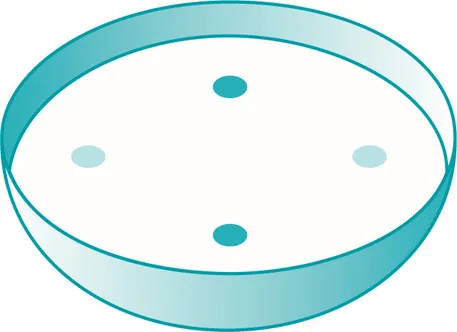
- Have students place two drops of food coloring at the 12 o’clock and 6 o’clock positions of the dish.
- Then have students place two drops of a different color food coloring at the 3 and 9 o’clock positions.
- Students should dip a toothpick into the milk in the center of the dish and quickly pull it out of the milk, then record their observations.
- Now, they repeat the toothpick procedure, but first dip the end of the toothpick into dish soap.
Figure 1.1 Milk Fireworks
Milk Fireworks initial setup
Part II
- 6. Have a whole-class discussion asking students to brainstorm a list of questions they have about what’s going on, recording the list of questions for everyone to see.
- 7. Take the list of questions students brainstormed and divide them into questions that can and cannot be answered directly by doing investigations. Accent how science is about asking and trying to answer the latter category, questions that are testable.
- 8. With your guidance, students can select one or more testable questions, figure out procedures to address the question, and go on to do the investigations. You’ll probably want students to write the question(s) they are testing, what they did to try answering the question, and what they found. You can do this with a worksheet students fill out, journal, interactive notebook, or any other method you like.
- 9. After completing their investigations, students share what they found, stressing the evidence supporting their ideas (i.e., what they observed during their investigations). The sharing can be individually (through writing), via pairs or small-group discussions, via a whole-group discussion, or again, any other method you like.
What’s Happening? Water tends to stick to itself, a phenomena scientists call surface tension. They believe detergents disrupt surface tension, ultimately pulling the water’s surface in various directions.
Try It!
Unless you’re teaching students about surface tension, properties of water, or colloids (see the What’s Going On in the Science section, below), it may be difficult to connect this investigation activity with a larger 5E or learningcycle model based science unit. However, students find the activity highly engaging, and it works well as an exploration. When you add in the fact its materials are familiar and readily available, Milk Fireworks works well early in the school year or as a 1-day standalone activity. It’s easy, cool, and accents how science is about asking and answering questions.
Teaching Tips
Steps 1–4: Even though I don’t want to spoil the spirit of inquiry, I am going to give it away: After completing the first four steps in the investigation, that is, when students dip a toothpick into the center of the milk-filled dish, they will observe nothing. Nothing much happens. But . . .
Step 5: When students then dip a toothpick with detergent on the end into the dish, something cool happens. The milk and food coloring will appear to move, with the colors swirling.
If you’ve never done this activity before, you should give it a try first on your own. Notice what happens, imagine how your students will react, and think through how you’ll manage the activity. As you are an experienced teacher, I don’t feel it’s my place to tell you how to manage the more general aspects of investigation activities. But, I do offer suggestions from some of your colleagues in Appendix B.
Steps 6–8: At this stage of the activity, as you facilitate a classroom discussion about your students’ observations and questions, here are three things to keep in mind.
Key Takeaway
Accepting student responses, and waiting several seconds after a student has responded, encourages other students to respond.
First, I recommend you simply accept what students say, neither praising nor rejecting—by saying things like “OK,” “got it,” repeating what the student says, or saying “thank you”—write their questions someplace for everyone to see, and encourage continued question generation. Students will start generating questions like
- “Why did the milk swirl?”
- “Will it still swirl with skim milk instead of whole milk?”
- “Will we be able to see the milk swirling without any food coloring?”
- “What will happen if we put the soap on the food coloring?”
- “Will it work with other soaps?”
- “What if we use warm milk?”
Second, once your students have generated some questions, divide them into two categories: those that can and those that cannot be answered directly via an investigation. All the questions I just listed except the first one are operational questions, meaning they can be investigated and answered pretty directly with evidence from investigations. To find out if the milk swirls any differently with skim and whole milk, for example, you would perform the procedure with whole milk, then perform it again keeping everything the same other than substituting in skim milk, and observe what happens. You might do it again or make sure others get the same results when they perform the same procedure, just to be sure, and you’ll have an answer.
“Why did the milk swirl?” is different. It cannot be answered as directly as the others via an investigation. It’s not an operational question.
If you can envision, almost immediately, how to figure out an answer to a question a student generated in Step 6, you’ll know it’s an operational question. “Will we be able to see the milk swirling without any food coloring?” Repeat the procedure as before, but don’t use any food coloring this time. “What will happen if we put soap directly on the food coloring?” Repeat the procedure as before, but put the soap directly on the food coloring this time.
Key Takeaway
The more tangible and observable an idea, the more students will understand it; this is especially true for younger students.
Operational questions like these, sometimes also called investigable questions, have special significance for elementary and middle school teachers. The more directly investigable a question, the closer the idea being investigated comes to being tangible and directly observable. And the more tangible an idea, the more likely students are to understand it. Generally speaking, elementary and middle school students are more likely to understand concrete, tangible, observable ideas than more abstract ones. Tangible concepts are more likely to be near students’ experiences than abstract concepts. Directly investigable questions and problems don’t just make for good science, as I explain below, they also make for good learning.
Third, even after limiting the list to operational questions, some questions may not reasonably be addressed in the classroom setting. They may be too complex, take too much time, or use mater...