![]()
Chapter One Introduction to the Book
Series
According to the Migration Policy Institute (2013), close to 5 million U.S.
students, which represent 9 percent of public school enrollment, are English
language learners (ELLs). Three-quarters of these 5 million students were born
in the United States and are either the children or grandchildren of immigrants.
In some large urban school districts such as Los Angeles, ELLs already comprise
around 30 percent of the student population. These demographic trends, along
with the rigorous content expectations of new content and language standards
(e.g., CCSS, WIDA, ELPA21, etc.), require that educational systems become
skilled at simultaneously scaffolding academic language and content for this
growing group of students. For ELLs, academic language mastery is the key to
accessing rigorous content. Now is a pivotal time in educational history to
address both academic language and content simultaneously so that ELLs do not
fall further behind in both areas while also becoming bored by methods that are
cognitively banal and lead to disengagement.
Another group of students who have academic language needs, but are not formally
identified as such, are standard English learners (SELs). SELs are students who
speak languages that do not correspond to standard American English language
structure and grammar but incorporate English vocabulary. They include African
American students who speak African American language (AAL), sometimes referred to as African American
English, and Mexican American–non-new-immigrant students who speak Mexican
American Language (MxAL) or what is commonly referred to as “Chicano English.”
ELLs and SELS also need instructional assistance in the academic language
necessary to be successful in school, college, and beyond. For both groups of
students, academic language represents the pathway to full access in meeting the
rigorous demands of the new standards.
Purpose of This Academic Language Development Book Series
The purpose of this series is to assist educators in developing expertise in,
and practical strategies for, addressing four key dimensions of academic
language when working with ELLs and SELs. To systemically address the needs
of ELLs and SELs, we educators must share a common understanding of academic
language development (ALD). Wong-Fillmore (2013) defines academic language
as “the language of texts. The forms of speech and written discourse that
are linguistic resources educated people in our society can draw on. This is
language that is capable of supporting complex thought, argumentation,
literacy, successful learning; it is the language used in written and spoken
communication in college and beyond” (p. 15). Given that we are preparing
ELLs and SELs for college, career, and beyond, they should receive ample
opportunities to learn and use academic language, both in spoken and written
form (Soto, 2014). ELLs and SELs also must be provided with scaffolded
access to cognitively and linguistically demanding content, which allows
them to cultivate their complex thinking and argumentation.
All students can benefit from academic language development modeling,
scaffolding, and practice, but ELLs and SELs need it to survive and thrive
in school. ELLs have plenty of language assets in their primary language
that we must leverage to grow their academic English, yet there is often a
very clear language and literacy gap that must be closed as soon as ELLs
enter school. Similarly, SELs come to school with a language variation that,
to be built upon in the classroom setting, must first be understood. In
reviewing the wide range of literature by experts in this field, most agree
that the key elements of academic English language for ELLs and SELs include
these four dimensions:
academic vocabulary, syntax and grammar, discourse, and culturally
responsive teaching.
We have therefore organized this book series around these four dimensions of
academic English:
- Conversational Discourse—developing students’ conversational skills
as an avenue for fostering academic language and thinking in a
discipline
- Academic Vocabulary—teaching high-frequency academic words and
discipline-specific vocabulary across content areas
- Syntax and Grammar—teaching sophisticated and complex syntactical
and grammatical structures in context
- Responsive Teaching—incorporating culture while addressing and
teaching language and honoring students’ home cultures and
communities
The focus on these four dimensions in this book series makes this a unique
offering for educators. By building upon the cultural and linguistic
similarities of ELLs and SELs, we embed strategies and instructional
approaches about academic vocabulary, discourse, and grammar and syntax
within culturally responsive teaching practices to make them all accessible
to teachers of diverse students. As the American poet and great thinker of
modern Hispanic literature, Sabine Ulibarrí, noted, “Language is culture; it
carries with it traditions, customs, the very life of a people. You cannot
separate one from the other. To love one is to love the other; to hate one
is to hate the other. If one wants to destroy a people, take away their
language and their culture will soon disappear.” Therefore, the heart of
this book series is to integrate language and culture in a manner that has
not been addressed with other books or book series on ALD.
Academic Language Development Dimensions Defined and
Connections to the Book Series
ALD is a pathway to equity. With new, rigorous state standards and
expectations, ALD is the scaffold that provides access for ELLs and SELs so
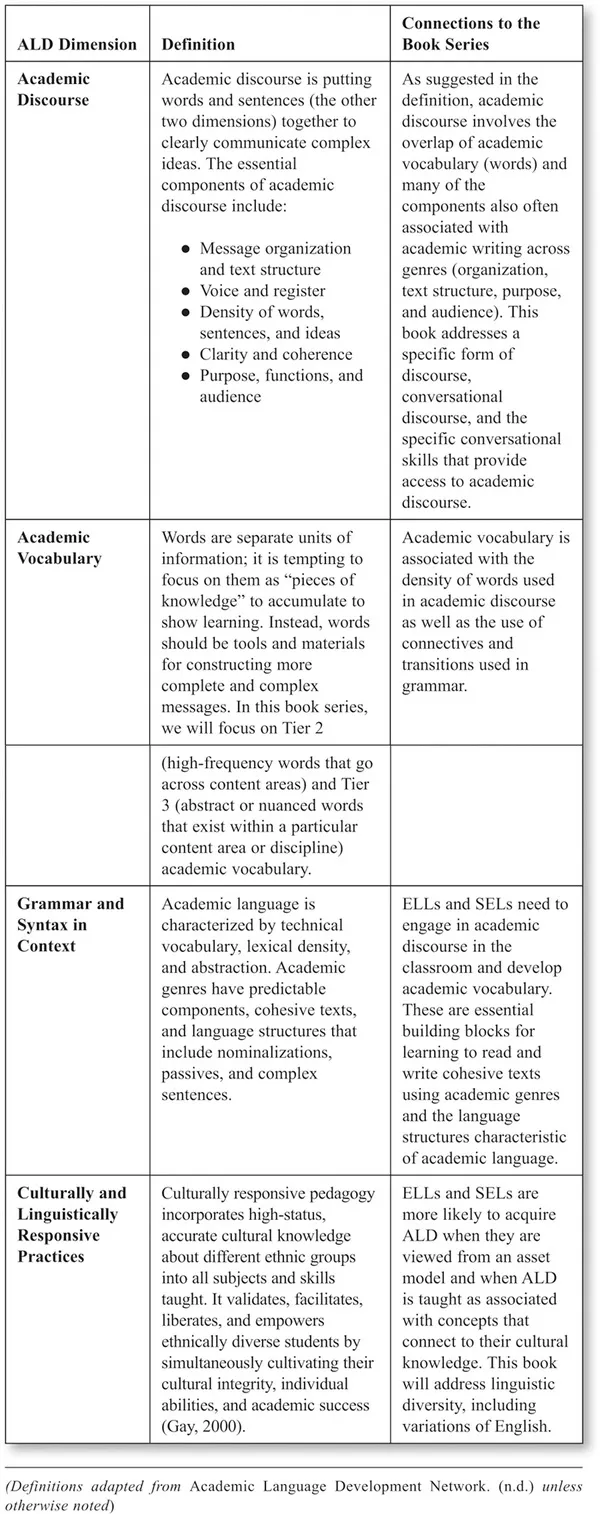
that high academic expectations can be maintained and reached. The following
matrix defines each dimension of ALD and demonstrates the connection of that ALD dimension
across the book series. For full proficiency in ALD, it is integral that
each dimension be addressed across disciplines—the dimensions should not be
taught as either/or skills. Instead, each of the dimensions should be
addressed throughout a course of study or unit. In that way, it is important
to read the book series in its entirety, as an ongoing professional
development growth tool (more on that later). The matrix also demonstrates
the connections made between ALD dimensions, which will prove helpful as
readers complete continue their study across the ALD book series.
(Definitions adapted from Academic
Language Development Network. (n.d.) unless otherwise noted)
Format for Each Book
At the beginning of each book is an introduction to the purpose of the book
series, including the format of each book and their intersections.
Additionally, connections between current ALD research and the specific
dimension of ALD are included in an abbreviated literature review. In the middle of each book,
the voice of the expert in the particular ALD dimension is incorporated with
practical strategies and classroom examples. These chapters include how to
move from theory to practice, classroom examples at elementary and secondary
levels, and ways to assess the dimension. At the end of each book, a summary
of major points and how to overcome related challenges are included along
with the rationale for use of the Institute for Culturally and
Linguistically Responsive Teaching (ICLRT) Design Principles as a bridge
between ALD and content. Also included at the end of each book are
additional professional development resources.
Additionally, each book in the series is organized in a similar manner for
ease of use by the reader. Chapter 1 is the introduction
to the series of books and not an introduction for each individual book.
Instead, Chapter 2 introduces each
dimension of ALD with the specific research base for that book. The heart of
each book in the series is in Chapter 3, where practical application to theory and classroom
examples can be found. Chapter 4 addresses how each
ALD dimension fosters literacy development. In Chapter 5, how to assess the specific ALD dimension is discussed
with checklists and rubrics to assist with formative assessment in this
area. Last, Chapter 6 connects each volume
with the others in the series and details how the book series can best be
used in a professional development setting. The epilogue revisits the vision
for the series and provides a description of the relationship to the
underlying principles of the ICLRT.
-
Chapter 1—Introduction
to the Book Series
-
Chapter 2—Abbreviated
Literature Review/Research Base for Grammar and Syntax
-
Chapter 3— Practical
Application to the Classroom for Grammar and Syntax
-
Chapter 4—Fostering
Literacy With Grammar and Syntax
-
Chapter 5— Assessing
Grammar and Syntax
-
Chapter 6—Conclusions,
Challenges, and Connections
- Epilogue: The Vision
How to Use the Book Series
While each book can stand alone, the book series was designed to be read
together with colleagues and over time. As such, it is a professional
development tool for educational communities, which can also be used for extended
learning on ALD. Educators may choose to begin with any of the four key
dimensions of ALD that interests them the most or with which they need the
most assistance.
How to Use Reflect and Apply Queries
Embedded throughout this book series you will find queries that will ask you
to reflect and apply new learning to your own practice. Please note that you
may choose to use the queries in a variety of settings either with a book
study buddy during PLC, grade-level, or department meetings. Each of the
queries can be answered in a separate journal while one is reading the text,
or as a group you may choose to reflect on only a few queries throughout a
chapter. Please feel free to use as many or as few queries as are helpful to
you, but we do encourage you to at least try a couple out for reflection as
you read the book series.
Try it out by responding to the first query here.
Reflect and Apply
What does the following Sabine Ulibarrí quote mean to you? How does it
connect to your students?
“Language is culture; it carries with it traditions, customs, the very
life of a people. You cannot separate one from the other. To love one is
to love the other; to hate one is to hate the other. If one wants to
destroy a people, take away their language and their culture will soon
disappear.”
Book Series Connection to Grammar and Syntax
As previously discussed, grammar and syntax are essential components of ALD.
Unfortunately, these components have either been overly emphasized and some
teachers have taught grammar in a rote manner that is decontextualized and
disconnected to student needs and learning, or they have completely
disregarded grammar due to their lack of experience in teaching grammar and
syntax appropriately. Still other teachers become overwhelmed with the large gaps in the
knowledge of grammar and syntax that ELLs may bring to school and are unsure
of the best approaches to meeting students’ needs. This book on grammar and
syntax addresses these concerns, first by building background knowledge and
confidence on the part of educators regarding the varying views of grammar
that have been used and then by giving specific recommendations for how to
teach ALD in a contextualized manner that addresses ELLs’ and SELs’ language
gaps. The approach to teaching grammar and syntax introduced in this book in
the series, along with the ICLRT Design Principles (in the epilogue),
provide a theoretical and practical framework for addressing ALD in a
contextualized manner across disciplines.
![]()
Chapter Two Abbreviated Literature Review/Research Base for Grammar and Syntax
To understand the role of grammar and syntax in ALD, it is important to have a clear understanding of the terms grammar and syntax as well as an understanding of the characteristics of academic language. Teachers who understand these concepts can better plan how to teach and assess English language learners.
Four Views of Grammar
In the minds of most people, grammar refers to a set of rules needed to speak and write the standard or conventional form of a language. A second view is that grammar is the built-in, subconscious knowledge of a language that enables people to communicate in that language. Most linguists, especially those whose work is based on Chomsky’s (1965) theories, consider grammar to be the study of syntactic structures. For these lingu...