CHAPTER 1 An Overview of Lab Class
The idea is that significant changes in student learning, engagement and success depend on deep and sustained changes in the practices in classrooms and schools, and that these changes will emerge from the teacher learning (professional knowledge creation and sharing) that occurs through interaction within and across schools in networks.
—Katz, Dack, & Earl (2009)
What Is Lab Class?
Lab Class is a professional learning structure combining the “teacher as researcher” approach of collaborative inquiry (Donohoo, 2013) with descriptive observation and analysis of student learning in the classroom. In Lab Class teachers examine the impact of instructional practice on student learning through collaborative planning, teaching, assessment, and observation and consider how evidence-informed instructional approaches can be implemented in their classrooms. Time for professional learning is embedded in Lab Class and is in response to observations of student learning; teachers learn from their students as well as from one another and with one another. It is a structure that can be effectively used by teachers from kindergarten to Grade 12.
As mentioned in the preface, the Lab Class structure grew out of our work as coaches and consultants using collaborative inquiry as a professional learning model with educators. Collaborative inquiry is a four-stage model where teachers are: Framing the Problem; Collecting Evidence; Analyzing Evidence; and Documenting, Sharing, and Celebrating (Donohoo, 2013). Educators and administrators used collaborative inquiry to focus on the goals set out in their school improvement plan, their students’ needs, and their own professional learning interests. But educators told us they wanted to see inquiry in action and get into one another’s classrooms. As a result, the Lab Class model was created to combine the elements of collaborative inquiry with purposeful classroom observation and analysis of student learning. The examples and quotations in this book are from students, teachers, and administrators who participated in Lab Class projects over the past 7 years in our school district. (The names of people and places have been changed to ensure anonymity.)
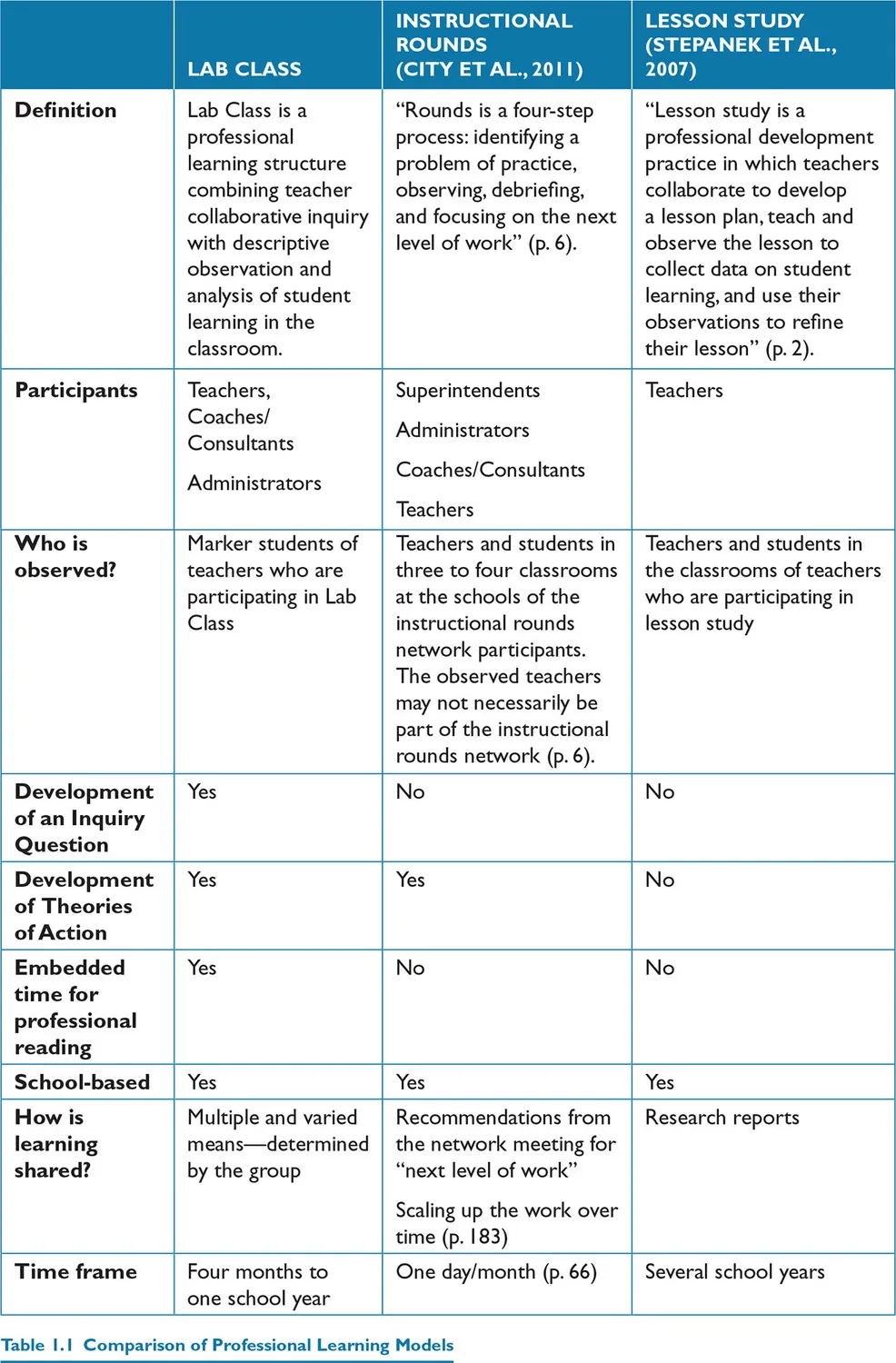
While Lab Class is similar to other professional learning models such as Instructional Rounds (City, Elmore, Fiarman, & Teitel, 2011) and Lesson Study (Stepanek, Appel, Leong, Turner Mangan, & Mitchell, 2007) in that it is school-based, it has many unique features that set it apart. In Lab Class, teachers observe student learning from an asset stance, concentrating on students’ learning strengths rather than their deficits. Observations are focused on three or four carefully selected marker students or “students of mystery”—these are students who are able to achieve but are not achieving, with no clear reason for their lack of progress (Ontario Ministry of Education, 2012). During Lab Class, teachers engage in professional learning using research and professional resources to determine next steps. The time frame for Lab Class can range from a few months up to a school year, and the number of participants can range from as few as three teachers to large groups of 20 teachers. Each of these features is explored in greater depth in subsequent chapters.
Lab Class can be used by several teachers at one school or by a network of teachers across multiple schools. The concept of networks is wide-ranging in professional learning models; in Lab Class, we refer to networks as groups of teachers within one school or across several schools who are engaging in collaborative professional learning to improve their teaching and ultimately improve student achievement. Capacity building in schools is strengthened by groups of teachers coming together to share and analyze their work, but school-to-school learning networks give schools and teachers an even wider range of ideas and choices and move good teaching around the system (Stoll, 2009).
The Lab Class Model—Step by Step
This resource is intended to act as a support for educators and facilitators interested in supporting colleagues in using the Lab Class process to engage in sustained professional learning. Lab Class takes place over a period of several months and begins with a Launch Meeting for all participants, including the school administrator. This is followed by several days of classroom observations, analysis, and professional learning spread over weeks or months, and Lab Class concludes with a final Consolidation Meeting. The steps of Lab Class, listed and outlined briefly below, are more fully explained in subsequent chapters. Templates and other resources for facilitators of Lab Class can be found in the Appendix.
A Visual Overview of Lab Class
Launch Meeting
- Overview and expectations
- Create norms
- Determine focus
- Develop inquiry question and theories of action
- Learn to be descriptive
- Walkthrough of Lab Class
- Select marker students
- Schedule observation visits
- Review inquiry question and theories of action
- Summarize key learning for students and teachers
- Develop communication plan
- Next steps and professional learning
Preparing for Lab Class: Launch Meeting
- Determine a focus. Teams develop their collaborative inquiry questions based on evidence about students’ capabilities and areas for growth as well as their own professional curiosities using the frame: What is the impact of this teacher practice on this student learning?
- Learn to be descriptive. City et al. (2011) noted that trying to simply observe what we see at the most basic descriptive level without inference or judgment is very difficult. Prior to engaging in the first classroom observation, teachers use photos and video clips of students engaged in learning to practice taking descriptive observations and provide feedback to each other on their progress.
- Discuss norms. Each lab class group creates their own set of norms for the in-school classroom observations, which are reviewed before each classroom observation visit. Determine a schedule for classroom observation visits.
Engaging in Lab Class
On a subsequent day, the teachers engage in the first round of Lab Class observation visits. The number of additional rounds of observation visits will be determined by the budget for teacher release time and by the number of teachers participating in Lab Class. Every teacher participating in Lab Class, including the teachers being observed, is provided with supply coverage by an occasional teacher for each session.
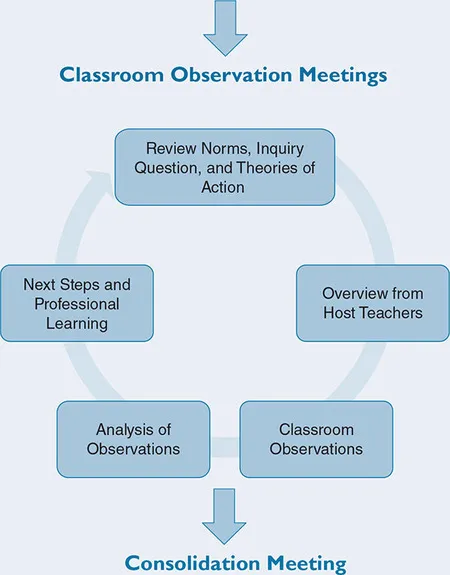
- 4. Take descriptive observations. Participants visit classrooms to take descriptive observations of student conversations, actions, and products. Before heading to the classrooms, teachers meet briefly to review the norms and the team’s inquiry question.
- 5. Engage in individual analysis of observations. Following the classroom observations each participant selects three to five observations that were descriptive, student-focused, asset-based, and related to the identified student learning focus to use for the analysis exercise.
- 6. Cluster observations and name emerging trends. With a curriculum consultant, coach, or teacher acting as facilitator, teachers work together to name and cluster emerging trends while they share the observations they had recorded.
- 7. Identify conditions present. Next, teachers discuss what conditions were present that allowed these trends to emerge. Conditions might include the routines and procedures in place, the organization of materials in the classroom environment, or specific teaching strategies.
- 8. Determine next steps. Based on the observations from Lab Class as well as the contributions from teachers whose classrooms were not observed, teachers collaboratively determine next steps and identify the resources that support the professional learning they need to engage in related to these next steps. These resources may include professional books, articles, district or government publications, curriculum materials, or human resources including support staff such as curriculum consultants, specialists, instructional coaches, or community partners.
- 9. Document the learning of teachers and students. Though many teachers are comfortable with documenting student learning, some struggle to document their own professional learning and growth. By providing time during Lab Class, teachers are supported in exploring a range of strategies for reflecting on and recording their own learning. Facilitators should review school and district policies on recording and sharing student learning prior to beginning Lab Class.
This cycle of Steps 4 through 9 is repeated on subsequent days until each teacher has had an opportunity to host observers in his or her classroom at least once.
Consolidation and Culmination of Lab Class
- 10. Share the learning. At the final networked learning session, teachers and administrators reflect on their own professional and personal learning, the students’ learning, and their team’s learning journey and consider with whom they want to share their learning and how they might share it.
Rationale for Lab Class
Years ago, professional development often took place at the district office or another central location such as a catering hall. Curriculum consultants from the central office were expected to have expertise in specific areas and to share their expertise with teachers, administrators, and the public. Teachers and administrators would leave their schools, attend a workshop, then return to their schools and be expected to implement whatever strategies had been introduced at the session. But researchers such as Borman (cited in Fullan, Hill, & Crévola, 2006) found little connection between professional development and changes in classroom instruction, even though the professional development was based on extensive modeling of specific instructional practices. Timperley and Alton-Lee (2008) noted that these highly prescriptive models of professional learning had little impact on student achievement whereas models of teacher inquiry had a more profound impact on teacher practice and knowledge.
There has been a dramatic shift in professional learning for educators and administrators and while there is still a time and a place for centralized workshops, much of the professional learning today takes place at the school through teacher inquiry. This inquiry learning is embedded in teachers’ daily work and is directed by the needs of educators and students. Inquiry has the potential to create deep and significant changes in education, but there is neither a specific prescribed protocol for inquiry nor only one model that all educators should use (Ontario Ministry of Education, 2014). Lab Class is one model for professional learning that can be used by teachers to engage in teacher inquiry.
Goals of Lab Class
Regardless of the number of schools or the number of teachers participating, the overall goals of Lab Class remain the same—deprivatization of teacher practice, implementation of evidence-informed instructional approaches, development of teacher efficacy, the adoption of a learning-as-inquiry stance, creation of a culture of collaboration, and improved student achievement. While the goals are listed separately here, in practice they are intertwined and recursive.
Deprivatization of Teacher Practice
Teachers often work in isolation behind closed classroom doors and as a result, some
teachers have come to regard autonomy and creativity—not rigorous, shared knowledge—as the badge of professionalism. . . . Teacher autonomy and isolation produce highly personalized forms of instruction and huge variations in teacher quality and effectiveness. In effect, each teacher is left to invent his or her own knowledge base—unexamined, untested, idiosyncratic, and potentially at odds with the knowledge from which other teachers may be operating. (Burney, 2004)
Each teacher who participates in Lab Class is able to observe in other teachers’ classroo...