The New Normal
The role of the school principal has changed dramatically in recent years (Hull, 2018). Whereas in previous eras the principal was responsible for building administration and operational duties, today’s principals are expected to be instructional leaders, culture builders, and data analyzers who guide school improvement efforts as well as manage building operations (Alvoid & Black, 2014). Student achievement data, once difficult for citizens to locate, is now easily found with a quick Internet search. As a result, the public is more involved in school functions, has more informed opinions, and has greater expectations of the school system and principals.
When you think of a principal from your own personal school experience, what images come to mind? Some people cite that the principal was a disciplinarian who ruled an iron fist. Others clearly remember the use of corporal punishment by their principal while others say they only remember the principal because his or her picture appeared on the class composite from the local photography company. Though we have different memories of that person, most of us will agree that it seemed like the principal was a permanent fixture at the school, often serving 10 to 20 years in the same office. Nowadays, the notion that the principal is permanent no longer holds true. Results from the 2016–2017 school year indicate that nearly 20% of public school principals changed schools or left the profession. These statistics have remained constant since 2008 (National Center for Educational Statistics [NCES], 2018c).
Principals face more scrutiny from the public than ever before. Society is concerned with the state of public education and how well our students perform in math when compared to students in other countries. The community wants to know how money is allocated to different programs and if their kid will go to Sea World this year. Parent involvement used to mean supporting school activities through bake sales. The National Education Association (NEA) reports that many states now require that education policy includes parents as decision makers in matters of school business. People are more actively involved in their children’s education than ever before (NEA, 2012).
Under the watchful eyes of the public, principals are also confronted by changing demographics in their schools. Increasing diversity, including racial, ethnic, linguistic, LGBTQ groups, and growing numbers of students with disabilities, have surfaced new challenges in school settings. Principals are tasked with ensuring the wide range of academic, emotional, and social needs of students are being met. Peter DeWitt’s (2017) top 10 list of critical issues that principals face on a daily basis includes the school-to-prison pipeline, student learning, social media, and the effects of poverty. A 2012 survey by MetLife indicated that principals feel their job responsibilities are remarkably different from just five years before, and 75% of those reported that their jobs are too complex and have led to higher degrees of stress and decreased job satisfaction (MetLife, 2012). Changing expectations, coupled with inadequate training and support, have led many principals to conclude that their jobs are no longer sustainable (Alvoid & Black, 2014).
Ten years ago, social media was not a thing. Today it is a thing and we are acutely aware of public posts to Facebook, Twitter, and other platforms. We are concerned that students use social media and instant messaging to communicate rapidly with their peers. We are worried about their quick access to cameras and video recorders. We are distressed that students are able to circulate inappropriate pictures and are quick to press the record button to film themselves and others. While technology has certainly played a positive role in transforming education, other aspects have led to disastrous consequences for the victims of slander, bullying, and other character smears. Each of these issues represent ethical challenges for principals.
Principals also grapple with local, state, and national policies that may be at odds with each other (Hull, 2018). For example, in recent years there has been a shift in some communities toward a restorative approach instead of punishment when a student misbehaves. The Obama administration was concerned with disparate suspension rates between African American students and other groups, taking steps to rectify unfair disciplinary practices. The Trump administration is taking a different approach, disregarding restorative practices but providing guidelines for schools who choose to arm their teachers (Meckler, 2018). Principals who choose to take the restorative approach find themselves needing to justify their decisions to parents who demand punishment for the perpetrator when their child is the victim or teachers who insist stringent consequences and high standards are in the best interest of the students.
Because of the evolving and complex nature of the job, being a school principal is no easy feat. The leadership terrain is often muddled by obstructions and hurdles that may require us to think fast, reevaluate, and make necessary pivots. Plans fail, people move, and there seems to be never-ending budget cuts that require leaders to stretch dollars further and further.
While principals from previous eras had power to rule unilaterally from their offices, today’s leaders are expected to work collaboratively, involving others in decision making. They are facilitators who help others to understand policy and context while ensuring discussions are inclusive. A chief role of the principal is to assist groups of people with divergent interests to come to a consensus in service of student learning. Today’s principals are unable to rely on a one-size-fits-all method that may have worked with a past generation; instead, they must be innovative problem solvers.
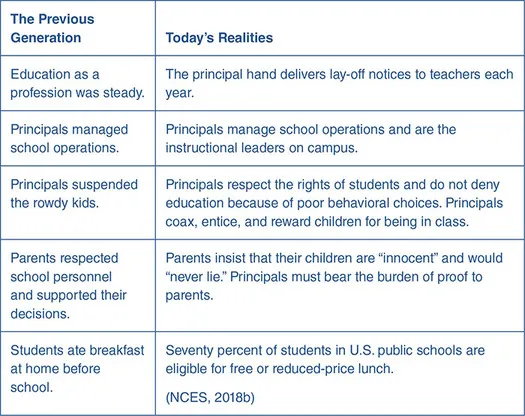
Further, solving problems is unlike previous eras when the principal could impose a decision or rule without rebuke. Today’s principals must consider how local and national policies might impact a wide range of diverse community members, who may have their own competing interests (see Figure 1.1). These problems, some of which feel unsurmountable, combined with a nonstop pace have resulted in high levels of principal turnover, especially in lower socioeconomic neighborhoods (Branch, Hanushek, & Rivkin, 2013).
Figure 1.1 Characteristics of Public Schools: Then and Now
Our understanding of ourselves and our profession should continue to deepen and grow throughout our lifetimes. Successful leaders keep up to date by continually reading and discussing emerging educational research as well as by staying current with what’s in the news. Regular attendance at workshops and conferences are opportunities to learn, build networks, and grow content knowledge. By taking advantage of these learning opportunities, you will extend your understanding of educational practices, are more likely to anticipate potential barriers that may pop up, and are better equipped to make sense of sensitive situations that arise at your school site.
Today’s realities in schools necessitate that principals are prepared to have conversations with students, staff, and parents that were unlikely only a few years ago. Current topics such as gender-neutral bathrooms, transgender teens who play on boys’ and girls’ sports teams, and beliefs about prayers during the school day are often highly sensitive and may result in ethical dilemmas because of people’s views. “Because ethical dilemmas are so value laden, it is essential that school leaders understand their own values and value positions” (Cranston, Ehrich, & Kimber, 2014, p. 240). As such, we must be able to articulate, and defend if necessary, what we truly stand for.
Commitment to our ideals is what makes us ethical leaders. This unwavering devotion establishes a reputation as a leader, parent, community member, or employee. It is a conscious effort to be explicit about what you believe in and what you’re not willing to let go. Consistently leading with our core values is one way to earn respect from others in the organization and school community. People take cues from the ways in which the leader behaves. As people get to know you, they come to expect how you will respond in given situations.
Strategies, goals, and missions may change; however, values are your core and remain intact despite new conditions, new laws, and new goals (Starr, 2016). Certainly, there are open and shut cases that do not require strategic thinking and careful analysis of solutions. Some issues can be handled by adhering to a policy or maintaining a child-centered approach. Often, we are able to resolve these “no brainers” because we have a firm understanding and devotion to our core values. So, what do you believe in? Why do you feel that way? How do your beliefs influence your actions?
Activity 1.1
Identify Your Core Values
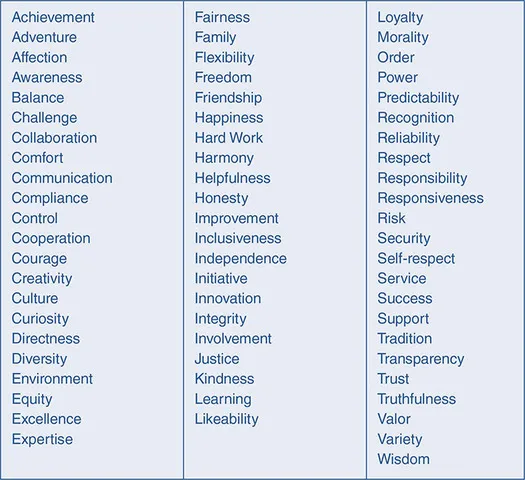
As a leader, it is important that you be able to succinctly articulate your leadership values, such that you are able to speak of them easily, infuse them into professional conversations, and lead based upon that awareness. A manager of an environmentally focused nonprofit may identify her core values as the environment, service, and creativity. A police officer may state that security, control, and integrity are the backbone of his work. It is important to be conscious of what our own personal values (see Figure 1.2) are so that we can evaluate whether the decisions we make match up to the values we have articulated.
Step 1. Reflect
Consider the values listed on the next page in relation to your career, not your personal life.
Step 2. Identify
Circle five values that you consider to be cornerstones of your leadership. Which values elicit strong feelings within you? Which can you not imagine leading without? Choose five, or feel free to include additional values that are not listed in Figure 1.2
Figure 1.2 List of Core Values
Step 3. Focus
Now that you have identified five values, cross two of them off. This might be challenging, but it’s important to truly identify the essence of your leadership. Once you have identified the top three core values that are most important to you, take notice of why these three stood out to you. There is often a reason, story, or a belief that deeply resonates with you. Use the lines below to record your top three core values and the reasons behind them.
- Core Value #1: __________ Underlying reason: ______________
- Core Value #2: __________ Underlying reason: ______________
- Core Value #3: __________ Underlying reason: ______________
Step 4. Communicate
Our beliefs drive our actions. As leaders, it is important to communicate our core values to the community we serve so that they know what we stand for and how decisions have been approached and informed. Now that you have identified your three core values, how might you reference them during discussions, presentations, meetings, e-mails, newsletters, or other communications? When you are transparent with your values and consistently communicate them verbally and nonverbally, people take notice of your character and what you believe in. Abiding by your core values also helps you stay true to yourself. The ability to name your core values, as well as lead in service of them, builds your credibility as a leader in your c...