The Intelligent, Responsive Leader
eBook - ePub

The Intelligent, Responsive Leader

  1. 192 pages
  2. English
  3. ePUB (mobile friendly)
  4. Available on iOS & Android
eBook - ePub

The Intelligent, Responsive Leader

About this book

Jump start your roles as "learning leader" and "lead learner!"


Designed for leaders to learn and lead within the "middle space" between the seemingly opposing dynamics of district expectations and practitioner experience, this book advances the concept of the school as a learning organization. This innovative perspective guides leaders through an intentional, deliberate learning process to develop intelligent, responsive leadership practice. Using stories, strategies, and tools, the authors

  • Explain the power of "purposeful practice" as a methodology for getting better
  • Show how to build the requisite capacities to lead effectively via "influence"
  • Describe how to turn adaptive challenges into leadership inquiries for growth

"This important work demonstrates and reinforces the idea that continuous improvement can only come from deep, intentional, focused, and hard work on the part of everyone within an organization. While the examples are rooted within schools and school districts, this work is applicable to any organization that seeks meaningful and specific improvement in their results. This is a must-read for leaders!"

—Lynn Macan

University at Albany - SUNY, Albany, NY

Frequently asked questions

Yes, you can cancel anytime from the Subscription tab in your account settings on the Perlego website. Your subscription will stay active until the end of your current billing period. Learn how to cancel your subscription.
No, books cannot be downloaded as external files, such as PDFs, for use outside of Perlego. However, you can download books within the Perlego app for offline reading on mobile or tablet. Learn more here.
Perlego offers two plans: Essential and Complete
  • Essential is ideal for learners and professionals who enjoy exploring a wide range of subjects. Access the Essential Library with 800,000+ trusted titles and best-sellers across business, personal growth, and the humanities. Includes unlimited reading time and Standard Read Aloud voice.
  • Complete: Perfect for advanced learners and researchers needing full, unrestricted access. Unlock 1.4M+ books across hundreds of subjects, including academic and specialized titles. The Complete Plan also includes advanced features like Premium Read Aloud and Research Assistant.
Both plans are available with monthly, semester, or annual billing cycles.
We are an online textbook subscription service, where you can get access to an entire online library for less than the price of a single book per month. With over 1 million books across 1000+ topics, we’ve got you covered! Learn more here.
Look out for the read-aloud symbol on your next book to see if you can listen to it. The read-aloud tool reads text aloud for you, highlighting the text as it is being read. You can pause it, speed it up and slow it down. Learn more here.
Yes! You can use the Perlego app on both iOS or Android devices to read anytime, anywhere — even offline. Perfect for commutes or when you’re on the go.
Please note we cannot support devices running on iOS 13 and Android 7 or earlier. Learn more about using the app.
Yes, you can access The Intelligent, Responsive Leader by Steven Katz,Lisa Ain Dack,John Malloy in PDF and/or ePUB format, as well as other popular books in Education & Leadership in Education. We have over one million books available in our catalogue for you to explore.

Information

Publisher
Corwin
Year
2017
Print ISBN
9781506333151
eBook ISBN
9781506386836

1 The Challenge of Leading in the Middle Space

Beyond Intentional Interruption

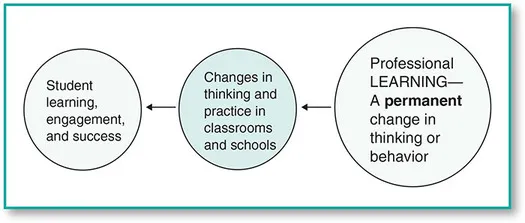
In our previous book, Intentional Interruption: Breaking Down Learning Barriers to Transform Professional Practice (Katz & Dack, 2013), we articulate the links among professional learning, high-quality classroom practice, and improved student achievement. We explain that new professional learning—real learning—is hard work. We describe how human beings have a natural (but unconscious) propensity either to avoid new learning or to turn something novel into something familiar. That is, we transform the world to fit what’s already in our minds. But what we are really after—real learning—involves changing our mental structures to fit new information that we encounter. New learning is about thinking, knowing, and understanding differently than we did before. In Intentional Interruption, we explain that if we are going to facilitate real professional learning—what we call deep conceptual change—then it’s important to understand what gets in the way. We suggest that successful school improvement is about intentional interruption—an intentional interruption of the subtle supports that work to preserve the status quo and impede new learning. And we outline what it means to intentionally interrupt the status quo of professional learning in order to enable real new learning that takes the form of permanent changes in thinking and practice.
Since the publication of Intentional Interruption, we have been part of many school districts’ efforts to put the book’s ideas into practice as a core part of their school improvement efforts and, in particular, their leadership development efforts. With much of the recent research on school leadership pointing to the impact and importance of instructional leadership (e.g., Hattie, 2015), the ability of leaders to lead real professional learning through intentional interruption has taken center stage. As we’ve said before, student success follows from high-quality classroom practice. High-quality classroom practice follows from real professional learning. Impactful school leaders know how to create the conditions for teachers to learn what they need to learn, so that teachers in turn can create the conditions for students to learn what they need to learn.
As we’ve joined many school (and district) leaders on their respective journeys to lead learning and improve schools, we’ve encountered a ubiquitous leadership problem of professional practice. Specifically, school leaders often find themselves situated between a set of top-down, district-level directives that prescribe expectations and a set of bottom-up, practitioner-driven preferences that favor experiential professional judgment. This duality seems to present often as an incompatibility, with the school leader caught in the middle. What does it mean to “lead” within that space? What does it mean to be a “learning organization” in that space? In this book we take up these questions by putting forth the notion of a school as a learning organization in which prescribed expectations and experiential professional judgment aren’t oppositional and incompatible. We refer to this particular type of learning organization as an intelligent, responsive school.
Our goal in this book is to unpack what it means to effectively lead an intelligent, responsive school. Before we can do that, however, we need to do a couple of things fairly quickly: first, we need to revisit and reiterate the centrality of professional learning to the school improvement agenda, because it’s at the heart of what impactful instructional leaders seek to influence; and second, we need to engage in the one practice that the literature on expertise suggests unites all experts regardless of domain—an in-depth understanding of the nature of the problem or challenge that we are up against. This chapter does both of those things.

The Centrality of Professional Learning

We consider professional learning to be at the heart of all school improvement processes because it’s at the heart of impactful practice. Professional learning that allows educators to grapple with complex challenges of practice, which grow out of student learning needs, has the best possibility of leading to different and effective ways of thinking and doing in schools. As we explain in Intentional Interruption, teacher practice is the single biggest predictor of student outcomes. If teacher practice doesn’t change in classrooms where students are struggling to achieve, it’s unlikely that student learning will improve. Real professional learning needs to drive this change. Real professional learning is much more than teachers planning lessons together, engaging in a book study, or even talking about the different challenges they face each day in their classrooms. The kind of professional learning that we are talking about here is that which is directed by a clear, needs-based focus and follows a professional learning cycle in a disciplined way. Figure 1.1 illustrates and explicates this process.
Figure 1
Figure 1.1 The Professional Learning Cycle
Source: Timperley, Wilson, Barrar, and Fung (2008).
Most teachers that we know work hard each and every day to provide the best opportunities for their students. They utilize all the strategies that they know to make a difference for the children in their care. Teachers don’t purposefully hold back. If they know what to do to ensure that each student is achieving in their classrooms, they do it. They don’t “save their best” for when students are more deserving! Research tells us that many teachers are good at knowing where students are struggling (Katz, Earl, & Ben Jaafar, 2009). The challenge is in knowing what to do for each student in the face of these learning gaps. We know that more of the same—even slower, louder, and a few more times—isn’t likely to yield a different result. This is why professional learning matters so much. There are only two options for change: new students or new teaching practices. The former usually isn’t possible. Parents aren’t keeping the good students at home. They’re sending the best they’ve got. So if teachers are teaching the best way they know how but there are still learning gaps for students, we need to think about changing teaching practice. That’s where professional learning comes in.
The research-based theory of action that we explicate in Intentional Interruption (reproduced here in Figure 1.2) shows how positive impacts on student learning, achievement, and well-being are dependent on high-quality classroom practice, which, in turn, is dependent on impactful professional learning. The challenge, as we have explained, is that most professional learning doesn’t result in changed thinking and practice in schools and classrooms because the new learning doesn’t reach the requisite threshold for “permanence.” Permanence refers to the extent to which the status quo of believing, thinking, and acting is changed forever. It doesn’t prohibit continuing to grow and move forward, but it does preclude going “back” to previous patterns of knowing and doing. Richard Elmore’s book title I Used to Think . . . and Now I Think . . . (2011) succinctly captures what we are getting at here. The details behind the what, how, and who of “real” or “permanent” professional learning are spelled out in Intentional Interruption, and we won’t recapitulate them here. Suffice it to say, the necessary evidence-based professional learning focus and the requisite professional learning methodology that we refer to as “collaborative inquiry that challenges thinking and practice” are essential enablers of professional learning. School leaders—as instructional leaders—play a key role in creating the conditions for these things.

Leading in the Middle Space

Principals, as instructional leaders, play a significant role in creating the conditions for learning for both students and staff (see, e.g., Robinson, Hohepa, & Lloyd, 2009). As they work collaboratively with their colleagues to learn about creating effective conditions for teaching and learning, they also find themselves in the challenging position of supporting each and every teacher in their schools while responding to the many expectations that come from their communities, their school districts, and state or provincial bodies. Being a principal is challenging; on the worst days, it feels like there is little escape from the “pressures from above” and “blame from below.” Leithwood and Azah (2014) have examined this phenomenon from a “workload” perspective, exploring the cognitive and emotional dimensions of workload pressures that principals feel while living in this space. But it is exactly in this “middle space” that principals do exercise their leadership, as they are the key link between the district’s central office and the classroom. And as we know from the research, principal leadership is second only to teacher practice when it comes to influencing student learning and achievement (Leithwood, 2012). The middle space is challenging but important.
Figure 2
Figure 1.2 The Path of School Improvement
Source: Katz and Dack (2013).
There are many examples to illustrate the challenges principals experience while leading in this middle space. Principals attend meetings where they learn about effective practice and hear expectations about school improvement efforts. They have opportunities to learn about what research says about good instruction and about the experiences of other colleagues in terms of their improvement efforts, and they are exposed to a myriad of initiatives (and resources) that have been created at the system level that are intended to assist them (even though they don’t always experience the initiatives as such). These principals also have many responsibilities at their schools in terms of managing day-to-day operations, meeting with parents, mediating various conflicts involving students, and administering different procedures. Principals walk a very fine line because they are expected to be visible and public co-learners alongside their staffs (Robinson et al., 2009) while at the same time maintaining supervisory responsibilities over their staffs. Negotiating this power dynamic is not easy. Principals are dealing with individual teachers, their interests and needs; they are dealing with the collective staff and the culture of that staff; they are working closely with their district leaders, and maybe even a learning team of principals; and they are expected to fulfill the expectations that come not only from their districts but also from the state/provincial level. Our observations across many school districts tell us that for principals, leading in this middle space often feels more frenetic and reactive than intentional. And without the “intentional,” there is no “intentional interruption” of the status quo (in the service of the kind of professional learning that results in improved teaching practice).
An Image to Hold in Mind
To illustrate the challenging dynamic we are describing, consider the experience of one principal in a school that we know well. It’s an elementary school of approximately six hundred students and thirty teachers, in a socioeconomically challenged urban community. For many years the prevailing narrative within the school was that the social and emotional challenges that the students experience precluded the school’s meeting their learning and achievement needs. Over the previous decade, whenever principals or vice principals tried to bring about a change in student learning outcomes, their efforts were met with the kind of resistance that implied that these administrators did not truly understand the plight of the students that the school was serving. The teachers in the school were very committed to their students, and they worked tirelessly in the community and in the school on efforts that we would describe as serving a “culture of care.” They defined their work—hard work—around important things like early-morning breakfast programs and winter coat drives, but it was difficult to see evidence of the kind of professional work focused on learning and teaching that might change learning outcomes for students. Furthermore, without intending to use a deficit lens when talking about their students, educators in this school did not seem to really believe that their students could attain higher levels of achievement. A culture of high expectations was absent. The teachers in the school were collegial with one another, but they did not believe that they had the collective capability to change life chances for their students. Most of the time, when students were not achieving, educators in the school reminded formal leaders that the social barriers were too great for them to actually make the kind of difference that the leaders were expecting. And this perpetuated a self-fulfilling cycle of what looked a lot like “learned helplessness” at a school level. Students performed at a low level, educators attributed the performance to a challenging and uncontrollable socioeconomic context while believing they were doing all they could given the circumstances, students continued to struggle, the prevailing educator beliefs were thus reinforced and classroom practice remained the same, and so on and so on. The school garnered a fair number of external resources from the district, but these resources were not focused on teacher professional learning in the service of improved classroom practice. The resources included things like social workers, child and youth counselors, education assistants, a psychologist, community outreach workers, and nutrition assistants, to name just a few.
Recently, a new principal was assigned to the school. His early experiences were similar to those of previous principals. Teachers felt that he needed to understand that this particular school was very unique in light of the challenges the students faced. The principal met very dedicated teachers who wanted to make a positive impact on the lives of their students, but who were clear in their beliefs that the prevailing socioeconomic and mental health challenges that students experienced meant that the grade-level academic expectations were unrealistic and not attainable. The teachers were kind, compassionate, and well-intentioned. When the principal asked questions in order to gain insight into the school, the students, and their learning, the teachers politely worked to “educate” the new principal about “how different things are here.” The teachers felt that it was necessary to help him understand the importance of making sure that students were fed each morning and at lunch, for example. They believed that he would soon understand that the challenges students and their families experienced would become the focus of his day. He would come to see that the school did not have enough social work and psychological support to assist these children. And finally, the teachers believed that the principal would soon realize that catering to the very real social needs of students on this scale is a full-time job.
Though the new principal agreed that the challenges in this particular school were real and prevalent, he was not willing to lower his expectations for high-quality teaching practice in each and every classroom. He understood that he would need to spend some of his time ensuring that the social and emotional needs of students were met, but not at the expense of effective instructional practice and enhanced student achievement. The school’s lagging student achievement results also meant that it was a primary concern for the area superintendent. The superintendent visited the school often, always with suggestions for how the principal and teachers should help the students achieve. She wanted the principal to act with urgency. She felt that the school had been underperforming for far too long and wanted to know what the principal was going to do about it. And she wanted to know what the principal was going to do to “get” positive student achievement results quickly.
The principal understood these expectations and their urgency, but he also knew that he had to develop relationships in the school in order to be able to motivate, guide, facilitate, and support teachers effectively to bring about these positive results. In other words, the urgency for student achievement required time for the principal to work effectively with the teachers. And this temporal tension was wrapped up in the bigger challenge of the prevailing culture of care coming at the expense of a culture of learning. The culture of care wasn’t just experienced; it was written down and formalized in the school improvement goa...
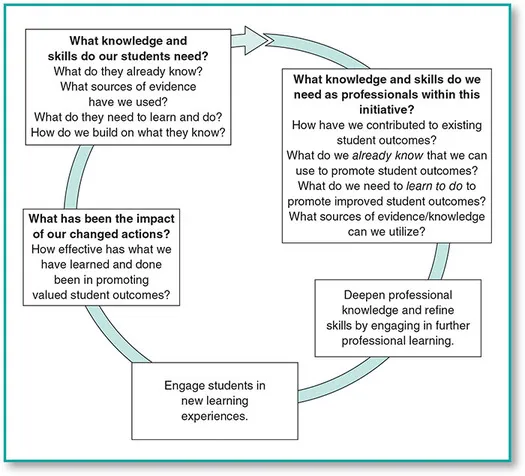
Table of contents

  1. Cover
  2. Half Title
  3. Title Page
  4. Copyright Page
  5. Contents
  6. Preface
  7. Acknowledgments
  8. About the Authors
  9. 1 The Challenge of Leading in the Middle Space
  10. 2 The Intelligent, Responsive School
  11. 3 Intelligent, Responsive Leadership Practice
  12. 4 The Psychological Foundations of “Getting Better”
  13. 5 Getting Better at “Influence” Through Leader Learning Inquiries
  14. 6 Ensuring That Together Is Better
  15. References
  16. Index
  17. Publisher Note