Finalist for the 2021 PROSE Award for Environmental Science!
An integrated approach to understanding and mitigating the problem of excess nitrogen
Human activities generate large amounts of excess nitrogen, which has dramatically altered the nitrogen cycle. Reactive forms of nitrogen, especially nitrate and ammonia, are particularly detrimental. Given the magnitude of the problem, there is an urgent need for information on reactive nitrogen and its effective management.
Nitrogen Overload: Environmental Degradation, Ramifications, and Economic Costs presents an integrated, multidisciplinary review of alterations to the nitrogen cycle over the past century and the wide-ranging consequences of nitrogen-based pollution, especially to aquatic ecosystems and human health.
Volume highlights include:
Comprehensive background information on the nitrogen cycle
Detailed description of anthropogenic nitrogen sources
Review of the environmental, economic, and health impacts of nitrogen pollution
Recommendations and strategies for reducing humanity's nitrogen footprint
Discussion of national nitrogen footprints and worldwide examples of mitigation policies
The American Geophysical Union promotes discovery in Earth and space science for the benefit of humanity. Its publications disseminate scientific knowledge and provide resources for researchers, students, and professionals.
Read the Editors' Vox: https://eos.org/editors-vox/exploring-the-widespread-impacts-of-ongoing-nitrogen-pollution
Frequently asked questions
Yes, you can cancel anytime from the Subscription tab in your account settings on the Perlego website. Your subscription will stay active until the end of your current billing period. Learn how to cancel your subscription.
At the moment all of our mobile-responsive ePub books are available to download via the app. Most of our PDFs are also available to download and we're working on making the final remaining ones downloadable now. Learn more here.
Perlego offers two plans: Essential and Complete
Essential is ideal for learners and professionals who enjoy exploring a wide range of subjects. Access the Essential Library with 800,000+ trusted titles and best-sellers across business, personal growth, and the humanities. Includes unlimited reading time and Standard Read Aloud voice.
Complete: Perfect for advanced learners and researchers needing full, unrestricted access. Unlock 1.4M+ books across hundreds of subjects, including academic and specialized titles. The Complete Plan also includes advanced features like Premium Read Aloud and Research Assistant.
Both plans are available with monthly, semester, or annual billing cycles.
We are an online textbook subscription service, where you can get access to an entire online library for less than the price of a single book per month. With over 1 million books across 1000+ topics, weâve got you covered! Learn more here.
Look out for the read-aloud symbol on your next book to see if you can listen to it. The read-aloud tool reads text aloud for you, highlighting the text as it is being read. You can pause it, speed it up and slow it down. Learn more here.
Yes! You can use the Perlego app on both iOS or Android devices to read anytime, anywhere â even offline. Perfect for commutes or when youâre on the go. Please note we cannot support devices running on iOS 13 and Android 7 or earlier. Learn more about using the app.
Yes, you can access Nitrogen Overload by Brian G. Katz in PDF and/or ePUB format, as well as other popular books in Physical Sciences & Geophysics. We have over one million books available in our catalogue for you to explore.
Nitrogen is essential to sustain life on Earth, as it is a major component of certain essential amino acids and proteins, enzymes, vitamins, and DNA and RNA. Also, nitrogen is contained in chlorophyll, the green pigment in plants that is essential for photosynthesis. Nitrogen, as dinitrogen (N2) gas is the most abundant element in the Earth's atmosphere making up 78% of all gases by volume. Galloway et al. (2003) estimated that the total amount of nitrogen in the atmosphere, soils, and waters of Earth is approximately 4 Ă 1021 g, which is more than the combined mass of all four other essential elements (carbon, phosphorus, oxygen, and sulfur) that are needed to sustain life. However, rather ironically, this bountiful form of nitrogen (N2 gas) is unusable by most organisms. The strong triple bond between the nitrogen atoms in nitrogen gas molecules makes N2 gas essentially unreactive. Fortunately, certain specialized nitrogenâfixing microorganisms in soils can transform or convert nitrogen gas to forms that are available to plants (e.g., ammonium, nitrate), thereby providing sustenance to all animal life on this planet. The process by which nitrogen gas is converted by microbes into inorganic nitrogen compounds, such as ammonia, is referred to as biological nitrogen fixation (BNF). BNF accounts for approximately 90% of this transformation, which is performed by certain bacteria (e.g., genus Rhizobium) and blueâgreen algae (cyanobacteria). Small amounts of nitrogen gas fixation can occur abiotically, through high temperature processes, such as lightning and ultraviolet radiation, both of which can break the strong triple bond in molecular nitrogen (N2) in the atmosphere. Denitrification is another important process in which microorganisms consume nitrate and convert it to reduced forms of nitrogen and ultimately back to nitrogen gas. This and other key processes of the nitrogen cycle are discussed in more detail in Chapter 2.
1.2. CYCLING OF NITROGEN IN THE ENVIRONMENT
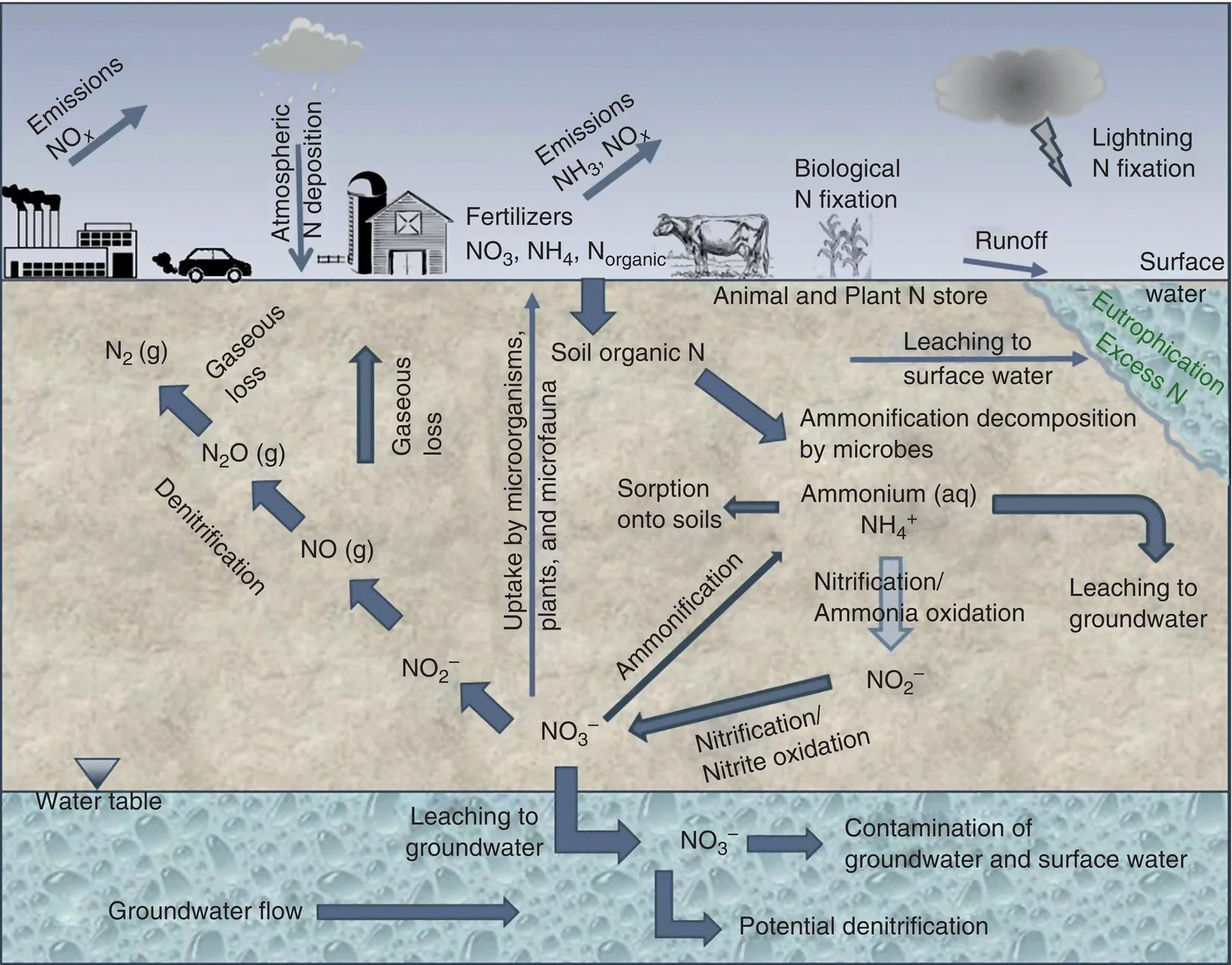
Nitrogen and its various forms can move or cycle between the atmosphere, biosphere, and hydrosphere (Fig. 1.1). The processes involved in the transfer of the different forms of nitrogen between these systems or reservoirs within these systems are collectively referred to as the nitrogen cycle. Prior to the 19th century, the reactive nitrogen produced by BNF and abiotic processes was balanced by plant uptake and denitrification processes and therefore did not accumulate in the environment. As human population increased substantially during the 19th century, there were two main needs for reactive nitrogen: fertilizers and explosives. To meet these needs, large amounts of nitrogen were mined from various sources including naturally occurring nitrate deposits, guano, and coal. The overall dependence on the use of these sources in Europe has been referred to as a âfossil nitrogen economyâ (Sutton et al., 2011a). By the end of the 19th century, these sources could not support the growing needs for more reactive nitrogen. Not long after the end of the 19th century, a solution to this problem was discovered. A process was developed in a laboratory in the early 20th century by Fritz Haber (who received a Nobel Prize for Chemistry in 1918) that synthesized ammonia (NH3) from nitrogen and hydrogen under high temperature and pressure. This process was industrialized by Carl Bosch (who received a Noble Prize in 1931) utilizing an iron catalyst along with high temperature (300â500°C) and high pressure (20 MPa) (Fowler et al., 2013). Thus, the combined discoveries of these two men became known as the HaberâBosch industrial chemical process, which converts hydrogen and atmospheric nitrogen gases by chemical reactions into synthetic ammonia. This process is used mainly to create inorganic fertilizers, which started the extensive human alteration of the natural nitrogen cycle. An estimated 128 teragrams (Tg, 1 Ă 1012 g; 1 billion kg) of reactive nitrogen are synthetically produced annually from the HaberâBosch process (Galloway et al., 2008) and used to make fertilizers for agriculture, lawns, and recreational turf grass. Sutton et al. (2011a) have referred to these large amounts of reactive nitrogen produced by the HaberâBosch process as the âgreatest single experiment in global geoâengineering that humans ever made.â The production of artificial nitrogen fertilizers has grown exponentially since the 1950s and is projected to grow into the future due to increasing demand and utilization (e.g., Erisman et al., 2015; Nielsen, 2005). The abundance of inexpensive fertilizer led to its excessive use throughout the industrialized world, which created a surplus of nitrogen that was followed by substantial releases of reactive nitrogen to the environment. Global increases in reactive nitrogen have resulted from intensive cultivation of legumes, rice, and other crops that result in the conversion of nitrogen gas (N2) to organic nitrogen compounds through humanâinduced BNF. The production of reactive nitrogen from HaberâBosch process was projected to increase from 120 Tg N/yr in 2010 to about 160 Tg N/yr in 2100 (Fowler et al., 2013).
Figure 1.1 A conceptual diagram showing sources of anthropogenic and natural sources of reactive nitrogen, the various forms of nitrogen, and processes in the nitrogen cycle in the atmosphere, hydrosphere, and biosphere.
Source: Modified from Rivett et al. (2008).
The anthropogenic production of reactive nitrogen has increased steadily and significantly since the midâ20th century as world population increased substantially (Fig. 1.2). Accompanying this increase in population are steady increases in meat and grain production, BNF, and NOx emissions. Galloway et al. (2003) estimated that reactive nitrogen inputs resulting from cultivation of legumes and other aforementioned crops (BNF) increased globally from approximately 15T g N/yr in 1860 to approximately 33 Tg N/yr in 2000. To increase productivity and crop yield per acre worldwide, increased amounts of fertilizer were being using along with fossil fuel burning machines that replace practices that involved manpower and the use of farm animals (Fig. 1.2). Throughout Europe, regional watersheds annually contribute approximately 3700 kg of reactive nitrogen per square kilometer, which is five times the background rate of natural N2 fixation (Sutton et al., 2011a). On a global scale, as a result of intensive farming practices, nitrogen and other nutrients were and are being depleted in some areas and have been concentrated in other areas, leading to a âcascadeâ of reactive nitrogen (Galloway et al., 2003) through the environment and creating a sequence of harmful environmental effects including ecosystem damages (loss of biodiversity, eutrophication of waters and soils, and soil acidification), increases in greenhouse gas emissions, contamination of drinking w...
Table of contents
Cover
Table of Contents
PREFACE
ACKNOWLEDGMENTS
1 Introduction
2 The Nitrogen Cycle
3 Sources of Reactive Nitrogen and Transport Processes
4 Methods to Identify Sources of Reactive Nitrogen Contamination
5 Adverse Human Health Effects of Reactive Nitrogen
6 Terrestrial Biodiversity and Surface Water Impacts from Reactive Nitrogen
7 Groundwater Contamination from Reactive Nitrogen
8 Nitrate Contamination in Springs
9 Coâoccurrence of Nitrate with Other Contaminants in the Environment
10 Economic Costs and Consequences of Excess Reactive Nitrogen
11 Strategies for Reducing Excess Reactive Nitrogen to the Environment