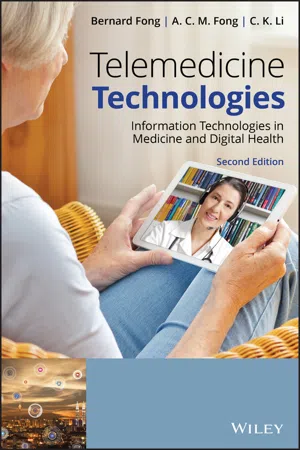
Since the launch of Telemedicine Technologies (Wiley, 2010), the technologies surrounding telemedicine have changed immeasurably, particularly with the emerging trends of Internet-of-Things (IoT), digital/e-Health, and wearable, smart and assistive technologies. This second edition overhauls and expands on the original text to reflect the technical advances of the last decade. It covers applications from traditional healthcare services to remote patient monitoring and recovery, to alternative medicine and general health assessment for maintaining optimal health. This welcome update brings together a broad range of topics demonstrating how information and wireless technologies can be used in healthcare.
eBook - ePub
Telemedicine Technologies
Information Technologies in Medicine and Digital Health
- English
- ePUB (mobile friendly)
- Available on iOS & Android
eBook - ePub
Telemedicine Technologies
Information Technologies in Medicine and Digital Health
About this book
Information
1
Introduction
1.1 Information Technology and Healthcare Professionals
The history of modern telemedicine goes back to the traditional telephone about a century ago. Medical advice was given by physicians over the telephone. The term “telemedicine” is very simply a description of supporting medical services through the use of telecommunications. The prefix tele comes from the Greek for “distant.” So, “telemedicine” literally means providing medical services over distance. Telecommunications used in medical applications can be categorized as sending medical information between a pair of transmitter and receiver. The “medical information” can be as simple as a doctor providing consultation from sophisticated data captured from a human body. “The Radio Doctor,” which first appeared in the Radio News magazine (c.1924), is perhaps the earliest documented case of utilizing telecommunication technology for medical application. Although information technology (IT) has been used in healthcare since then, it was the first scientific literature formally addressing the application of technology in medicine that appeared. (Moore et al. 1975).
IT advances over the past decades mean a wider range of healthcare services can be supported. Indeed, the types of services that can be supported are so vast that any book which makes an attempt to provide comprehensive coverage of all areas will most likely contain thousands of pages over several volumes. This book aims to provide in‐depth coverage of how wireless communications and related technologies are used in medical services. We will also look at the challenges and limitations of current technology associated with healthcare information systems.
We begin by taking a look at how simple wireless communication networks function and what a telemedicine system consists of. We look at a number of examples that describe how a primitive system supports healthcare services. Over the course of the book, more sophisticated systems will be described in more detail.
This chapter aims give readers an overview on how IT is widely used in assisting healthcare without going into any technical depth. To begin our discussion, we revisit the term “information technology,” something often associated with computer science. Essentially, it is extensively interpreted as a blend of computing and telecommunications. This leads to the acronym ICT, which stands for information and communications technology, also known as “infocomm” for short. All these are merely descriptions of the use of technology to securely and reliably transmit information between two or more entities. IT is widely used in many areas that influence our daily life, for example banking, transportation, manufacturing, etc. This list is seemingly endless. When we see information technologies support so many things that we use on a daily basis, it will not be difficult to understand how widely it can be used in supporting healthcare and medical applications.
The IT industry has never quite recovered from the “dot‐com bubble” bursting in 2000, which saw the industry lose much of its value for several years. And the IT sector was similarly hit by the financial crisis of 2008/09, triggered by the collapse of the subprime mortgage market. Put simply, although IT systems are widely used in many aspects of daily life, the industry remains tied to the global economic market, and so will always be affected by any changes to it. In contrast, health and medical services are two of the few domains that are in consistent high demand, simply because illness is not market led: it is experienced by everyone on the planet to a lesser or greater degree. For this simple reason, healthcare naturally becomes an essential part of daily life that will continue to be in high demand for many years to come.
Having realized the prime importance of healthcare, we go further into how IT is applied to healthcare and medical services. Long before the evolution of IT, herbal medicine practitioners millennia ago were already using the most primitive form of information exchange mechanism, namely communication system, to convey messages on medical services. Wang et al. (1999) documented a case where Shen Nong made use of information exchange for the treatment of respiratory syndrome as far back as 2735 BCE. This may not be the first case but it is certain that medicine and communications have been linked together for over 4000 years. As IT became more sophisticated over time, a more diverse range of medical services could be supported. To name a few, IT in medicine involves drug prescription, spread of pandemic modeling, patient monitoring, remote operation, medical database, and so on. This is by no means an exhaustive list and we cover these as well as many others throughout the book.
Obviously, healthcare professionals can make use of IT advancements in different areas. Advantages brought by IT include improvement in reliability, efficiency, precision, ease of information retrieval, accomplishing tasks remotely, and better organization. Healthcare therefore becomes more readily accessible and more efficient. We will look at how technology benefits healthcare professionals, with the assumption that readers have very little prior IT knowledge and know virtually nothing about the underlying technologies.
1.2 Providing Healthcare to Patients
In addition to facilitating medical practitioners perform their tasks, providing healthcare services to patients is also an important issue to address as they are the end users who must feel comfortable to receive the treatment given. Providing a technically feasible solution is not the only obstacle to deal with. Other important issues, including patients' acceptance and accessibility, must also be addressed. We strive to look at providing healthcare solutions to patients using IT from the perspectives of both providers and patients. End users, particularly children and older people, may not be too keen on accepting technology as a tool for healing. Convincing patients of the benefits of IT for healthcare may involve liability, security, and privacy issues. For example, in the case of monitoring or tracking a patient recovering at home, the patient must be assured that personal information is securely kept and no such information accessed in any way without consent.
With the number of senior citizens increasing steadily over the past decade, there has been a growth in demand for healthy aging care (Colby and Ortman 2014). Assistive care provides numerous opportunities for supporting independent living through smart home integration (Bonaccorsi et al. 2015). A comprehensive range of customized solutions for the care of older people has been made possible through advances in IT and digital health.
Before leaving the topic on providing care to older people, it is worth briefly noting the advantages brought to this group of users by telemedicine technology. As population aging is becoming more significant concern in many countries, it can widely be expected that more care and monitoring will be needed. A significant increase in the application of wireless communications in care for older people has been seen over the past few years as related technologies have matured. The cost of service becomes more affordable and portable devices become smaller and more user‐friendly. As pervasive computing technology advances, more comprehensive and automated services will become available to the aging population in the years to come (Stanford 2002). The design of interconnected devices and sensors on the patients' side must ensure non‐obtrusiveness and can be comfortably worn. Also, users' movement will not be restricted and reliability will not be affected irrespective of wearing condition. User‐friendliness is another important design factor, as absolute minimal training should be necessary, especially for children and older people. These should be genuine plug‐and‐play devices. In this sense, the healthcare system in the patient's home can be installed by a technician during initial deployment. Thereafter, almost everything should be fully automatic, except for unavoidable scheduled maintenance such as battery replacement and calibration.
Let's elaborate more on a patient's point of view as an end user. The primary objective of telemedicine is to provide medical services remotely. Among numerous advantages brought to patients by telemedicine, an obvious convenience is reducing the need for clinical visits. Through the utilization of IT, a patient can rest at home while receiving full medical attention. Reviewing the level of medical support provided over the past two to three decades, it can be seen that IT has certainly provided tremendous benefits to the general public as a whole. The advancement of faster computers and more efficient bandwidth usage has allowed more types of services to be extended to more users. For example, a few decades ago a simple request for medical advice could be obtained by finding a fixed line telephone and dialing in to the clinic where a physician was stationed. With the availability of mobile voice over Internet protocol (VoIP) technology, one can now simply pick up a mobile phone and place a video‐enabled call to a physician; the physician does not necessarily have to be situated inside the clinic in order to provide advice. This is just one among numerous examples where IT advancements have made healthcare more readily available. More such examples are presented throughout the book.
While the benefits to patients are obvious, there is a wide range of challenges that different parties face in order to serve pati...
Table of contents
- Cover
- Table of Contents
- Foreword
- Preface
- Acknowledgments
- About the Book
- Book Overview
- 1 Introduction
- 2 Communication Networks and Services
- 3 Information and Communications Technology in Health Monitoring
- 4 Data Analytics and Medical Information Processing
- 5 Wireless Telemedicine System Deployment
- 6 Safeguarding Medical Data and Privacy
- 7 Information Technology in Alternative Medicine
- 8 Digital Health for Community Care
- 9 Wearable Healthcare
- 10 Smart and Assistive Technologies
- 11 Future Trends in Healthcare Technology
- Index
- End User License Agreement
Trusted by 375,005 students
Access to over 1.5 million titles for a fair monthly price.
Study more efficiently using our study tools.
Frequently asked questions
Yes, you can cancel anytime from the Subscription tab in your account settings on the Perlego website. Your subscription will stay active until the end of your current billing period. Learn how to cancel your subscription
No, books cannot be downloaded as external files, such as PDFs, for use outside of Perlego. However, you can download books within the Perlego app for offline reading on mobile or tablet. Learn how to download books offline
Perlego offers two plans: Essential and Complete
- Essential is ideal for learners and professionals who enjoy exploring a wide range of subjects. Access the Essential Library with 800,000+ trusted titles and best-sellers across business, personal growth, and the humanities. Includes unlimited reading time and Standard Read Aloud voice.
- Complete: Perfect for advanced learners and researchers needing full, unrestricted access. Unlock 1.5M+ books across hundreds of subjects, including academic and specialized titles. The Complete Plan also includes advanced features like Premium Read Aloud and Research Assistant.
We are an online textbook subscription service, where you can get access to an entire online library for less than the price of a single book per month. With over 1.5 million books across 990+ topics, we’ve got you covered! Learn about our mission
Look out for the read-aloud symbol on your next book to see if you can listen to it. The read-aloud tool reads text aloud for you, highlighting the text as it is being read. You can pause it, speed it up and slow it down. Learn more about Read Aloud
Yes! You can use the Perlego app on both iOS and Android devices to read anytime, anywhere — even offline. Perfect for commutes or when you’re on the go.
Please note we cannot support devices running on iOS 13 and Android 7 or earlier. Learn more about using the app
Please note we cannot support devices running on iOS 13 and Android 7 or earlier. Learn more about using the app
Yes, you can access Telemedicine Technologies by Bernard Fong,A. C. M. Fong,C. K. Li in PDF and/or ePUB format, as well as other popular books in Biological Sciences & Biotechnology. We have over 1.5 million books available in our catalogue for you to explore.