- 432 pages
- English
- ePUB (mobile friendly)
- Available on iOS & Android
eBook - ePub
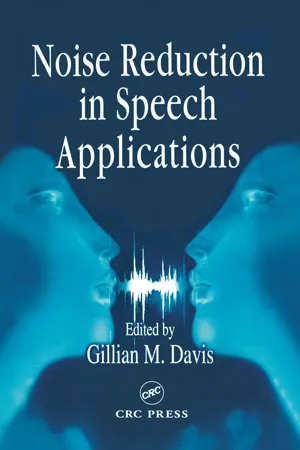
Noise Reduction in Speech Applications
About this book
Noise and distortion that degrade the quality of speech signals can come from any number of sources. The technology and techniques for dealing with noise are almost as numerous, but it is only recently, with the development of inexpensive digital signal processing hardware, that the implementation of the technology has become practical.
Noise Reduction in Speech Applications provides a comprehensive introduction to modern techniques for removing or reducing background noise from a range of speech-related applications. Self-contained, it starts with a tutorial-style chapter of background material, then focuses on system aspects, digital algorithms, and implementation. The final section explores a variety of applications and demonstrates to potential users of the technology the results possible with the noise reduction techniques presented.
The book offers chapters contributed by international experts, a practical, systems approach, and numerous references. For electrical, acoustics, signal processing, communications, and bioengineers, Noise Reduction in Speech Applications is a valuable resource that shows you how to decide whether noise reduction will solve problems in your own systems and how to make the best use of the technologies available.
Trusted by 375,005 students
Access to over 1.5 million titles for a fair monthly price.
Study more efficiently using our study tools.
Information
Subtopic
Ingeniería acústicaSection IV:
Special Applications
9
Signal and Feature Compensation Methods for Robust Speech Recognition
CONTENTS
Introduction
Speech Recognition as Statistical Pattern Classification
Effect of Noise on Speech Recognition Systems
Compensating for the Effects of Noise
Signal Compensation
Linear Spectral Subtraction
Nonlinear Spectral Subtraction
Wiener Filtering
Feature Compensation
Multivariate Gaussian-Based Cepstral Normalization
Vector Taylor Series Compensation
Codeword-Dependent Cepstral Normalization
Cepstral and Spectral High-Pass Filtering
Discussion of Relative Merits of the Methods
Acknowledgments
References
Introduction
As computing, communication, and other electronic devices become physically smaller and attempt to perform increasingly complicated functions, traditional interfaces such as buttons, keyboards, etc. become difficult to use. Speech is a much more natural and simpler interface for such devices, especially if they are to be remotely operated. Viable technology currently exists for the deployment of speech-enabled devices in controlled environmental conditions. However, as these devices are deployed in increasingly difficult operating conditions that are open to uncontrolled noises and acoustical disturbances, the performance of speech recognition systems degrades greatly. This chapter and Chapter 10 are concerned with the subject of development of techniques that reverse this degradation.
Broadly, techniques that enhance environmental robustness for speech recognition systems can be divided into two categories: techniques that operate on speech signals or the features derived from them prior to the recognition process, and techniques that modify the recognition system to perform optimally on incoming noisy speech signals. In this chapter, we review techniques that modify incoming signals or feature vectors. Techniques that modify the structure or parameters of the speech recognition system are discussed in Chapter 10.
For the benefit of readers with a limited background in speech recognition technologies, we begin by reviewing the formulation of automatic speech recognition as a statistical pattern classification process and by discussing how environmental disturbances adversely affect classifier performance. Later sections describe selected signal and feature compensation techniques in current usage, which were chosen on the basis of their efficiency and generality.
Speech Recognition as Statistical Pattern Classification
Automatic speech recognition systems are pattern classifiers designed to solve a rather specific statistical pattern classification problem. A simple example of a statistical pattern classification problem is that of determining the member of a set of N classes C1, C2,…, CN to which a specific vector Xs belongs, knowing that it does belong to one of the classes.
Let be the known distribution of all vectors belonging to class Ci. Let αi be the fraction of all data points that belong to class Ci; αi is also known as the a priori probability of Ci. It can be shown that if the data vector Xs is assigned to a class according to the following rule1:
(9.1) |
the expected classification error is minimum. In other words, given an infinitely large set of data points to classify, the total number of misclassified points will be minimum if the classification rule above is followed. Pattern classifiers based on the above rule are known as Bayesian classifiers. If the criterion for classification is other than that of minimum expected classification error, e.g., that of minimizing the expected cost of classification (known as minimum risk classification), where the cost may be any function of the output of the classifier, the actual classification rule can vary from the one given above, but its form will still be very similar.
Speech recognition is the problem of determining the sequence of words that were spoken in an utterance, given the recorded signal for that utterance. We can consider the set of all signals that are instances of a particular word sequence to form the class of signals representing that word sequence. Hence, there is a class of signals associated with every possible sequence of words in a language. Statistical speech recognition can be stated as the problem of determining to which of these classes a given signal belongs. This problem can now be treated as an instance of the Bayesian classification ...
Table of contents
- Cover
- Half Title
- Title Page
- Copyright Page
- Table of Contents
- Section I Tutorial
- Section II System Aspects
- Section III Digital Algorithms and Implementation
- Section IV Special Applications
- Index
Frequently asked questions
Yes, you can cancel anytime from the Subscription tab in your account settings on the Perlego website. Your subscription will stay active until the end of your current billing period. Learn how to cancel your subscription
No, books cannot be downloaded as external files, such as PDFs, for use outside of Perlego. However, you can download books within the Perlego app for offline reading on mobile or tablet. Learn how to download books offline
Perlego offers two plans: Essential and Complete
- Essential is ideal for learners and professionals who enjoy exploring a wide range of subjects. Access the Essential Library with 800,000+ trusted titles and best-sellers across business, personal growth, and the humanities. Includes unlimited reading time and Standard Read Aloud voice.
- Complete: Perfect for advanced learners and researchers needing full, unrestricted access. Unlock 1.5M+ books across hundreds of subjects, including academic and specialized titles. The Complete Plan also includes advanced features like Premium Read Aloud and Research Assistant.
We are an online textbook subscription service, where you can get access to an entire online library for less than the price of a single book per month. With over 1.5 million books across 990+ topics, we’ve got you covered! Learn about our mission
Look out for the read-aloud symbol on your next book to see if you can listen to it. The read-aloud tool reads text aloud for you, highlighting the text as it is being read. You can pause it, speed it up and slow it down. Learn more about Read Aloud
Yes! You can use the Perlego app on both iOS and Android devices to read anytime, anywhere — even offline. Perfect for commutes or when you’re on the go.
Please note we cannot support devices running on iOS 13 and Android 7 or earlier. Learn more about using the app
Please note we cannot support devices running on iOS 13 and Android 7 or earlier. Learn more about using the app
Yes, you can access Noise Reduction in Speech Applications by Gillian M. Davis in PDF and/or ePUB format, as well as other popular books in Tecnología e ingeniería & Ingeniería acústica. We have over 1.5 million books available in our catalogue for you to explore.