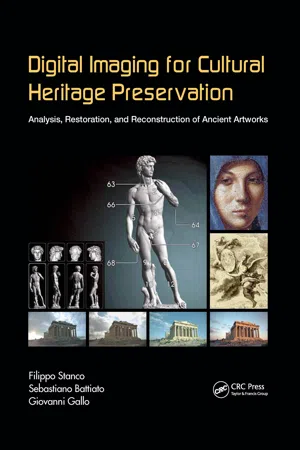
This edition presents the most prominent topics and applications of digital image processing, analysis, and computer graphics in the field of cultural heritage preservation. The text assumes prior knowledge of digital image processing and computer graphics fundamentals. Each chapter contains a table of contents, illustrations, and figures that elucidate the presented concepts in detail, as well as a chapter summary and a bibliography for further reading. Well-known experts cover a wide range of topics and related applications, including spectral imaging, automated restoration, computational reconstruction, digital reproduction, and 3D models.
eBook - ePub
Digital Imaging for Cultural Heritage Preservation
Analysis, Restoration, and Reconstruction of Ancient Artworks
- 523 pages
- English
- ePUB (mobile friendly)
- Available on iOS & Android
eBook - ePub
Digital Imaging for Cultural Heritage Preservation
Analysis, Restoration, and Reconstruction of Ancient Artworks
About this book
Information
1
Experiencing the Past: Computer Graphics in Archaeology
CONTENTS
1.1 The Past and the Future: Archaeology and Computer Science
1.2 From the Field to the Screen: 3D Computer Graphics and the Archaeological Heritage
1.2.1 3D Computer Graphics and the Archaeological Fieldwork
1.2.2 Monitoring the Heritage
1.2.3 The Virtual Museum
1.2.4 3D Modeling as a Cognitive Tool
1.3 The Archeomatica Project
1.4 Archaeological 3D Modeling
1.5 Haghia Triada, Crete
1.5.1 Propylon
1.5.2 House of the Razed Rooms
1.5.3 VAP House
1.6 Polizzello Mountain, Sicily
1.6.1 Buildings A, B, C, D, E
1.6.2 Temenos and Room III
1.6.3 Precinct F, East House, Temenos House
1.6.4 The Virtual Acropolis and the Multilayered 3D Model
1.7 Digital Restoration
1.7.1 Minoan Model
1.7.2 Asclepius
1.7.3 Female Torso
1.7.4 Hellenistic Thysia
1.8 Dealing with Image Data in Archaeology: New Perspectives
Acknowledgments
Bibliography
1.1 The Past and the Future: Archaeology and Computer Science
In the last fifty years, the growing use of computer applications has become a main feature of the archaeological research [1]. Since the ’90s, when computer science was oriented to the creation of work tools and solutions for the archive and management of quantitative data, to the development of virtual models and to the dissemination of knowledge, it quickly changed into a true theoretical approach to the problems of archaeology. It is now, indeed, able to influence the interpretation procedures and to revolutionize the language and contents of the study of the past [2]. This new evidence introduced in several branches of the theoretical debate new scientific themes. There are different views about the integration of computers and archaeology. Digital archeology in the Anglo-Saxon cultural world [2] is considered as a computer approach to the modern cognitive archaeology. Archaeological computing [2], on the other hand, is a methodology for the elaboration of archaeological data via computer. Archaeological computer science [2] is devoted to the representation with computer applets of the cognitive procedures behind the interpretation of the archaeological data, and the more popular virtual archaeology (VA) [2], is the analysis of the procedures of management and representation of the archaeological evidence through computer graphic 3D techniques.
From its first definition, by Reilly in 1991 [2], VA was intended as the use of digital reconstruction in archaeology. Recently to its research the development of new communicative approaches to archaeological contents through the use of interactive strategies has been added. The birth of the VA is not simply caused by the proliferation of 3D modeling techniques in many fields of the knowledge, but as a necessity to experience new systems to archive an overgrowing amount of data and to create the best medium to communicate those data with a visual language. From this point of view, the application of 3D reconstructions, obtained with different available techniques, became the core area of study of the VA in regard to the potential of cognitive interaction offered by a 3D model. In this way, virtuality turns into a a communication method even more effective if applied to particular fields, archaeological areas well preserved but not accessible [2], sites not preserved but known by traditional documentations [2], sites destroyed but depicted in iconographical repertoires [2], contextualization in progressive dimensional scale (object, context, site, landscape), and functional simulations repeating in virtual environment the processes of the experimental archaeology.
1.2 From the Field to the Screen: 3D Computer Graphics and the Archaeological Heritage
The cognitive experiences of 3D computer graphics can essentially be divided into passive and active forms of interaction. The first case refers mainly to applications related to research and study, where the primary need is of documentary type, as the archaeological excavation or the monitoring of the degradation. In the second case, the interaction with the virtual recreated reality is further exploited in the enhancement of the archaeological heritage through the creation of a virtual museum, reachable on digital media or on the web, intended both as a virtual version of a proper museum and as a closer study of an archaeological site. Different is the case of the 3D reconstructions, developed within interdisciplinary research projects, made for the purpose of interpretation as a cognitive accessory available to the archaeologists.
1.2.1 3D Computer Graphics and the Archaeological Fieldwork
The other major field of application of 3D computer graphics in the world of archeology is the documentation of the excavation data in real time. Since archeology is the science of destruction par excellence, the need to document in a comprehensive and detailed way each item that is removed during excavation, imposed gradually the methods of graphic and photographic documentation in support of traditional 3D modeling [2]. This technique can be used both for recording singular evidence but also for the objects set inside a GIS system in which 3D data are fully integrated. From this point of view the combination of GIS systems in archaeology and the development of 3D laser scanning and image-based 3D modeling techniques determined the birth of experimental systems of 3D GIS. This system is able to visualize inside the geographic information system 3D data, such as point clouds from laser scanners, and it has already produced excellent results as demonstrated in the case of Miranduolo excavation (Siena) Italy [2] or in the investigations in the Jabal Hamrat Fidan region of the Faynan District in Southern Jordan [2], just to name a few recent examples. The point of the application of these techniques on the excavation activity is the possibility to perform analysis on multidimensional scale. At landscape scales, digital 3D modeling and data analysis allow archaeologists to integrate, without breaks, different archaeological features and physical context in order to better document the area. At monument/site scale, 3D techniques can give accurate measurements and objective documentation as well as a new aspect from a different point of view. At artifact scale, 3D modeling allows the reproduction of accurate digital/physical replicas of every artifact that can be studied, measured and displayed, as well as data for general public use, virtual restoration, and conservation.
1.2.2 Monitoring the Heritage
3D modeling could also be extremely useful for the identification, monitoring, conservation, restoration, and promotion of archaeological goods. The archaeological heritage is always under constant threat and danger. Architectural structures and cultural and natural sites are exposed to pollution, tourists, and wars, as well as environmental disasters such as earthquakes, floods, or climatic changes. Hidden aspects of our cultural heritage are also affected by agriculture, changes in agricultural regimes due to economic progress, mining, gravel extraction, construction of infrastructure, and the expansion of industrial areas. In this context, 3D computer graphics can support archaeology and the politics of cultural heritage by offering scholars a “sixth sense” for understanding the traces of the past, as it allow us to experience it [2]. 3D documentation of still existing archaeological remains or building elements is an important part of collecting the necessary sources for a virtual archaeology project. New developments allow this documentation phase, including the obtaining of correct measures and ground plans from photography using freely available tools. This is important when restoring archaeological remains, when older phases are reconstructed in a virtual way. The original state, the restored state, and eventual in between states can be recorded easily through this photo modeling technique [2]. Furthermore, the recent application of 3D computer graphics has proved crucial in planning strategies of restoration and conservation issues of monuments that are part of world cultural heritage, on which there is still an open debate, as in the case of the restoration of the Parthenon on the Acropolis of Athens [2].
1.2.3 The Virtual Museum
The rapid development of 3D visualization techniques, and the subsequent derivation in the promotion policies for the archaeological heritage as well as the creation of 3D models of monuments and artifacts of past civilizations has become the basis for the birth of the concept of virtual museum as a means of transmission of knowledge based on the use of multimedia [17,18]. More recently, the seductive ability of visual communication, simplified and made more attractive by the opportunity to interact intuitively with multimedia content, has led to a huge proliferation of virtual museums on the web. The phenomenon in some cases has grown, losing sight of what are the ideological assumptions of the virtual museum itself. The virtual museum should not be considered as a transposition of a real museum in electronic form or on the web, nor can it be intended as a supplementary tool to complete the real museum, like a sort of exhibition space or additional digital catalog. Its nature is closely lin...
Table of contents
- Cover Page
- Title Page
- Copyright Page
- Table of Contents
- Digital imaging and ComputerVision Series
- Preface
- Editors
- Contributors
- 1 Experiencing the Past: Computer Graphics in Archaeology
- 2 Using Digital 3D Models for Study and Restoration of Cultural Heritage Artifacts
- 3 Processing Sampled 3D Data: Reconstruction and Visualization Technologies
- 4 ARC3D: A Public Web Service That Turns Photos into 3D Models
- 5 Accurate and Detailed Image-Based 3D Documentation of Large Sites and Complex Objects
- 6 Digitizing the Parthenon: Estimating Surface Reflectance under Measured Natural Illumination
- 7 Applications of Spectral Imaging and Reproduction to Cultural Heritage
- 8 Did Early Renaissance Painters Trace Optically Projected Images? The Conclusion of Independent Scientists, Art Historians, and Artists
- 9 A Computer Analysis of the Mirror in Hans Memling’s Virgin and Child and Maarten van Nieuwenhove
- 10 Virtual Restoration of Antique Books and Photographs
- 11 Advances in Automated Restoration of Archived Video
- 12 Computational Analysis of Archaeological Ceramic Vessels and Their Fragments
- 13 Digital Reconstruction and Mosaicing of Cultural Artifacts
- 14 Analysis of Ancient Mosaic Images for Dedicated Applications
- 15 Digital Reproduction of Ancient Mosaics
- 16 Pattern Discovery from Eroded Rock Art
- 17 Copyright Protection of Digital Images of Cultural Heritage
- Index
Trusted by 375,005 students
Access to over 1.5 million titles for a fair monthly price.
Study more efficiently using our study tools.
Frequently asked questions
Yes, you can cancel anytime from the Subscription tab in your account settings on the Perlego website. Your subscription will stay active until the end of your current billing period. Learn how to cancel your subscription
No, books cannot be downloaded as external files, such as PDFs, for use outside of Perlego. However, you can download books within the Perlego app for offline reading on mobile or tablet. Learn how to download books offline
Perlego offers two plans: Essential and Complete
- Essential is ideal for learners and professionals who enjoy exploring a wide range of subjects. Access the Essential Library with 800,000+ trusted titles and best-sellers across business, personal growth, and the humanities. Includes unlimited reading time and Standard Read Aloud voice.
- Complete: Perfect for advanced learners and researchers needing full, unrestricted access. Unlock 1.5M+ books across hundreds of subjects, including academic and specialized titles. The Complete Plan also includes advanced features like Premium Read Aloud and Research Assistant.
We are an online textbook subscription service, where you can get access to an entire online library for less than the price of a single book per month. With over 1.5 million books across 990+ topics, we’ve got you covered! Learn about our mission
Look out for the read-aloud symbol on your next book to see if you can listen to it. The read-aloud tool reads text aloud for you, highlighting the text as it is being read. You can pause it, speed it up and slow it down. Learn more about Read Aloud
Yes! You can use the Perlego app on both iOS and Android devices to read anytime, anywhere — even offline. Perfect for commutes or when you’re on the go.
Please note we cannot support devices running on iOS 13 and Android 7 or earlier. Learn more about using the app
Please note we cannot support devices running on iOS 13 and Android 7 or earlier. Learn more about using the app
Yes, you can access Digital Imaging for Cultural Heritage Preservation by Filippo Stanco, Sebastiano Battiato, Giovanni Gallo, Filippo Stanco,Sebastiano Battiato,Giovanni Gallo in PDF and/or ePUB format, as well as other popular books in Computer Science & Art General. We have over 1.5 million books available in our catalogue for you to explore.