MicroCMOS Design
eBook - ePub

MicroCMOS Design

  1. 434 pages
  2. English
  3. ePUB (mobile friendly)
  4. Available on iOS & Android
eBook - ePub

MicroCMOS Design

About this book

MicroCMOS Design covers key analog design methodologies with an emphasis on analog systems that can be integrated into systems-on-chip (SoCs). Starting at the transistor level, this book introduces basic concepts in the design of system-level complementary metal-oxide semiconductors (CMOS). It uses practical examples to illustrate circuit construction so that readers can develop an intuitive understanding rather than just assimilate the usual conventional analytical knowledge.

As SoCs become increasingly complex, analog/radio frequency (RF) system designers have to master both system- and transistor-level design aspects. They must understand abstract concepts associated with large components, such as analog-to-digital converters (ADCs) and phase-locked loops (PLLs). To help readers along, this book discusses topics including:

  • Amplifier basics & design
  • Operational amplifier (Opamp)
  • Data converter basics
  • Nyquist-rate data converters
  • Oversampling data converters
  • High-resolution data converters
  • PLL basics
  • Frequency synthesis and clock recovery

Focused more on design than analysis, this reference avoids lengthy equations and instead helps readers acquire a more hands-on mastery of the subject based on the application of core design concepts. Offering the needed perspective on the various design techniques for data converter and PLL design, coverage starts with abstract concepts—including discussion of bipolar junction transistors (BJTs) and MOS transistors—and builds up to an examination of the larger systems derived from microCMOS design.


Frequently asked questions

Yes, you can cancel anytime from the Subscription tab in your account settings on the Perlego website. Your subscription will stay active until the end of your current billing period. Learn how to cancel your subscription.
No, books cannot be downloaded as external files, such as PDFs, for use outside of Perlego. However, you can download books within the Perlego app for offline reading on mobile or tablet. Learn more here.
Perlego offers two plans: Essential and Complete
  • Essential is ideal for learners and professionals who enjoy exploring a wide range of subjects. Access the Essential Library with 800,000+ trusted titles and best-sellers across business, personal growth, and the humanities. Includes unlimited reading time and Standard Read Aloud voice.
  • Complete: Perfect for advanced learners and researchers needing full, unrestricted access. Unlock 1.4M+ books across hundreds of subjects, including academic and specialized titles. The Complete Plan also includes advanced features like Premium Read Aloud and Research Assistant.
Both plans are available with monthly, semester, or annual billing cycles.
We are an online textbook subscription service, where you can get access to an entire online library for less than the price of a single book per month. With over 1 million books across 1000+ topics, we’ve got you covered! Learn more here.
Look out for the read-aloud symbol on your next book to see if you can listen to it. The read-aloud tool reads text aloud for you, highlighting the text as it is being read. You can pause it, speed it up and slow it down. Learn more here.
Yes! You can use the Perlego app on both iOS or Android devices to read anytime, anywhere — even offline. Perfect for commutes or when you’re on the go.
Please note we cannot support devices running on iOS 13 and Android 7 or earlier. Learn more about using the app.
Yes, you can access MicroCMOS Design by Bang-Sup Song in PDF and/or ePUB format, as well as other popular books in Technology & Engineering & Electrical Engineering & Telecommunications. We have over one million books available in our catalogue for you to explore.

1
Amplifier Basics

Amplifiers operate mostly in a linear mode, and their performance is improved by applying feedback. Basic circuit concepts such as complex transfer function, poles, frequency and transient responses, trade-off of gain for bandwidth and linearity, feed-forward zero, and stability criteria of feedback systems are essential to understand, design, and operate amplifier circuits properly.

1.1 Driving-Point and Transfer Functions

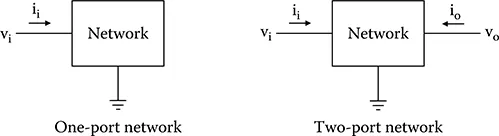
Consider any electrical networks with one or two ports as shown in Figure 1.1. We can define the voltage on each port and the current flowing into each terminal. Here, the voltage and current are small signal and frequency dependent.
In the one-port case shown on the left side, the following two ratios of the voltage and current can be defined as
Z(s)=vi(s)ii(s),andY(s)=ii(s)vi(s).(1.1)
Images
The former is the driving-point impedance, and the latter is the driving-point admittance. Their units are Ω and 1/Ω, respectively. At low frequencies, they are commonly called driving-point resistance and conductance, respectively. That is, if the input and output are referred to the same port, the term driving point is used. Similarly, in the two-port case as shown on the right side, the four ratios can be defined as follows:
Av(s)=vo(s)vi(s),Ai(s)=io(s)ii(s),Z(s)=vo(s)ii(s), and Y(s)=io(s)vi(s),(1.2)
Images
where Av(s) and Ai(s) are the unit-less transfer functions called the voltage and current gains, respectively. The latter two definitions are the same as in Equation (1.1) for the one-port network, but they are now called transimpedance and transadmittance as the input and output ports are referred to two ports. The prefix trans relates voltages and currents in two different terminals. Of course, at low frequencies, they are more commonly called transresistance and transconductance, respectively.
Images
Figure 1.1 Driving-point and transfer concepts.

1.2 Frequency Response

In the small-signal steady state, impedances of reactive components such as inductor and capacitor are frequency dependent as sL and 1...

Table of contents

  1. Cover Page
  2. Half title
  3. Title Page
  4. Copy Page
  5. Preface
  6. Acknowledgments
  7. The Author
  8. 1. Amplifier Basics
  9. 2. Amplifier Design
  10. 3. Operational Amplifier (Opamp)
  11. 4. Data Converter Basics
  12. 5. Nyquist-Rate Data Converters
  13. 6. Oversampling Data Converters
  14. 7. High-Resolution Data Converters
  15. 8. Phase-Locked Loop Basics
  16. 9. Frequency Synthesis and Clock Recovery
  17. Index